You manage technicians, schedules, and customer expectations every day, and field service software helps you do all of that faster and with fewer mistakes. The right platform centralizes scheduling, real-time tracking, and job management so you can reduce travel time, finish more jobs, and improve customer satisfaction.
This article Field Service Software breaks down the core capabilities that modern field service platforms offer and shows how to match those features to your business needs. You’ll get practical guidance for comparing tools on scheduling, dispatching, inventory, and integrations so you can pick a solution that scales with your operation.
Key Features of Modern Field Service Platforms
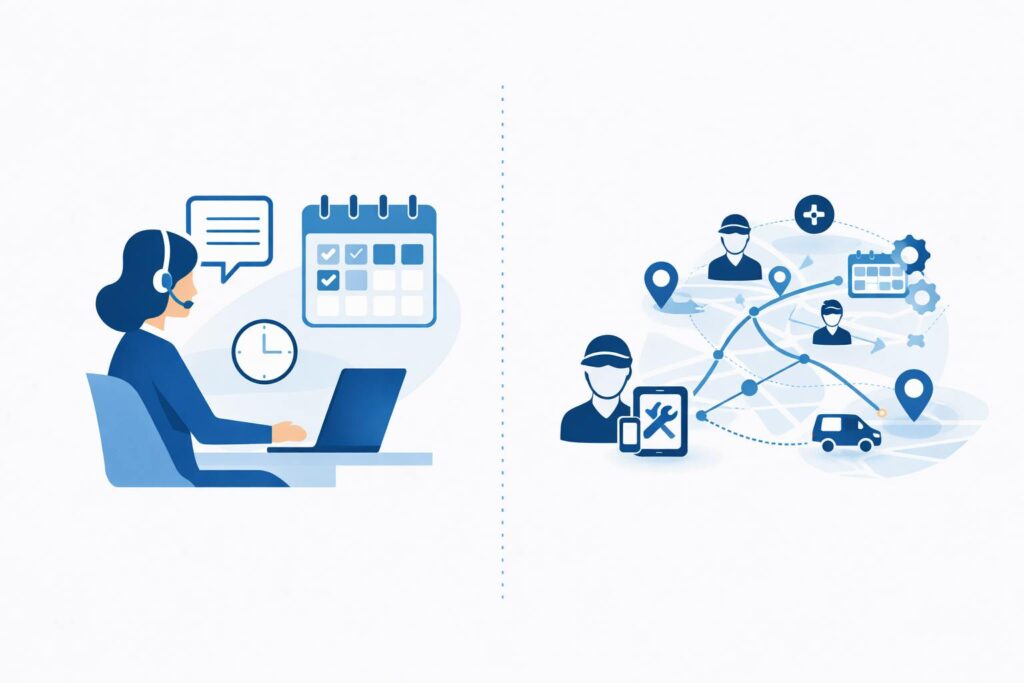
These platforms focus on assigning the right technician, equipping them with job details and customer history, and keeping everyone connected in real time. Expect automation that reduces manual work, mobile tools that capture field data, and communication channels that shorten response times.
Scheduling and Dispatch Automation
You get automated scheduling that matches technician skills, certifications, and location to job requirements. Systems use rules-based engines and optimization algorithms to minimize travel time and balance workload across your crew.
Use these common capabilities to improve dispatching:
- Skill and certification matching: Prevent unqualified assignments.
- Route optimization: Reduce drive time and fuel costs.
- Real-time availability: Block out PTO or breaks automatically.
- Recurring job templates: Auto-schedule repeat maintenance.
Set priority rules for urgent calls and configure buffers for travel or parts pickup. Integrations with calendars and CRM ensure appointments sync to customer records and billing systems.
Mobile Workforce Management
Your technicians need actionable work orders on a mobile app with offline access and data sync. The app should present step-by-step tasks, parts lists, safety checklists, and customer signatures.
Key mobile features to require:
- Offline mode with automatic sync: Let techs update jobs without coverage.
- Parts inventory and barcode scanning: Reduce mis-picks and speed invoicing.
- Photo, video, and annotated diagrams: Capture proof of work and defects.
- Time tracking and geolocation: Validate on-site attendance and calculate drive time.
Mobile workflows should push completed job data into your back office for invoicing and warranty tracking, eliminating duplicate entry and accelerating cash flow.
Real-Time Communication Tools
You must keep dispatchers, technicians, and customers aligned with instant updates. Real-time tools lower first-time-fix rates and cut customer inquiries.
Essential communication capabilities include:
- Two-way SMS and in-app messaging: Notify customers and receive confirmations.
- Push notifications for schedule changes: Alert techs immediately to reassignments.
- Integrated calling and video support: Enable remote troubleshooting with visual context.
- Shared job notes and audit trails: Keep a single source of truth for job history.
Ensure these channels integrate with your CRM and job records so every message, call log, and media file attaches to the correct work order for reporting and compliance.
Choosing the Right Solution for Your Business
Focus on how the software will connect to your current tools, grow with your team, and be easy for technicians and dispatchers to use. Prioritize measurable integration points, clear scalability limits, and a simple mobile experience.
Integration With Existing Systems
You must map the exact systems the software must connect to: CRM (e.g., Salesforce), ERP (e.g., NetSuite), accounting (e.g., QuickBooks), and your inventory or parts database. List required APIs, data fields, and sync frequency before evaluating vendors.
Ask vendors for real examples of implemented integrations and request a data-mapping plan. Confirm support for single sign-on (SAML/OAuth), middleware platforms (e.g., MuleSoft, Zapier), and webhooks for real-time updates. Verify import/export formats (CSV, XML, JSON) and whether the vendor provides prebuilt connectors.
Measure integration risk by testing a sandbox with sample data flows: work orders, invoices, customer records, and parts consumption. Get SLAs for data reconciliation and change management procedures for live updates. If you rely on legacy systems, prefer vendors that offer custom integration services and documented APIs.
Scalability and Customization
Identify current workload (jobs/day, concurrent mobile users) and project growth for 12–36 months. Use those numbers to size the solution: database limits, concurrent API calls, and license costs at scale.
Determine which features must be configurable versus custom-built. Prioritize configurable workflows, custom fields, and role-based permissions before considering bespoke code. Ask about multi-site support, data partitioning, and automated provisioning for new locations.
Clarify pricing model for scale: per-user, per-job, or tiered usage. Request performance benchmarks under your expected peak loads and a cost projection worksheet showing price at 1×, 3×, and 10× growth. Ensure the vendor provides a roadmap for feature requests and a sandbox for testing customizations.
User Experience Considerations
Test the mobile app for offline job capture, photo attachments, signature capture, and parts lookup. Field technicians must complete forms in under two minutes and synchronize without data loss when connectivity returns.
Evaluate the dispatcher interface for drag-and-drop scheduling, route optimization, and real-time ETA updates. Check inboxing for customer communications and whether alerts can be automated for delays or SLA breaches.
Measure adoption risk by running a pilot with representative users for at least two weeks. Track task completion time, error rates in work orders, and user satisfaction. Prioritize solutions with role-specific dashboards, minimal clicks to close a job, and accessible training resources like guided tours and API documentation.