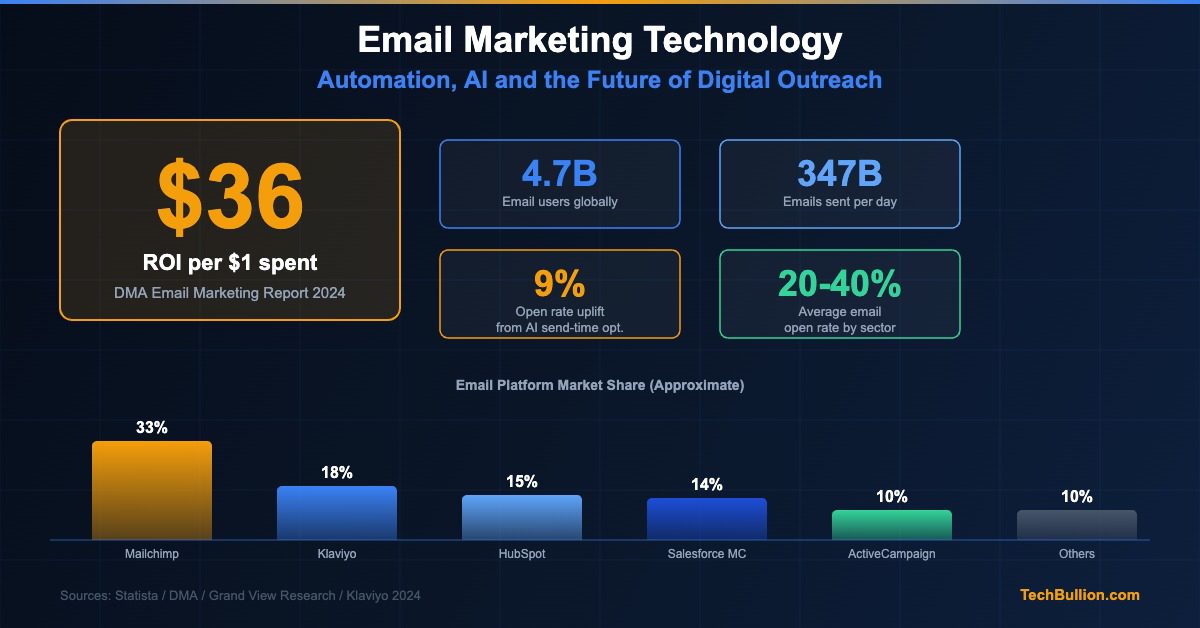
Email remains one of the highest-return channels in digital marketing, and the technology supporting it has evolved significantly beyond the simple broadcast systems of the early internet era. The global email marketing technology market was valued at approximately $1.5 billion in 2023 and is projected to reach $3.5 billion by 2030, according to Grand View Research. Within the broader context of the $589 billion global MarTech market, email technology sits as one of the most widely deployed categories — with an estimated 4.7 billion email users globally and more than 347 billion emails sent daily in 2023, according to Statista.
The Economics of Email Marketing
The case for email marketing investment rests on its return on investment, which consistently outperforms other digital channels. The Data and Marketing Association estimates an average ROI of $36 for every $1 spent on email marketing. This efficiency is rooted in the owned-channel economics that define email’s position in the MarTech versus AdTech distinction. Email contacts are first-party relationships — customers and prospects who have consented to receive communications. Unlike paid digital advertising, where every impression requires expenditure, email allows organisations to communicate at marginal cost once the relationship exists, making the list a capital asset that compounds in value over time.
The Evolution from Broadcast to Behavioural Email
Early email marketing was characterised by mass broadcast — the same message sent to the entire list at the same time. The introduction of marketing automation transformed this into behaviour-triggered communication: welcome sequences when users sign up, abandoned cart reminders when purchases are not completed, re-engagement campaigns when activity drops. Modern email platforms have further evolved to incorporate predictive personalisation, where machine learning models determine not just what triggers an email but what content each individual recipient is most likely to engage with.
The integration between email platforms and the CDP layer is central to this evolution. When the CDP feeds real-time unified customer profiles into the email platform, the personalisation depth available goes far beyond what the email platform alone could achieve using its own engagement data.
AI’s Role in Modern Email Technology
Artificial intelligence is transforming email marketing technology across multiple dimensions. Send-time optimisation — ML models that determine the optimal send time for each individual recipient based on historical open patterns — has become a standard feature of leading platforms including Klaviyo, Mailchimp, HubSpot, and Salesforce Marketing Cloud. Klaviyo reports that send-time optimisation increases email open rates by an average of 9 percent. Generative AI is being applied to subject line generation and email copy creation, with platforms including Persado, Phrasee, and HubSpot’s AI assistant reporting uplift rates of 10 to 25 percent on open and click metrics. The alignment with the broader AI-driven MarTech transformation is clear.
Platform Landscape and Market Segmentation
The email marketing technology market is strongly segmented by company size. At the SMB level, Mailchimp, Klaviyo, ActiveCampaign, and ConvertKit dominate. Klaviyo, which went public in 2023 at a valuation of $9.2 billion, has become particularly dominant in e-commerce with deep Shopify integrations. At the enterprise level, Salesforce Marketing Cloud, Oracle Responsys, and Adobe Campaign provide the scale and deliverability infrastructure required by organisations sending hundreds of millions of emails per month — reflecting the broader investment patterns across the 15,000-tool ecosystem.
Deliverability as a Technical Discipline
Deliverability — ensuring emails reach inboxes rather than spam filters — is a discipline that is often underappreciated. Gmail, Yahoo Mail, and Microsoft Outlook use increasingly sophisticated filtering systems evaluating sender reputation, engagement rates, authentication records, and content quality. Managing deliverability requires investment in technical infrastructure (SPF, DKIM, DMARC), list hygiene practices, and engagement monitoring. This technical complexity has created a specialist sub-category within the broader email technology market.
The Path Forward for Email Technology
The trajectory for email marketing technology through the 2034 MarTech horizon points towards increasingly sophisticated personalisation and deeper integration with other MarTech investment priorities. Interactive email — where carousels, surveys, and mini-applications are embedded directly within the email — is a growing technical frontier. For organisations building their MarTech stack, email remains one of the highest-priority technology investments: a channel with unmatched cost efficiency, measurable return, and a direct relationship with first-party customer data that becomes more strategically valuable as third-party data continues to retreat.
Research from McKinsey’s 2024 analysis indicates that organisations deploying AI at scale report efficiency improvements of 15 to 25 percent within the first 18 months of production implementation.
According to Mordor Intelligence, the AI in fintech market is projected to grow at a compound annual growth rate exceeding 20 percent through 2029, driven by demand for automated fraud detection, credit scoring, and customer service applications.
Enterprise Deployment Patterns and ROI Metrics
Enterprise adoption of AI has shifted from experimental pilots to production deployments with measurable returns. According to McKinsey’s 2024 research, organizations that deployed AI at scale reported a 15 to 25 percent improvement in operational efficiency within the first 18 months. The financial services sector leads adoption, with 78 percent of large banks now running at least one AI system in production for fraud detection, credit scoring, or customer service automation. Healthcare and manufacturing follow, driven by computer vision applications in diagnostics and quality control.
For more coverage on related topics, explore our dedicated section on artificial intelligence.
Workforce Implications and Skill Requirements
AI deployment is reshaping workforce composition rather than simply eliminating roles. Companies report that AI tools have automated approximately 30 percent of routine analytical tasks, freeing knowledge workers to focus on judgment-intensive decisions. However, this shift has created acute demand for professionals who can bridge domain expertise with technical implementation. Data engineering, prompt design, and AI governance have emerged as the fastest-growing skill categories in enterprise hiring. Organizations investing in internal upskilling programs report 40 percent faster AI deployment timelines compared to those relying solely on external hiring.
Enterprise Deployment Patterns and ROI Metrics
Enterprise adoption of AI has shifted from experimental pilots to production deployments with measurable returns. According to McKinsey’s 2024 research, organizations that deployed AI at scale reported a 15 to 25 percent improvement in operational efficiency within the first 18 months. The financial services sector leads adoption, with 78 percent of large banks now running at least one AI system in production for fraud detection, credit scoring, or customer service automation. Healthcare and manufacturing follow, driven by computer vision applications in diagnostics and quality control.
Readers interested in this space may also find value in our reporting on technology news.