Talk to most Shopify store owners about their email marketing and you’ll hear something like: “Yeah, we have a welcome email set up. And our cart abandonment thing runs automatically.” That’s it. That’s the whole program.
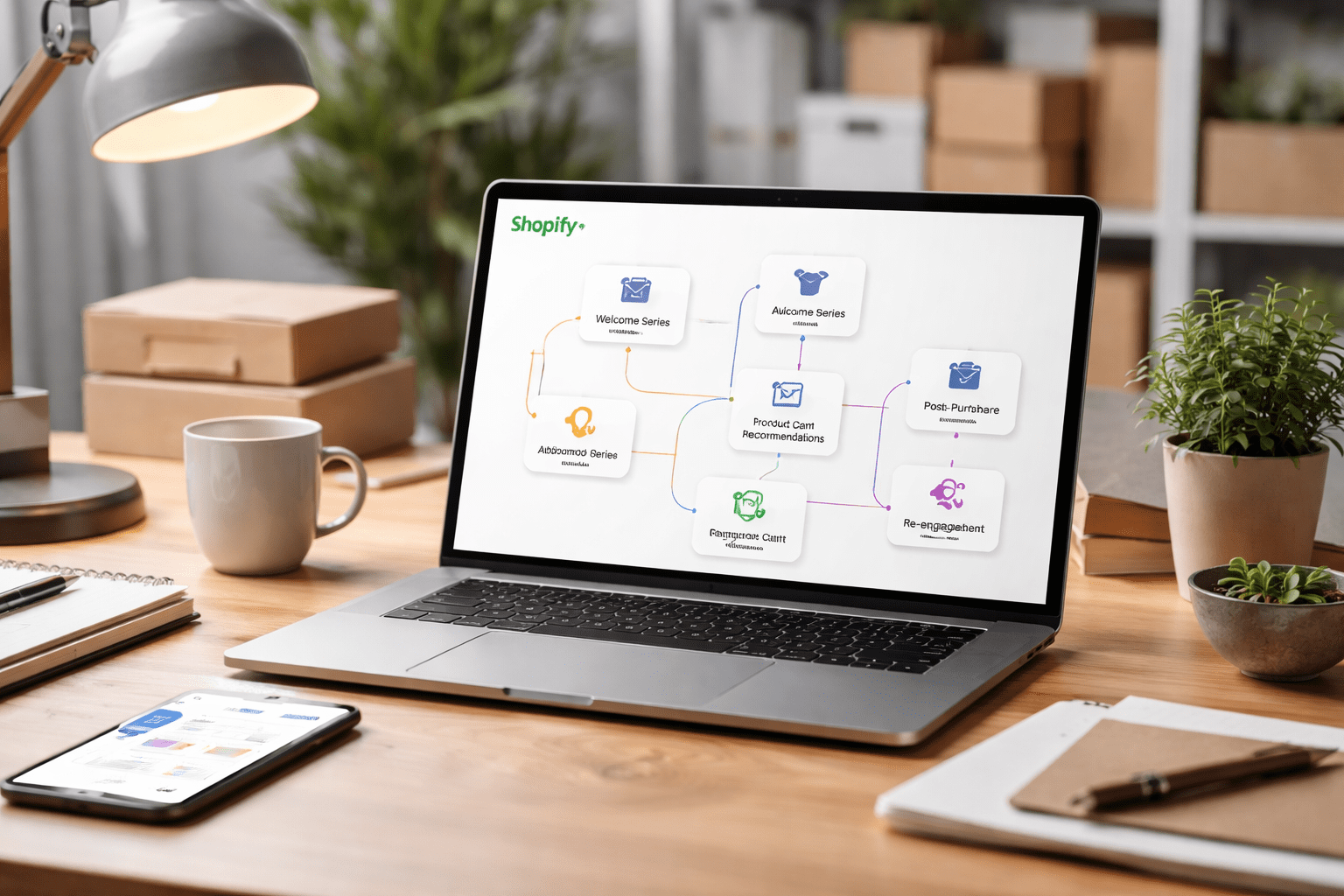
Meanwhile, the brands quietly compounding their growth — the ones adding 30, 40 percent year over year without doubling their ad spend — are running five, six, sometimes eight automated flows before they ever open a campaign calendar. The gap isn’t about budget or team size. It’s about building a version of email marketing that works while you’re asleep.
Here’s the context that makes this urgent in 2026: paid acquisition is getting more expensive every year. CPCs are up. ROAS is down. Every new customer costs more to acquire than they did two years ago. The stores winning right now are extracting more value from the traffic they already paid for, and email automation is the primary vehicle for doing that.
Triggered emails — emails sent based on what a customer actually did rather than what day it is on your calendar — generate roughly three times more revenue per email than broadcast campaigns. Not because they’re longer or more elaborate. Because they show up at the moment the customer is already thinking about your product.
This piece walks through the flows that matter most, and the order to build them.
Why Triggered Emails Outperform Campaigns
A campaign goes out when you decide to send it. You pick a date, you pick a segment, you hit send. A triggered email goes out when the customer does something. Their behavior tells your platform: now is the right moment.
That difference in timing is why triggered emails average around 47% open rates while broadcast campaigns sit closer to 20%. Relevance drives engagement. And nothing is more relevant than a message that responds directly to what someone just did on your store.
The practical decision rule is straightforward: if a customer took a meaningful action, there should be an email. Browsed a product? Email. Abandoned a cart? Definitely an email. Bought once and gone quiet for 60 days? Email. Build the behavioral triggers first. Schedule-based campaigns fill in the gaps around them.
The Welcome Series
The welcome series is where most stores should start because it’s the only automation that touches 100% of new subscribers from the moment it goes live. Every person who joins your list after today flows through it automatically.
Most welcome emails have one job: deliver the discount code. Then silence. The subscriber uses the code (or doesn’t), forgets the brand exists, and a week later gets a campaign newsletter with no connection to why they signed up. The welcome series, done well, is nothing like that. It’s a 7-to-10-day relationship arc that introduces who you are, builds confidence through other customers’ voices, and creates a natural path to a first purchase.
Here’s a structure that works across most Shopify categories.
Email 1 (immediate): Get the promised incentive into the inbox within five minutes. That’s the only job. Below the incentive, one warm brand line and a single CTA to your most popular collection. Keep it short. The subscriber is in peak anticipation mode and you don’t need to earn attention right now — you already have it. Don’t bury the offer.
Email 2 (day 2–3): This is the brand story email. Tell it in 150 words or fewer. Why does this brand exist? Who started it and why? What makes the product different from everything else on the market? Put two or three product images below the story, framed as “if you’re curious, here’s where most people start.” No hard sell. The goal is familiarity.
Email 3 (day 5–7): Four to six real customer reviews, a UGC photo if you have one, and a review-led subject line. Something like “2,847 people can’t be wrong” consistently outperforms generic options at this stage. The goal of this email is straightforward: make the subscriber feel confident that real people love this brand, which lowers the last bit of friction before a first purchase.
Subscribers who receive a three-email welcome series convert to first purchase at roughly 51% higher rates than those who receive a single email. If you build one automation this week, make it this one.
The Abandoned Cart Flow
About 70% of shopping carts get abandoned before checkout. For a store doing $50,000 a month, that’s roughly $115,000 in potential revenue walking out the door every 30 days. Some of that is genuinely unrecoverable — the person was comparison shopping or had zero intent to buy. But a meaningful chunk left because they got distracted, weren’t sure about a detail, or simply ran out of time. Those people can come back.
A single abandoned cart email recovers some of them. A three-email sequence recovers two to three times more, and the reason is simple: different emails address different reasons people left in the first place.
Email 1 (30–60 minutes after abandonment): No discount. No long copy. Product image at the top, the product name, a brief acknowledgment that they left it behind, one or two reviews placed below the product, single CTA back to the cart. The subject line formula that wins in A/B tests: “[Product name] is still waiting for you” beats “You left something behind” every time because it’s specific and product-anchored.
Email 2 (24 hours later): This one is about trust, not reminding. Lead with reviews specific to the abandoned product — not generic store reviews. Address the most likely objection for your category: sizing uncertainty for apparel, efficacy for supplements, compatibility for tech. Add a visible trust signal at the bottom: a return policy summary, a satisfaction guarantee, a secure checkout badge. Free shipping for carts over a threshold works well here too.
Email 3 (48–72 hours later): The closing email. This is where urgency or a discount lives, if you use one. Make it time-limited and specific: “Your 10% offer expires tonight at midnight” creates real urgency. “For a limited time” does not. One caveat worth flagging: premium brands shouldn’t discount abandoned carts. It trains customers to abandon on purpose and wait for the coupon. For those brands, free expedited shipping or a small gift-with-purchase is a better offer that doesn’t touch perceived value.
One thing email can’t do: reach abandoners who never gave you an email address. Visitors who added to cart and left anonymously are invisible to email-based recovery. Web push notifications can reach a subset of those people if they opted into browser push during their session, which is worth knowing when you’re planning your full recovery stack.
The Browse Abandonment Flow
Browse abandonment is the flow that fires when someone views a product page but doesn’t add to cart. The intent signal is softer than a cart abandoner, so the approach needs to match that. But the audience is larger, and a well-built browse abandonment flow has conversion rates high enough to justify building it.
Timing matters more here than in cart recovery. A 4–6 hour delay on the first email is better than 30 minutes, because a short delay can feel invasive when someone was genuinely just browsing. A two-email sequence is enough: the first features the browsed product prominently with price, two or three reviews, and a couple of related products as a secondary option. The second arrives 24 hours later if there was no click, and can add a light incentive like free shipping.
Subject line approach: product-name-led wins consistently. “Still thinking about [Product]?” works because it mirrors the natural thought process of someone who viewed something, left, and is now seeing it referenced in their inbox. It doesn’t feel surveillance-y. It feels like a helpful nudge.
Build this one third, after welcome series and cart recovery are running.
The Post-Purchase Flow
The 48 hours after a first purchase might be the most underused window in ecommerce. Trust is at its absolute peak. The customer is excited. They’re paying attention to everything you send. And most Shopify merchants send a generic order confirmation and then disappear for two weeks.
The post-purchase flow exists to convert first-time buyers into repeat customers while that window is still open. The goal isn’t to sell again immediately — it’s to deepen the relationship so the second purchase feels natural.
Email 1 (immediate): Customize the order confirmation. Not the Shopify default. Add warmth, clear delivery expectations, and one piece of anticipation-building content: what to expect, how to unbox, what to have ready. This takes 20 minutes and sets the tone for everything that follows.
Email 2 (day 3–5): Product experience email. A how-to guide, a usage tip, a recipe, a styling guide — whatever makes sense for your category. Deliver genuine value before asking for anything. This email is what separates brands that sell products from brands that build communities around them.
Email 3 (day 7–10): Review request. Not before day 7, because the customer needs time to actually use the product and form an opinion. Keep it simple: product photo, warm thank-you, one clear CTA to leave a review. Review timing research consistently shows day 10–14 outperforms day 3–5 for most physical product categories.
Email 4 (day 14–18): Soft cross-sell based on what they bought. Use behavioral logic, not random recommendations. Someone who bought a yoga mat is more likely to want a foam roller than a new water bottle. Frame it as “customers who ordered [X] often also love [Y]” — the social proof framing outperforms algorithmic suggestion language.
Customers who receive a structured post-purchase sequence have a 40–50% repeat purchase rate within 60 days, compared to 27–32% with no follow-up. That’s a gap worth closing.
The Win-Back Flow
Every Shopify store loses customers to silence. Not to bad reviews, not to a visible falling-out — just to the slow drift of someone who meant to come back and never did. The win-back flow exists to interrupt that drift before it becomes permanent.
It also does something else: a list full of inactive subscribers is actively damaging your deliverability, which means it’s hurting the performance of every email you send to everyone. Running a win-back sequence and suppressing non-responders protects your sender reputation.
Define lapse by category. For replenishment products like supplements or skincare, 45–60 days is a meaningful threshold. For fashion and lifestyle, 90 days. For home goods and high-consideration purchases, 120–180 days.
Email 1 (day 1 of lapse window): No discount, no guilt. Show them something new. New arrivals, a bestseller they haven’t tried, a product update. Subject line: curiosity or update-framed, not “we miss you.” People respond to “here’s what’s new” much better than to emotional appeals from a brand they quietly drifted from.
Email 2 (day 5–7): Social proof and a light incentive. Recent customer reviews work well here. Add free shipping or a small gift-with-purchase rather than a percentage discount — you’re lowering the barrier without starting a coupon expectation cycle.
Email 3 (day 10–14): Clear offer with a deadline. “Your 15% offer expires Sunday.” Direct subject line, specific expiry, single CTA. If they engage, move them back into an active re-onboarding flow. If they don’t respond to all three, suppress them from regular sends. The clean break is the right call for your deliverability.
Back-in-Stock and Price Drop Alerts
These two flows have some of the highest click-to-purchase rates in all of email marketing, for one simple reason: the subscriber already wants the product. You’re not convincing anyone. You’re delivering news they asked for.
Back-in-stock: Goes out when a sold-out item returns to inventory. Keep it direct and fast. Subject line: “[Product] is back in stock.” Add a genuine inventory count if it’s limited — “Only 38 units available” creates urgency that doesn’t feel manufactured because it’s true.
One tactic worth trying: send the first notification to 20% of the waitlist about 30 minutes before the general send. Creates a real VIP moment and often drives faster initial purchase velocity.
Price drop: Fires when a product a subscriber viewed or wishlisted drops in price. Frame it as early access rather than a clearance signal. “You’re getting first access to this price” performs better than “Price reduced on your wishlist item,” even though both say the same thing. The framing shifts how the subscriber feels about receiving it.
Both flows need your email platform to sync with Shopify product and inventory data in real time. Most modern platforms support this natively, but check before you build.
Where to Start: The Priority Sequence
You don’t need everything running before you see results. Here’s the order that makes the most sense for most stores.
Priority 1 is the welcome series, because it affects every subscriber from day one. Priority 2 is the abandoned cart flow, because it recovers the most immediate revenue. Priority 3 is the post-purchase flow, because converting one-time buyers into repeat customers is where long-term store value gets built. Priority 4 is browse abandonment. Priority 5 is the win-back flow. Priorities 6 and 7 are back-in-stock and price drop alerts.
Welcome series plus abandoned cart alone will outperform most stores’ current email programs within the first 30 days. Start there, then build outward.
Frequently Asked Questions
How many email automation flows does a Shopify store need?
Six core flows cover the full customer lifecycle for most stores: welcome series, abandoned cart, browse abandonment, post-purchase, win-back, and back-in-stock or price drop alerts. You don’t need all six live on day one. Start with welcome and abandoned cart, which address the highest-volume moments, then add the rest in order of revenue impact.
What’s the difference between an email automation flow and a campaign?
A campaign goes out on your schedule to a defined segment, regardless of what those subscribers are currently doing. An automation flow goes out based on something the subscriber actually did — a purchase, an abandonment, a period of inactivity. Flows consistently outperform campaigns in open rate, click rate, and revenue per email because they arrive at a moment of real intent.
How long does it take to set up email automation flows on Shopify?
A basic welcome series and abandoned cart flow can be live in two to four hours on most Shopify-connected email platforms. More complex sequences with branching logic take longer, but it’s a one-time setup. Most merchants who delay building automation significantly underestimate how fast the ROI kicks in.
Do email automation flows work for small Shopify stores?
Yes, and they arguably matter more for smaller stores. A store with 500 subscribers and a proper welcome series plus abandoned cart flow will generate more email revenue per subscriber than a store with 10,000 subscribers and nothing automated. The leverage is higher when every subscriber interaction counts.
Wrapping Up
Email automation is the only marketing channel that works around the clock without someone steering it. Build the six flows outlined here, launch them in priority order, and they compound over time — recovering carts, converting first-time buyers, and reactivating lapsed customers every single day without you touching a thing.
The stores winning at email right now aren’t sending more. They’re sending more relevant emails at the right moment. Automation is how that happens at scale.