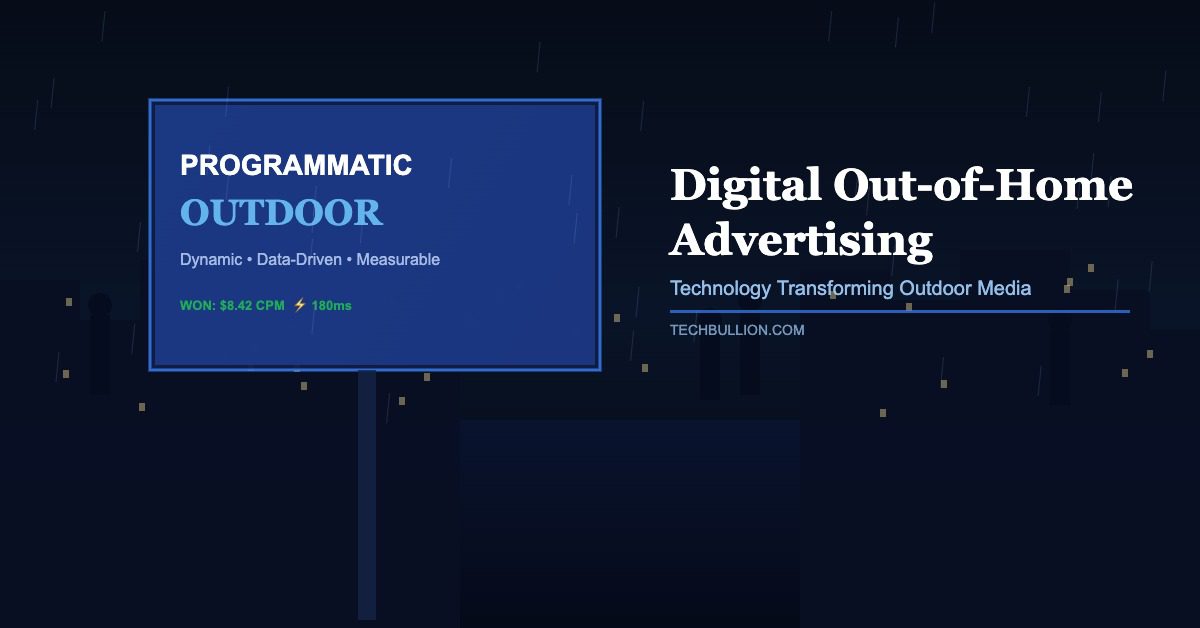
At 7:43 on a wet Tuesday morning in central London, a digital billboard above a busy roundabout switches its creative within 200 milliseconds. The trigger is not a manual instruction from a campaign manager sitting at a desk somewhere. It is a bid won in a programmatic auction that ran, cleared, and executed before the nearest commuter completed a single step. The advertiser was a quick-service restaurant chain, the trigger was weather data confirming rain in that postal district, and the creative was a hot breakfast promotion selected from a library of 14 variants by a machine-learning optimisation layer that had already determined this particular audience, at this particular moment, was most likely to convert on a warm-food message.
This is digital out-of-home advertising in 2024. It is no longer about static posters rotating on a fixed schedule. It is a fully addressable, data-driven, programmatically traded channel that has become one of the fastest-growing segments within the broader AdTech ecosystem, attracting sustained investment from both traditional outdoor media owners and technology companies that see outdoor as an underexplored inventory surface.
Digital Screens Have Crossed the Threshold That Makes Programmatic Viable
The transformation of out-of-home advertising from a static print medium to a dynamic digital channel has been underway for more than a decade, but the pace of screen digitalisation accelerated sharply between 2020 and 2024. According to the World Out of Home Organization’s Global Report 2024, digital out-of-home inventory now represents approximately 40 per cent of all out-of-home advertising revenue globally, up from under 20 per cent in 2018, and in advanced markets such as the United Kingdom, Australia, and Singapore, that share exceeds 70 per cent.
The United States digital out-of-home market reached $3.08 billion in revenue in 2024, according to the Out of Home Advertising Association of America, representing growth of approximately 11 per cent over the prior year. Globally, the DOOH segment is projected to reach $33 billion by 2027, according to Grand View Research’s outdoor advertising market analysis, driven by continued screen installation programmes across transit networks, retail environments, roadside corridors, and urban street furniture.
| Market | DOOH Revenue 2024 | Digital Share of OOH | Growth Rate (YoY) |
|---|---|---|---|
| United States | $3.08 billion | ~38% | +11% |
| United Kingdom | £1.4 billion | ~72% | +14% |
| China | $7.2 billion | ~60% | +9% |
| Australia | AUD 1.1 billion | ~74% | +16% |
| Global Total (est.) | ~$22 billion | ~40% | +12% |
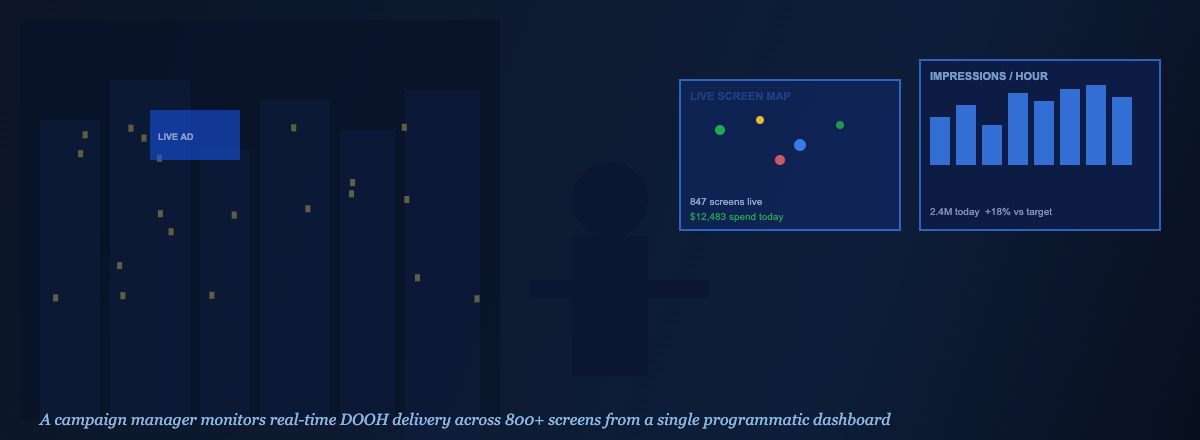
The critical threshold for programmatic viability is screen density. A single billboard, however digitally capable, does not offer the inventory depth required to sustain the real-time auction infrastructure that defines programmatic trading. As operators including Lamar Advertising, Clear Channel Outdoor, JCDecaux, and Outfront Media have expanded their digital screen networks to tens of thousands of displays across geographically concentrated urban corridors, the inventory surface has crossed the scale required to make automated trading economically rational for both buyers and sellers.
The Programmatic DOOH Stack Borrows from Display but Operates Under Different Rules
The technological architecture of programmatic digital out-of-home trading shares conceptual DNA with the display programmatic stack, but the operational specifics differ in ways that have required significant technical development. Understanding where DOOH programmatic diverges from browser-based programmatic is essential for anyone operating within the wider AdTech ecosystem.
The most fundamental difference is the absence of individual user identifiers. In browser-based programmatic advertising, bid requests carry cookie IDs, device IDs, or hashed email addresses that allow buyers to target or exclude specific individuals. In DOOH, the unit of targeting is an audience segment defined by the likely demographic composition of people passing a screen location at a given time, derived from anonymised mobility data, census data, and panel surveys rather than individual device tracking. This structural difference makes DOOH one of the few large-scale digital advertising channels that is inherently privacy-compatible without requiring adaptation to a post-cookie world, as explored in TechBullion’s analysis of privacy-preserving advertising technology.
The principal supply-side platforms serving programmatic DOOH inventory include Hivestack, acquired by Bell Media in 2023, Vistar Media, Place Exchange, and Broadsign. These platforms aggregate digital screen inventory from media owners and expose it through OpenRTB-compatible bid request schemas that demand-side platforms can access using standard programmatic buying infrastructure. The Trade Desk, which has invested significantly in DOOH buying capabilities, allows advertisers to plan and execute DOOH campaigns through the same interface used for connected television and display, creating operational efficiencies for buyers managing omnichannel campaigns. The broader mechanics of programmatic trading across channels are detailed in TechBullion’s guide to real-time bidding infrastructure.
Contextual Triggers and Dynamic Creative Are Redefining What Outdoor Advertising Can Do
The combination of programmatic trading infrastructure with real-time data feeds has unlocked a category of outdoor advertising that was technically impossible in the static poster era: contextually triggered dynamic creative. Campaigns that automatically adapt their message based on live conditions represent one of the most commercially compelling capabilities in the DOOH toolkit.
Weather-triggered creative, which changes advertising messages based on current temperature, precipitation, or UV index data, is among the most widely adopted trigger formats. A sun cream brand might serve a UV-alert creative when the index exceeds a defined threshold and suppress spend entirely when overcast conditions reduce product relevance. A hot drink retailer might increase bid prices during temperature drops in specific postcodes. The data feed driving the trigger is integrated at the DSP level, and the creative swap occurs within the standard ad serving workflow without requiring manual campaign manager intervention.
Sports score triggers, traffic congestion data, flight arrival boards, and local event calendars have all been integrated as contextual signals in live campaigns. More sophisticated implementations use audience mobility data from anonymised mobile device location signals to estimate the real-time demographic composition of passers-by at a given screen, enabling buyers to adjust bids dynamically based on whether the passing audience skews toward their target segment at that moment.
Measurement Has Evolved from Impressions to Verified Audience and Outcomes
Historically, out-of-home advertising was measured using opportunity-to-see counts derived from traffic surveys and pedestrian flow studies, producing broad reach estimates with limited granularity. Programmatic DOOH has driven significant investment in measurement infrastructure, with audience verification and outcome attribution emerging as primary metrics for sophisticated buyers.
| Measurement Type | Methodology | Data Source | Adoption Level |
|---|---|---|---|
| Opportunity-to-see (OTS) | Footfall / traffic count | Census + survey panels | Universal baseline |
| Verified audience delivery | Anonymised mobile location | Mobility data providers | Growing among programmatic buyers |
| Footfall attribution | Exposed vs unexposed store visits | Location panels | Retail and QSR campaigns |
| Brand lift | Survey comparison (exposed vs control) | Panel-based research | Large brand campaigns |
| Online conversion lift | Mobile retargeting post-exposure | DSP + mobile ID matching | Performance-focused campaigns |
Footfall attribution, which measures the incremental lift in store visits among audiences exposed to a DOOH campaign relative to matched unexposed panels, has become a standard metric for retailers and quick-service restaurant brands. Providers including Foursquare, StreetMetrics, and Sightline use anonymised mobile location panels to construct exposed and control groups and deliver post-campaign reports that translate outdoor impressions into verified commercial outcomes. This is the same fundamental attribution challenge that faces the broader digital advertising industry, detailed in TechBullion’s review of attribution technology across AdTech.
Retail Media and DOOH Are Converging in Ways That Reshape Both Channels
One of the most commercially significant developments in digital out-of-home advertising is the convergence of DOOH inventory with retail media networks. Physical retail environments represent a substantial and largely undermonetised DOOH opportunity: screens in supermarket aisles, petrol station forecourts, pharmacy waiting areas, and bank branch networks all command audiences with high purchase intent in an environment where contextual relevance to product categories is inherent.
Retailers including Walmart, Kroger, and Tesco have begun incorporating their in-store screen networks into their broader retail media propositions, allowing brands that advertise on their digital platforms to extend campaigns into the physical store environment with closed-loop attribution connecting screen exposure to basket data. This integration of physical and digital retail media creates a measurement model that is arguably more robust than any other advertising channel, as the conversion data is sourced from the retailer’s own transaction systems rather than probabilistic attribution models. The growth of retail media as a structural force in digital advertising is examined in detail in TechBullion’s analysis of retail media technology.
The AdTech Investment Case for DOOH Rests on Structural Advantages That Other Channels Lack
Within the $869 billion AdTech investment landscape analysed across TechBullion’s broader coverage of the global AdTech market, digital out-of-home occupies a distinctive position. It is one of the few digital advertising channels that is structurally immune to ad blocking, cannot be skipped or scrolled past, is consumed in a shared public environment that amplifies brand salience, and is by its physical nature protected from the inventory quality concerns that plague open web display advertising.
The combination of these structural advantages with maturing programmatic infrastructure, improving measurement capabilities, and the convergence with retail media positions DOOH as one of the more compelling growth segments within the broader AdTech ecosystem for the remainder of the decade. For brands seeking reach in an environment where attention is genuinely unavoidable, and for technology vendors seeking inventory surfaces that are both growing and structurally differentiated, the outdoor screen is no longer a legacy medium. It is a frontier.
Related reading: Programmatic Advertising and RTB | Retail Media Technology | Attribution Technology in AdTech | AdTech Market Size Analysis
Data from Statista’s digital market outlook shows that global digital spending continues to grow at double-digit rates, with mobile channels accounting for an increasingly dominant share of total transactions.
PwC’s analysis of financial services trends through 2025 highlights the convergence of technology and media as a defining dynamic, with data-driven personalisation becoming the primary competitive differentiator.