Designing RESTful Financial APIs That Survive a Decade in U.S. FinTech

RESTful APIs are the lingua franca of modern financial systems integration. Banks, fintech platforms, regulators, and data providers all converge on REST as the default contract because it is well understood, widely tooled, and reasonably easy to evolve. The interesting questions are no longer whether to expose REST APIs but how to design them so they age well across regulatory change, partnership churn, and the predictable mistakes that every team makes in its first year of API ownership.
This piece sets out the design patterns that separate U.S. financial REST APIs that survive a decade from the ones that need to be deprecated within two. The framing is practitioner-focused. The patterns are unglamorous. They are also where most of the value in any modern financial integration gets created or destroyed.
Resource modelling for money is harder than it looks
Modelling a banking resource as a REST entity sounds simple. An account has a balance, a customer, and a set of transactions. The complications appear quickly. Should the balance endpoint return a single value or a structured object containing pending, posted, and available balances. Should the transaction list return pre-clearing or post-clearing data. Should the account state include holds, restrictions, and freezes inline or as separate sub-resources.
The mature pattern treats the account as a parent resource with explicit sub-resources for state, holds, and transactions. Each sub-resource has clearly versioned semantics. The pattern that does not age treats the account as a flat blob with implicit fields, then spends the next three years deprecating fields that downstream consumers depend on. The choice between the two patterns is the design decision that distinguishes durable APIs from rewrites.
Versioning that matches the regulatory clock
Versioning a financial REST API is harder than versioning most other APIs because the regulatory clock and the engineering clock do not align. Regulators publish guidance with implementation deadlines that may force breaking changes. Engineering teams need to ship those changes without breaking downstream consumers. The collision between the two timelines is where most of the operational pain in API ownership shows up.
The pattern that handles this collision well is explicit URL or header versioning combined with a published deprecation policy. Major versions correspond to breaking changes. Minor versions correspond to additive ones. Deprecation windows are at least as long as the longest sponsorship-bank or regulatory cycle the API has to support, and the deprecation calendar is communicated through the API itself rather than only through email. The operators who do this well rarely surprise their consumers. The operators who do not do this well surprise their consumers monthly.
Idempotency is the foundation of trust
State-changing financial APIs without idempotency are time bombs. Every retry under partial failure becomes a potential double-charge, double-transfer, or double-issuance. The fix is well understood: every state-changing endpoint accepts an idempotency key, the server stores the dedup map for at least the maximum retry window any consumer is likely to use, and the response on duplicate requests is identical to the first response.
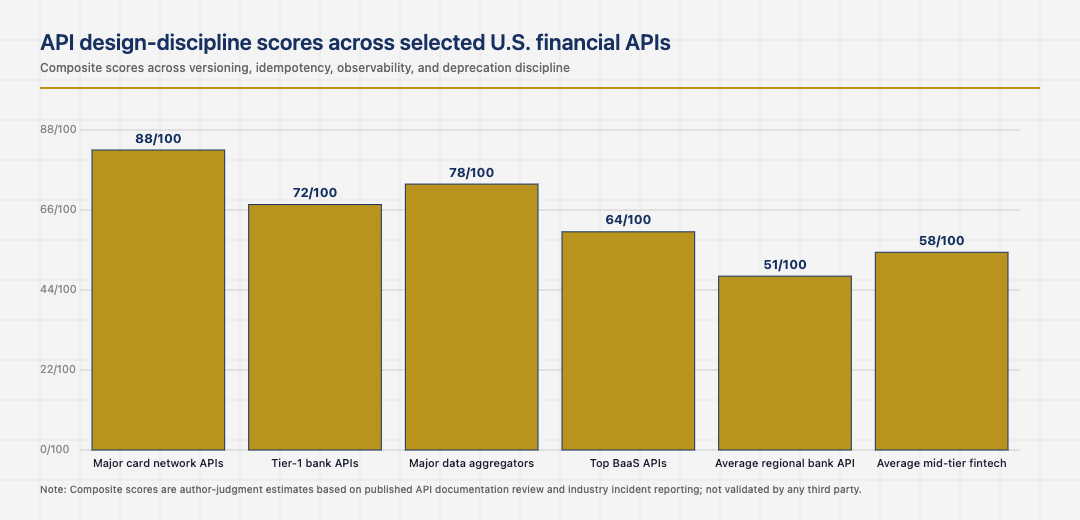
This is unglamorous. It is also the single design pattern that distinguishes financial APIs that earn consumer trust from financial APIs that lose it. The U.S. operators with the strongest API reputations all share strict idempotency discipline. The ones with reputational damage from production incidents almost always trace the damage back to retry-related double-spend events that idempotency would have prevented.
Authentication, authorisation, and the OAuth fork
The U.S. financial API landscape is increasingly converged on OAuth 2.0 and OpenID Connect for authentication and authorisation. The CFPB’s 1033 final rule has accelerated this convergence by requiring stronger consent management and stronger third-party identification for personal financial data access. Bank-direct APIs, data aggregators, and fintech consumer products all now operate inside the same broad OAuth framework, with progressively tighter consent screens and progressively stronger token-rotation discipline.
The design tradeoffs inside that framework are real. Token lifetimes, refresh-token rotation strategies, scope granularity, and consent-revocation propagation are all decisions that affect both user experience and operational risk. The operators who get these decisions right reduce both fraud and friction simultaneously. The operators who get them wrong end up with either security incidents or customer churn driven by re-authentication fatigue, often both.
Observability and the graceful-deprecation discipline
The fifth design pillar is observability and graceful deprecation. Financial APIs need detailed structured logging, request tracing, error-code consistency, and rate-limit transparency. They also need a deprecation discipline that telegraphs upcoming changes through the API itself, not only through release notes that integration teams may not read.
The mature operators publish a deprecation header on every response indicating which version is active, when the next version will be available, and when the current version will sunset. They surface usage data to consumers showing which deprecated endpoints they are still calling. They run synthetic transactions against their own APIs from outside their network to detect what consumers experience. None of this is novel. All of it is consistently underbudgeted in API design until the second or third painful sunset.
Read across these five design dimensions, the U.S. financial REST API patterns that survive a decade are the ones that take resource modelling seriously, version explicitly, build idempotency into the foundation, run authentication on top of an OAuth-aligned framework, and treat observability and deprecation as first-class concerns. The patterns that do not survive treat any of these as luxuries. The cost of cutting corners in any one of them shows up across years of integration debt that no roadmap captures cleanly.
Looking back across the full sweep makes one final point clear. The American financial system has accumulated its strength through the patient layering of standards, institutions, and supervisory expectations on top of an active commercial layer. The application layer captures attention because it is visible and fast-moving. The institutional layer captures durability because it is invisible and slow-moving. Operators who learn to read both layers at once tend to outlast operators who only read the visible one, and the discipline of doing so is not glamorous but it is the discipline that consistently shows up in the firms that compound through multiple cycles instead of just the one they happened to start in.
The same lesson shows up in the founders who quietly build through down cycles that catch the louder ones flat-footed. Reading the institutional rebuild as carefully as the product roadmap is what separates the long-lived operators in 2026 from the ones whose names appear only in retrospectives. The competitive position of the next decade will turn less on the surface features that draw press attention and more on the structural features that draw supervisory attention. The two are increasingly the same set of features, and the operators who recognise that early are the ones who position correctly while the rest are still arguing about whether the rules apply to them.
One last consideration is worth carrying forward. Cross-cycle perspective sharpens any single decision. Looking at how peer ecosystems have handled the same question, what they got right and where they stumbled, almost always reveals something about the decisions that the U.S. system is in the middle of making right now. The operators who travel intellectually as well as commercially tend to make better forecasts about which infrastructure layer will matter most in the next phase, and which segment is being quietly reset under the noise of the daily news. The disciplined version of that practice is what the next ten years of American FinTech will reward most consistently.