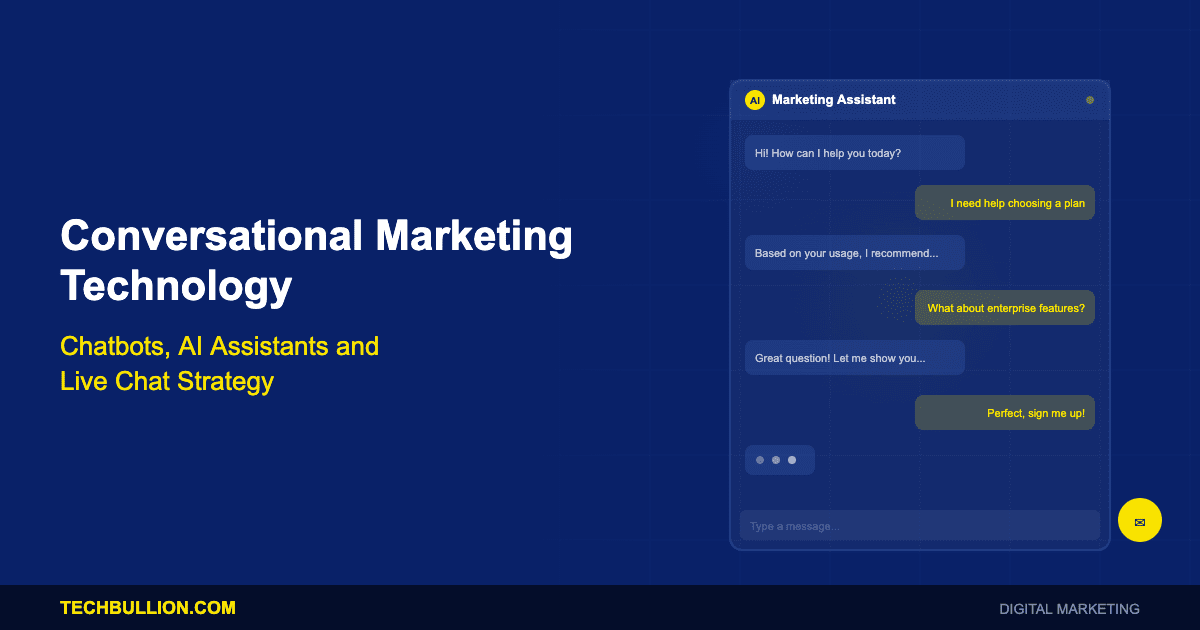
A potential customer lands on a software company’s pricing page at 11:47 PM, scrolling between the professional and enterprise tiers for the third time this week. A chatbot detects the hesitation pattern, surfaces a comparison of the two plans tailored to the visitor’s industry based on firmographic data, and offers to connect them with a sales engineer who specialises in their vertical. The visitor engages, asks three technical questions about API rate limits, receives instant answers pulled from the knowledge base, and books a demo for the following morning. By the time a human sales representative opens their laptop, the prospect has already been qualified, their technical concerns addressed, and a meeting scheduled with full conversation context attached. That interaction, which would have been a silent bounce just three years ago, represents the measurable impact conversational marketing technology delivers in 2026.
Market Growth and Adoption Trends
The global conversational AI market reached $10.7 billion in 2024 and is projected to grow to $32.6 billion by 2029, according to MarketsandMarkets, reflecting a compound annual growth rate of 24.9 percent. Gartner predicts that by 2027, chatbots will become the primary customer service channel for approximately 25 percent of organisations. The adoption curve has accelerated dramatically since the introduction of large language models, which transformed chatbots from rigid, rule-based decision trees into fluid conversational agents capable of understanding nuance, context, and intent across dozens of languages.
Drift’s 2024 State of Conversational Marketing report found that 55 percent of companies using conversational marketing generated more qualified leads than those relying solely on traditional forms. The average response time for web leads dropped from 42 hours to under 90 seconds for organisations deploying AI-powered chat, and conversion rates on pages with conversational interfaces averaged 36 percent higher than those with static forms alone.
| Metric | Value | Source |
|---|---|---|
| Conversational AI Market (2024) | $10.7 billion | MarketsandMarkets |
| Projected Market (2029) | $32.6 billion | MarketsandMarkets |
| CAGR (2024-2029) | 24.9% | MarketsandMarkets |
| Lead Qualification Improvement | 55% more qualified leads | Drift |
| Average Response Time Reduction | 42 hours to under 90 seconds | Drift |
| Conversion Rate Lift with Chat | 36% higher | Drift |
Technology Architecture and AI Capabilities
Modern conversational marketing platforms operate on a layered architecture that combines natural language understanding, dialogue management, knowledge retrieval, and integration capabilities. The natural language understanding layer processes incoming messages to extract intent, entities, sentiment, and context. Large language models have revolutionised this layer, enabling chatbots to understand conversational language, handle misspellings, interpret ambiguous requests, and maintain context across multi-turn conversations without requiring exhaustive training on every possible phrase variation.
The dialogue management layer determines how the conversation should progress based on the detected intent, conversation history, and business rules. Advanced platforms blend scripted flows for high-stakes interactions like payment processing with generative responses for informational queries, creating a hybrid approach that balances reliability with conversational flexibility. This architecture ensures that critical business processes follow predictable paths while allowing natural, free-flowing conversation for discovery and engagement.
Knowledge retrieval through retrieval-augmented generation has become the standard approach for grounding chatbot responses in accurate, company-specific information. Rather than relying solely on the language model’s training data, RAG systems retrieve relevant content from product documentation, help centre articles, pricing pages, and internal knowledge bases, then use the language model to synthesise that information into natural conversational responses. This approach dramatically reduces hallucination while keeping responses current with the latest product and policy information.
The integration layer connects conversational platforms with customer data platforms, CRM systems, marketing automation tools, and analytics infrastructure. When a chatbot identifies a qualified lead, it creates a contact record in the CRM, triggers a nurture sequence in the email marketing automation platform, and logs the conversation for sales follow-up. This integration ensures that conversational interactions feed into the broader customer journey rather than existing as isolated touchpoints.
Leading Conversational Marketing Platforms
| Platform | Primary Focus | Key Capability |
|---|---|---|
| Drift (Salesloft) | B2B revenue acceleration | AI-powered buyer intent scoring + meeting booking |
| Intercom | Customer service + engagement | Fin AI agent with custom training + inbox management |
| Qualified | Enterprise pipeline generation | Salesforce-native with real-time visitor intelligence |
| Tidio | SMB and e-commerce | Lyro AI chatbot + live chat + helpdesk |
| Ada | Automated customer service | No-code AI agent builder with multilingual support |
| ManyChat | Social messaging automation | Instagram, WhatsApp, Messenger automation |
Conversational Commerce and Revenue Impact
Conversational marketing has expanded beyond lead generation into direct commerce facilitation. WhatsApp Business API now supports complete purchase flows within the messaging interface, enabling customers to browse products, ask questions, and complete transactions without leaving the conversation. Meta reports that businesses using WhatsApp for commerce see 60 percent higher customer engagement rates compared to traditional e-commerce channels.
The integration of conversational interfaces with social commerce platforms creates buying experiences that feel like natural conversations rather than transactional processes. Instagram DM automation, TikTok chat integrations, and Facebook Messenger commerce bots enable brands to convert social engagement into purchases through dialogue-driven interactions that guide customers from discovery to checkout.
For B2B organisations, conversational marketing’s revenue impact centres on pipeline acceleration. By engaging website visitors in real time, qualifying their intent through conversation, and routing high-value prospects directly to sales representatives, conversational platforms compress the time between first touch and sales engagement. Companies using Drift report 40 percent faster sales cycles and 67 percent larger deal sizes when conversations initiate the relationship compared to traditional form submissions.
Voice Assistants and Multimodal Conversations
Voice-based conversational marketing through smart speakers and voice search interfaces adds another dimension to the conversational landscape. Amazon Alexa, Google Assistant, and Apple Siri process billions of voice queries monthly, creating opportunities for brands to engage consumers through spoken dialogue. Voice commerce reached $19.4 billion in the United States in 2023 and continues growing as voice assistant accuracy improves and consumer trust increases.
Multimodal conversational interfaces that combine text, voice, images, and video represent the next evolution. A customer can photograph a product they want to match, share it with a chatbot, and receive recommendations with visual comparisons. Video-enabled live chat allows agents to demonstrate products, walk customers through complex configurations, or provide visual troubleshooting support. These rich media capabilities transform conversational interfaces from text-only channels into immersive engagement platforms.
Measurement, Analytics, and Optimisation
Conversational marketing analytics extend beyond traditional chatbot metrics like containment rate and resolution time to measure business impact. Revenue attribution models connect conversational interactions to pipeline generation and closed revenue, enabling marketing teams to quantify the ROI of their conversational investments. Marketing attribution that includes conversational touchpoints provides a more complete picture of how chat interactions influence the customer journey alongside other marketing channels.
Conversation intelligence platforms analyse the content of chat interactions at scale, identifying common questions, objections, competitive mentions, and feature requests that inform product development and marketing strategy. Sentiment analysis tracks customer satisfaction across conversational interactions, providing real-time quality signals that complement traditional survey-based measurement approaches. Predictive analytics models trained on conversation data forecast which chat interactions are most likely to convert, enabling intelligent routing that prioritises high-value conversations for human agent attention while AI handles routine enquiries.
The Future of Conversational Marketing
The trajectory of conversational marketing through 2027 points toward increasingly autonomous AI agents that manage complex customer interactions end to end. These agents will negotiate pricing within approved parameters, configure custom product bundles, process returns and exchanges, and manage subscription modifications without human intervention for the majority of interactions. The integration of conversational AI with customer journey orchestration platforms will enable conversations that reference the customer’s complete interaction history across all channels, creating continuity that makes every conversation feel like a continuation of an ongoing relationship rather than a fresh start. Organisations investing in conversational marketing infrastructure today are building the foundation for customer engagement models that will define competitive advantage in an increasingly dialogue-driven digital economy.
Research from McKinsey’s 2024 analysis indicates that organisations deploying AI at scale report efficiency improvements of 15 to 25 percent within the first 18 months of production implementation.
According to Mordor Intelligence, the AI in fintech market is projected to grow at a compound annual growth rate exceeding 20 percent through 2029, driven by demand for automated fraud detection, credit scoring, and customer service applications.