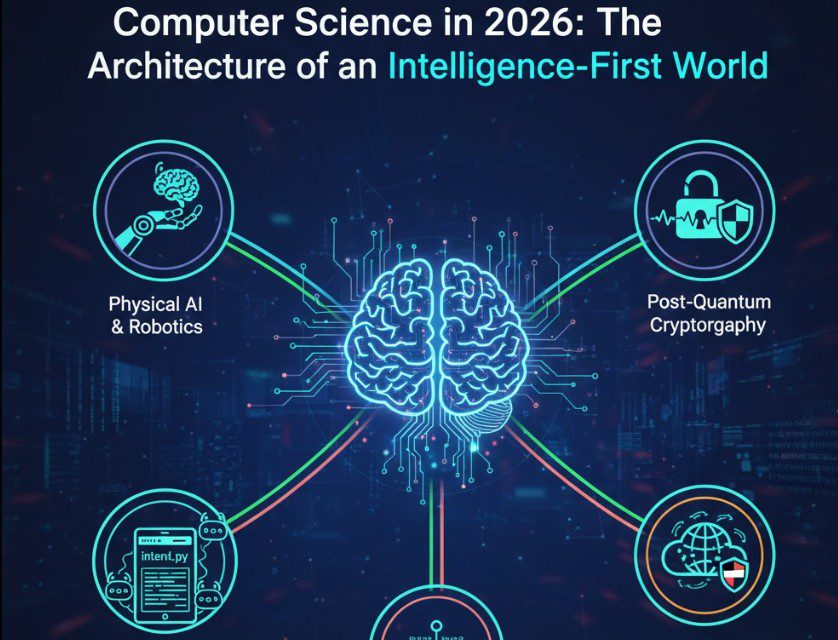
In 2026, Computer Science (CS) has evolved far beyond the study of “computers.” It is now the fundamental architecture of modern existence, A multidisciplinary science that orchestrates the flow of information, the automation of physical labor, and the evolution of artificial intelligence.
While the core principles of algorithms and data structures remain the bedrock of the field, the focus in 2026 has shifted toward convergence. We are no longer just writing software; we are building autonomous, intelligent systems that live in both the digital and physical realms.
The Core Branches of Modern Computer Science
To understand CS today, we must look at how its traditional branches have matured into specialized powerhouses:
| Branch | 2026 Focus Area | Real-World Application |
| Artificial Intelligence | Agentic & Multiagent Systems | AI agents that execute complex business workflows without human oversight. |
| Cybersecurity | Preemptive & Quantum-Resistant | Using AI to block threats before they strike and securing data against quantum decryption. |
| Physical AI & Robotics | Humanoid & Swarm Intelligence | Autonomous robots in warehouses and smart surgical assistants in hospitals. |
| Software Engineering | AI-Native Development | Developers use GenAI to “express intent” rather than manually typing every line of code. |
| Data Science | Predictive Intelligence | Extracting actionable insights from “unstructured telemetry” to prevent system failures. |
The 2026 Technological Vanguard
Several breakthrough trends are currently redefining the boundaries of what is possible in computer science:
1. Agentic AI and Multiagent Systems
We have moved from “Chatbots” to “Action-Bots.” Modern computer science is now focused on Agentic AI—systems that don’t just answer questions but set goals and take actions. Multi-agent systems allow different specialized AI “workers” to collaborate, much like a human team, to solve massive logistical or scientific problems.
2. Post-Quantum Cryptography (PQC)
As quantum computing inches closer to “Quantum Advantage,” computer scientists are racing to implement Post-Quantum Cryptography. This is the new standard for digital security, designed to ensure that the encryption protecting our banks and governments remains unbreakable even by future quantum machines.
3. Spatial Computing & Digital Twins
Computer graphics have merged with AI to create Living Digital Twins. These are photorealistic, computationally driven replicas of real-world operations (like a factory or a city). Using techniques like Gaussian Splatting, these digital environments allow for high-fidelity simulation and real-time decision-making.
Careers and the Future of Work
A degree in Computer Science remains one of the most versatile and rewarding paths in 2026. The job market has moved toward highly specialized roles:
-
AI/ML Engineers: Designing the “brains” behind autonomous systems.
-
Cybersecurity Threat Hunters: Proactively identifying vulnerabilities using AI security platforms.
-
Software Architects: High-level thinkers who design the blueprint for complex, integrated systems.
-
Cloud & Sovereign Infrastructure Engineers: Building regionalized clouds to protect data privacy and national sovereignty.
Did You Know? In 2026, the demand for AI and Cybersecurity experts has grown by over 35%, with senior roles like Software Architects commanding salaries upwards of $200,000.
Conclusion: The Human-AI Symbiosis
The computer science of 2026 is defined by a shift from human-oriented tools to AI-oriented ecosystems. However, the most successful computer scientists are those who balance technical mastery with ethical governance. As we build faster models and more powerful robots, the ultimate goal of computer science remains the same: solving human problems with elegant, efficient, and secure logic.
Would you like me to draft a study roadmap for a specific specialization in computer science, or perhaps an SEO-optimized blog post about AI career paths?
Top Computer Science Trends in 2026
This video explores the 15 major technology trends, including quantum breakthroughs and neural networks, that are currently shaping the field of computer science.