
Buying Gold and Silver With Bitcoin: How Bitgolder Turns Crypto Gains Into Real, Tangible Wealth


Buying Gold and Silver With Bitcoin: How Bitgolder Turns Crypto Gains Into Real, Tangible Wealth
If you’ve held crypto for any length of time, you already know the feeling. The portfolio doubles, then halves. A green week followed by a red one. You check the price on your phone and think the same thing every long-term holder eventually thinks: I should take some of this off the table.
The problem is what comes next. Cashing out to a bank account means tax forms, KYC headaches, frozen transfers, and watching a chunk of your gains evaporate into a number on a screen that the Federal Reserve is busy diluting. Holding stablecoins works until it doesn’t — Tether and USDC are still IOUs sitting on a centralized issuer’s balance sheet. And buying more crypto just keeps you exposed to the same volatility you were trying to escape.
There’s a third option that an increasing number of crypto holders are quietly choosing: convert some of those digital gains into something physical. Gold. Silver. Real metal you can hold in your hand, store however you want, and pass on without anyone’s permission.
This is exactly the gap BitGolder was built to fill.
The Real Problem With “Just Sell Some Crypto”
Before getting into how the crypto-to-bullion path actually works, it’s worth being honest about why so many holders never take profit in the first place.
Selling on a major exchange triggers a paper trail. Your gains get reported. The wire to your bank account might get flagged for review, especially if it’s a large amount or it’s the first time you’ve moved that kind of money. In some jurisdictions, banks have started outright refusing transfers from crypto exchanges. Reddit threads on r/Bitcoin and r/CryptoCurrency are full of people describing accounts frozen, payments reversed, and “compliance reviews” that take weeks to resolve.
Then there’s the bigger picture. Even if you cash out cleanly, you’ve just traded a deflationary digital asset for fiat currency that’s losing purchasing power every year. Global government debt has crossed levels not seen since the world wars. Inflation never quite returned to the 2% target central banks promised. The case for holding any paper currency long-term gets weaker every quarter.
This is why gold has quietly broken out to record highs over the past three years. It’s why the smartest crypto holders aren’t choosing between Bitcoin and gold — they’re holding both. Bitcoin gives you portability, growth potential, and protection from sovereign default risk. Physical gold and silver give you something Bitcoin still can’t: an asset that isn’t a database entry, doesn’t depend on electricity, and has held value for five thousand years across every empire that’s ever existed.
The question stops being should I diversify into metals and becomes how do I do it without undoing all the privacy and self-custody work I did with crypto in the first place.
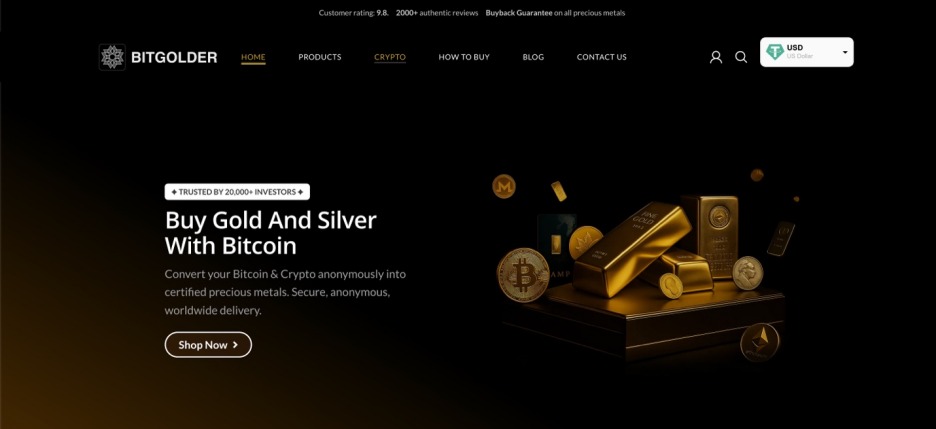
Why a Crypto-Native Bullion Dealer Matters
Here’s the trap most people fall into. They decide to buy some gold, head to a major bullion retailer, and discover three things at once.
First, the dealer wants a bank wire or credit card payment, which means converting crypto to fiat first — fees on both ends. Second, even the dealers who “accept Bitcoin” usually route through BitPay or a similar processor that locks the price for ten minutes, charges its own spread, and requires KYC verification on top of the dealer’s own paperwork. Third, the entire industry is built around customers who already operate inside the traditional banking system. The crypto holder gets treated as an edge case.
A crypto-native dealer flips that around. The whole stack is built for people paying in Bitcoin, Ethereum, Monero, or stablecoins. Pricing is locked at order confirmation rather than at the moment of payment, which matters when you’re sending a cross-chain transfer that takes a few minutes to confirm. Privacy is the default rather than something you have to fight for. And the people running the business actually understand why someone would want to pay in XMR or use a stablecoin on Tron to avoid Ethereum gas fees.
That’s the category BitGolder operates in.
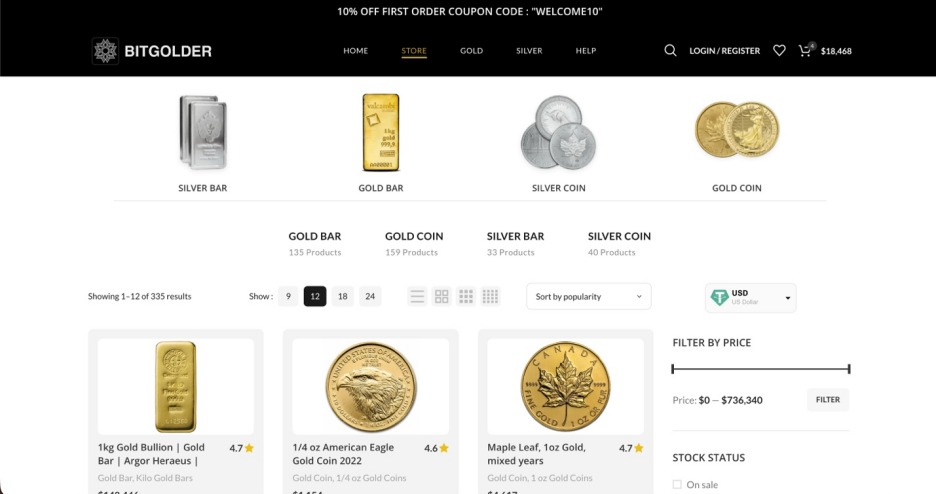
What BitGolder Actually Does
BitGolder is an online precious metals dealer that lets you buy physical gold and silver — coins, bars, rounds — using cryptocurrency. No bank involved. No conversion to fiat in the middle. You send crypto, you receive metal at your door.
A few specifics that matter:
No KYC for orders up to $20,000. Most dealers require government ID for any transaction. BitGolder uses simplified due diligence below the $20,000 threshold, meaning you can place a meaningful order without uploading your driver’s license, proof of address, or any of the other documents that turn into permanent records of your private wealth. This is the single biggest practical reason people use the platform.
Wide cryptocurrency support. The accepted list includes Bitcoin (BTC), Ethereum (ETH), Litecoin (LTC), Monero (XMR), Ripple (XRP), Dash, BNB, and major stablecoins like USDT and USDC. Stablecoins are supported across multiple networks — Ethereum, Arbitrum, Base, and Tron — so you can pick whichever chain has the lowest fees at the time of payment. If privacy is the priority, Monero gives you on-chain confidentiality that Bitcoin can’t match.
LBMA-certified products only. Every gold bar and coin sold is sourced from London Bullion Market Association-accredited refineries and mints. That’s the global standard. You’re not buying mystery metal from a sketchy supplier — you’re getting the same Umicore, C.Hafner, Royal Mint, and Perth Mint products that institutional buyers purchase, with certificates of authenticity included on bars where the refiner issues them.
Discreet, insured shipping worldwide. Packages are unmarked. Nothing on the outside indicates what’s inside. Every shipment is fully insured, and signature confirmation is required on delivery. If a package gets lost in transit, BitGolder reships or refunds in full. They ship to over 100 countries, and EU orders typically dispatch within a day.
Anonymous shipping option. For buyers who want an extra layer of privacy on larger orders, anonymous shipping is available by request on orders up to $20,000.
Price locked at order confirmation. Gold and silver spot prices move every second. When you confirm an order, your price is locked — no surprise repricing if Bitcoin dips while your transaction is confirming on-chain.
4.8/5 rating from nearly 4,000 customers. The platform has shipped over 10,000 successful orders since launching, which is the kind of operational track record that matters when you’re sending crypto to someone you’ve never met for an asset that’s worth real money.
How the Process Actually Works
The flow is simpler than most people expect. There are no middlemen, no complicated settlement, and no waiting for bank transfers to clear.
You browse the catalog and add what you want to your cart — say, a 1 oz American Gold Eagle, a few Silver Britannias, or a 100 g gold bar from a refiner like Umicore. At checkout, you fill in your shipping address. You don’t create an account, you don’t upload ID (assuming you’re under the $20k threshold), and you don’t link a bank.
Then you pick your cryptocurrency. BitGolder uses CoinPayments and BTCPay Server as payment gateways, both of which are well-established crypto processors. BTCPay specifically is open-source and supports Bitcoin Lightning Network payments, meaning Bitcoin transactions can confirm in seconds rather than minutes if you’ve got a Lightning wallet. For other coins, you scan a QR code or copy the wallet address, send the exact amount from your wallet of choice, and that’s it.
Once the network confirms your payment, the order moves into fulfillment. You get email confirmation. The package goes out from a secure facility — weighed and packed under camera surveillance, sealed in tamper-proof packaging that gives no hint of what’s inside, and dropped into the insured mail stream. You track it like any other package.
What you don’t have to do: open an account, verify your identity (under threshold), provide a phone number tied to your real name, link a bank account, expose your home address to a third-party payment processor, or wait for ACH/wire settlement.
Gold or Silver — Which Makes Sense?
Both have a place in a crypto holder’s portfolio, but they play different roles.
Gold is the heavyweight. It’s denser value per ounce, easier to store in small spaces, and has the cleanest macro narrative — central banks have been buying record amounts of it since 2022. If you’re converting a large chunk of crypto gains into metal as a long-term hedge against currency debasement, gold does that job efficiently. A single 1 oz gold coin represents a meaningful amount of stored wealth in something the size of a poker chip.
Silver is the workhorse. It’s much cheaper per ounce, which means more flexibility — you can build a position in smaller increments, stack rounds and bars over time, and hold something useful for actual barter scenarios where a $4,000 gold coin would be hard to break. Silver also has a real industrial demand floor: solar panels, electronics, medical devices, EV components. Mining supply has been running below demand for years, which creates a structural deficit that supports long-term price appreciation regardless of what happens in financial markets.
A common approach: gold for the core hedge, silver for the optionality. BitGolder carries both — gold coins like the American Gold Eagle, Canadian Gold Maple Leaf, and Britannia, gold bars from 1g up to 1kg, plus a full range of silver coins (Silver Britannia, Silver Maple Leaf, Silver Eagle) and silver bars in various weights.
Privacy Without the Sketchy Trade-Offs
Most “anonymous” gold dealers fall into one of two failure modes. Either they’re sketchy operations with no track record, vague product descriptions, and a higher-than-real chance of fraud — or they’re “anonymous” in name only and end up requiring KYC anyway once you try to actually place a real order.
BitGolder’s approach is different and worth spelling out, because privacy is the main reason most people are reading an article like this in the first place.
The no-KYC threshold up to $20,000 is publicly stated and operationally real, not buried in fine print or quietly retracted at checkout. The discreet packaging policy means no logos, no return address that gives away the contents, and no customs declaration that announces “VALUABLE METALS” to anyone who handles the package. Payment processing is direct between you and the platform, without your transaction getting routed through a third-party processor that pulls KYC data on its end.
That said — and this is the honest part most marketing pages skip — Bitcoin itself is pseudonymous, not anonymous. Every transaction sits on a public ledger. If you’re paying from a wallet that’s already linked to your identity through a KYC exchange, the transaction can theoretically be traced. For maximum privacy, Monero is genuinely the better choice — its transaction graph is opaque by design — and BitGolder accepts it. Pairing Monero with the no-KYC threshold and discreet shipping gets you about as close to a clean private gold purchase as currently exists in the legitimate market.
When This Makes Sense (And When It Doesn’t)
This isn’t for everyone. If you’re buying gold inside a retirement account for tax-advantaged storage, you need a regulated custodian, not a crypto-native dealer. If you want fractional, tradeable exposure to gold price movements without taking physical delivery, an ETF like GLD is more efficient.
Where the crypto-to-bullion path makes sense:
You’ve got crypto gains and you want to lock in some of those gains into something that isn’t another digital asset. You want to diversify out of pure crypto without going through a fiat off-ramp that creates a paper trail and tax-reporting headache before you’ve even decided what to do with the cash. You value privacy in your investment activity and don’t want every purchase tied back to a government ID. You believe physical metal — held by you, in your possession — is qualitatively different from a brokerage statement that says you “own” some allocated gold somewhere.
Or, more simply: you remember why you got into crypto in the first place. The whole point was sovereignty over your own money. Buying physical metal with that crypto is just an extension of the same principle.
Final Thoughts
The crypto market will keep doing what it does. Up cycles, down cycles, ten more years of debate about what Bitcoin actually is. Gold and silver will keep doing what they’ve done for thousands of years — sitting there, holding value, indifferent to whatever the latest macro narrative happens to be.
The interesting move isn’t picking one over the other. It’s recognizing they solve different problems and using each for what it’s good at. Crypto for the upside, the portability, the censorship resistance. Metal for the foundation underneath everything else.
BitGolder exists because turning the first into the second used to be unnecessarily hard — full of fiat conversions, KYC walls, and processors that didn’t really understand what their crypto-paying customers wanted. It’s a lot less hard now. Browse the catalog, pick what you want, pay in whichever crypto you actually hold, and a few days later a discreet package shows up at your door with the metal inside.
That’s the whole pitch. The rest is just deciding how much of your stack you want sitting in your hand instead of on a screen.






Comment