
Your CRM Isn’t A Database Anymore. Most Leaders Haven’t Noticed.

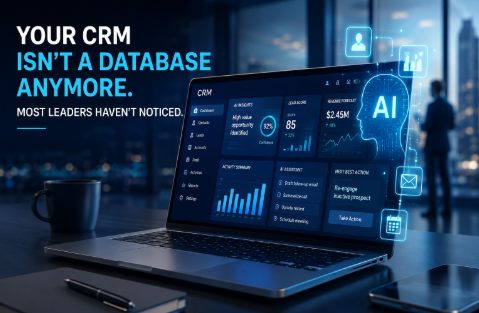
Every few years, enterprise software goes through a quiet reclassification nobody sends a memo about. CRM is going through one right now.
For 20 years, the pitch was simple: put your customer data in one place so nobody has to remember it by hand. That was the whole job. Hold the data, organize the data, report on the data.
That job is disappearing. Not the CRM, the passive part of it.
I’ve watched enough platform rollouts to know the difference between a feature update and an architectural shift. What’s happening in CRM right now is the second one, and most leaders are still budgeting for the first.
The Shift Nobody’s Pricing In
Gartner projects that 40% of enterprise applications will include task-specific AI agents by the end of 2026. CRM isn’t a bystander in that number. It’s one of the categories driving it.
The global CRM market is on pace to hit roughly $126 billion this year, with several forecasts placing it past $300 billion within a decade. But the total figure isn’t the interesting part.
What’s interesting is who’s buying the AI-native version versus who’s still buying the old model with AI features stapled on top. Platforms built with AI embedded into the data layer from day one are capturing new licenses at a rate that’s climbed sharply in just a few years.
Here’s the part that should actually get a leadership team’s attention: smaller businesses are adopting AI-native CRM faster than large enterprises.
That’s backwards from how enterprise software normally spreads. It usually trickles down from the Fortune 500. This time, smaller, faster-moving companies are getting there first, mostly because they’re not dragging fifteen years of legacy infrastructure behind them.
If you’re running a large organization and telling yourself you’ll “get to it next year,” a smaller competitor with none of your baggage may already be two steps ahead.
Most “AI-Powered CRM” Marketing Is Noise
I’ll say the quiet part out loud: “AI-powered CRM” has become a label slapped on almost anything with a chatbot in the corner. Most of it doesn’t move the needle.
A few things actually do.
Lead scoring that uses real behavioral signals instead of static point systems. Generative AI drafting the first pass of outreach emails and call summaries, so reps spend less time on admin and more time actually selling. Service teams using AI assistants that measurably cut response times instead of just adding another screen to click through.
But the real dividing line isn’t any single feature. It’s whether the system runs continuously in the background, enriching records, catching anomalies, syncing data across tools without a human pressing a button or whether it still waits for someone to trigger it manually.
Both get marketed as “AI-powered.” Only one of them changes how a team actually works day to day.
The Problem Nobody Wants To Own
Here’s what rarely makes it into a vendor’s pitch deck: AI is only as good as the data underneath it, and CRM data has been a mess for a long time. Roughly a quarter of CRM implementations are still undermined by poor data quality alone.
An AI model doesn’t know when it’s working with garbage. It will still confidently score a lead or flag a churn risk off duplicated, half-complete records and hand you a wrong answer with total conviction. That’s arguably worse than having no AI insight at all, because leadership tends to trust a number generated by a model more than they’d trust a hunch.
I’ve seen this play out the same way more than once: a company rolls out AI-driven CRM features, gets excited about the dashboard, and only discovers months later that the “insights” were built on a foundation of duplicate contacts and half-filled fields nobody cleaned up first. In our own research at Software Cora, this exact pattern shows up in nearly every case where an AI CRM rollout underdelivers.
The companies actually seeing returns treated data hygiene as step one, not an afterthought bolted on after the AI rollout already underwhelmed everyone.
Where This Goes Next
The next shift isn’t another feature. It’s autonomy.
A growing number of organizations plan to deploy autonomous AI agents inside their CRM before this year is out systems that can identify a re-engagement opportunity, draft the outreach and schedule the follow-up, all without a human kicking off each step.
That’s a genuinely different operating model than the assistive AI most teams use today. And it opens a governance question I don’t think enough leadership teams have actually sat down and answered: who’s accountable when an autonomous agent sends something it shouldn’t have?
I don’t think the answer is “slow down.” I think the answer is “decide on purpose.” Know exactly how much autonomy you’re comfortable handing to software before you hand it over, not after something goes wrong.
The Real Takeaway
Don’t chase every AI feature a vendor puts on a slide. Fix your data first. Decide deliberately how much decision-making authority you’re willing to give AI inside your customer relationships. Treat your CRM choice as an architecture decision, not a checklist comparison.
The gap between platforms built AI-native and platforms with AI bolted on isn’t closing. It’s widening. The companies that treat that gap seriously in 2026 will be the ones still standing when it’s no longer optional.
CRM and AI software have already merged into a single category. The only question left is which side of that merger your business is actually on.







Comment