A new industry report from Cornerstone Communications puts hard numbers behind what engineers already know: the devices carrying tomorrow’s AI cannot carry the charge to run it.
There is a version of the edge AI story that gets told constantly in technology media. It involves breakthrough models, shrinking chips, and a near future where your smartphone handles tasks that once required a data center. It is a compelling story. It is also, according to a report released today, only half the picture.
The other half involves the battery in your pocket, and it is not nearly as flattering.
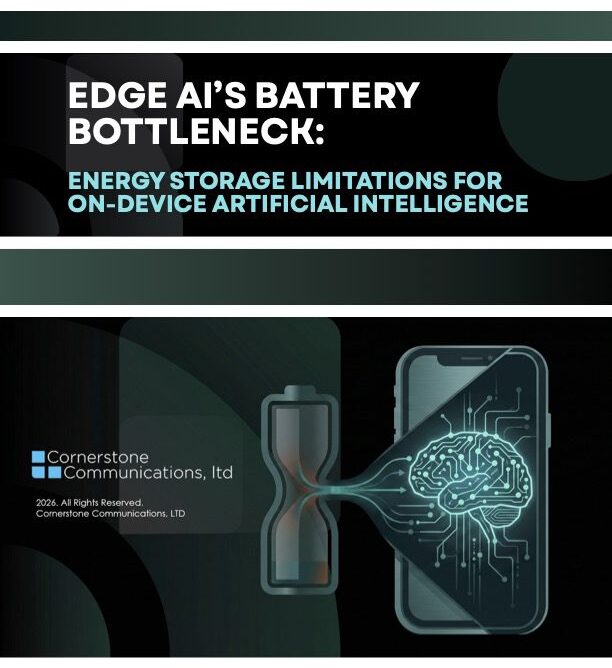
Cornerstone Communications, LTD, a strategic communications firm based in Rockville, Maryland, published a new industry research report today titled “Edge AI’s Battery Bottleneck: Energy Storage Limitations for On-Device Artificial Intelligence.” The report lands at a moment when the technology industry is making historic bets on on-device AI, and it raises a question that most of those bets have not yet answered: where does the power come from?
The Numbers Behind the Problem
The report’s technical findings are specific enough to be uncomfortable. Running a large language model inference task that generates 1,000 tokens, which is a fairly standard output for a generative AI application completing a writing or summarization job, can consume up to 13 percent of the total battery charge on an iPhone 16 Pro. Run that workload a handful of times in a single day and a significant portion of the device’s battery is already gone before a user has made a phone call or taken a photo.
That figure becomes more alarming when placed alongside the broader ambitions of the industry. Generative AI-enabled smartphones are forecast to reach 912 million units annually by 2028, which would represent more than 70 percent of the entire global smartphone market. AI-capable PCs are projected to hit 205 million units in the same timeframe, accounting for 40 percent of all PC shipments. These are not niche products being built for specialist users. They are the mainstream consumer devices of the near future, and they will be expected to run AI workloads continuously.
The power math simply does not work yet.
Conventional lithium-ion battery energy density has been improving at roughly five percent per year. That rate of improvement has been adequate for previous generations of mobile workloads. It is not adequate for what the AI industry is planning to put on those batteries. The report describes this gap precisely: an incremental improvement curve measured against exponential AI demand. That is the bottleneck, and it is sitting in the middle of every hardware roadmap being drawn today.
The Agentic Complication
The challenge grows harder still when the conversation shifts to agentic AI, which is the category of AI systems designed to run persistently in the background, take autonomous actions, monitor context, and respond to conditions without waiting for a user to issue a specific request. Unlike a search query or a one-time generation task, agentic AI requires sustained, continuous power. It does not allow the processor to idle. It does not allow the battery to recover.
This is the category that major technology companies are most aggressively developing. It is also the category that places the greatest possible stress on the energy storage systems of the devices designed to host it. The Cornerstone report makes clear that current battery technology was not designed for this use case and that the gap between what these systems require and what today’s batteries deliver is not a minor tuning problem. It is a foundational mismatch.
The Consumer Reality Check
Beyond the engineering dimension, the report surfaces a market reality that should give product strategists pause. Battery life is not simply one feature among many for device buyers. According to the research, 53 percent of smartphone purchasers name battery life as their top consideration when choosing a device. AI features, by contrast, rank fifth. Only 11 percent of consumers identify AI capability as the primary reason they would upgrade their phone.
This is the pressure point where the business risk becomes concrete. Manufacturers are investing in AI components that increase device cost and power consumption. Consumers are evaluating those same devices primarily on how long the battery lasts. If the battery cannot sustain the AI features being added, those features do not become a neutral non-factor. They become a source of frustration, a reason to return a product, and eventually a reason to distrust a brand.
What the Industry Must Build
The report does not simply document the problem. It identifies the direction the industry needs to move in order to solve it. On the materials side, closing the energy density gap will require investment in next-generation technologies including silicon anodes, lithium-metal anodes, advanced cathode materials, and new binders and additives capable of meaningfully pushing storage capacity beyond the current improvement trajectory.
Sustainability is raised as a parallel obligation. The volume of battery production required to power a global fleet of AI-enabled consumer devices will place real strain on raw material supply chains. The industry cannot treat that dimension as a future consideration. It is already becoming a present one.
The report’s most direct appeal is aimed at capital allocators. The argument is that whoever solves the energy storage problem does not simply solve a hardware inconvenience. They unlock the full commercial value of the edge AI market, a market that the technology industry has already committed hundreds of billions of dollars to building.
Dr. John Cooley, Founder and CEO of Nanoramic, a company focused on advanced battery materials, put the stakes plainly: “At Nanoramic, we have spent years developing advanced materials that push the boundaries of what batteries can do, because we understand that energy storage is not a secondary problem. It is the central problem. The industry needs to treat it that way, and the capital investment community needs to follow.”
That framing, energy storage as the central problem rather than a supporting one, is the core argument of the entire report. It is a reordering of priorities that the battery investment landscape has not yet fully reflected, but that the physics of AI workloads is demanding.
Why This Report Matters Now
The timing of this report is deliberate. The technology industry is in the phase where edge AI is being designed in, not bolted on. Chipsets are being architected around on-device inference. Software frameworks are being built to support persistent background processing. Supply chains are being organized around AI-capable device production at scale.
That is the moment to get the energy equation right, not after 912 million AI smartphones are in users’ hands and the reviews are describing battery life as a disappointment.
Brooke Greenwald, President and CEO of Cornerstone Communications, described the intent directly: “The data is clear. The bottleneck is real. And the window to act before consumer confidence erodes is narrowing.”
The full report, “Edge AI’s Battery Bottleneck: Energy Storage Limitations for On-Device Artificial Intelligence,” is available now at cornerstonepr.net. For technology journalists, product executives, hardware engineers, and battery investors, it is a document worth reading before the devices they are covering, building, or funding run out of charge.