Image: Vinit Jogani, Founder, Diatech AI
Surat (Gujarat) [India], March 05: Jewelry design has never had an ideas problem. It has had a time problem. A designer can only sketch so many concepts before a deadline closes in. And for every sketch that makes it to a client meeting, there are a dozen more left behind – not because they weren’t worth pursuing, but because turning a rough idea into something presentable takes days of back-and-forth and expensive iteration. That is the specific constraint AI is beginning to dissolve, and the results are more concrete than most people realize.
Take client presentations for instance. One of the most common friction points in jewelry design is the gap between what a designer imagines and what a client can actually see. Rough sketches get rejected because the client can’t visualize it. When AI tools can take that same rough sketch and render it as a photorealistic 3D model (across different metals, stone settings, and finishes) within hours rather than days, rejection rates drop sharply. Clients stop saying no to things they can’t picture. Designers stop redoing work that was right the first time.
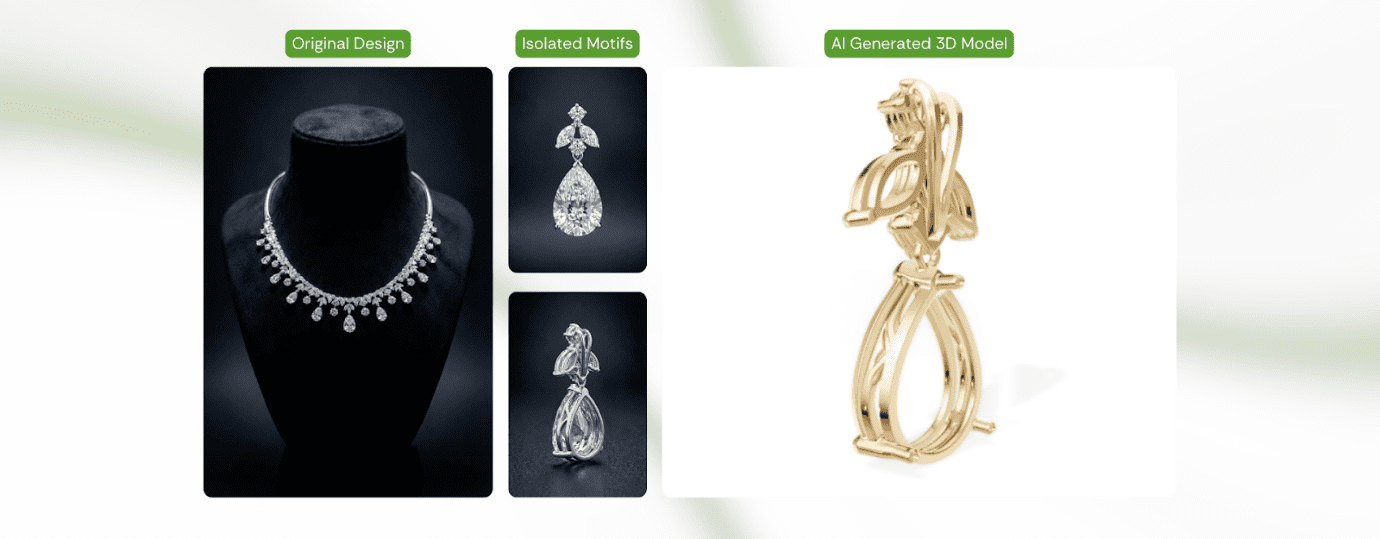
That evolution doesn’t stop at visualization. It carries forward into the production pipeline, where CAD design plays a critical role. Computer-aided design has always been essential to jewelry product development, but translating creative intent into precise, manufacturable geometry is a highly specialized process. It often sits as a separate phase, disconnected from the fluidity of early design exploration.
What is beginning to change is that separation. We are already seeing this play out at Diatech Studio . Instead of building every component from scratch, we can now generate structured 3D meshes for complex forms directly from simple reference inputs. This gives us a starting point that already holds form, proportion, and intent – something we can refine rather than construct piece by piece. CAD, in that sense, stops being a downstream task and becomes part of t he creative loop itself.
Brands are under growing pressure to show up consistently – across social media, email, retail displays, and seasonal campaigns – with fresh content that actually reflects what they make. Historically, that meant commissioning new photography and renderings every time, which was expensive and slow. Now, the same design assets that go into a client presentation can feed a content pipeline: new colorways, seasonal variations, lifestyle compositions generated at a pace that lets brands post something new every day without going back to zero each time. The design work doesn’t multiply; the reach of that work does.
The same logic applies to ideation. When a designer can generate fifty concept directions in the time it once took to develop five, the nature of the work changes. The question stops being “do we have enough ideas?” and starts being “which of these is actually worth making?” That is a better creative problem to have. It puts taste, judgment, and brand instinct back at the center, which is where they belong.
At Diatech Studio, what we’ve seen across the workflows we support is that AI handles the repetition and the rendering. Designers handle everything that requires knowing why something should feel the way it does.
There is also a commercial dimension that gets underestimated. When creative workflows connect to what’s selling (inventory trends, price point gaps, which aesthetics are gaining traction) designers can respond with a speed that traditional processes simply don’t allow. A gap in the mid-range category gets flagged on a Tuesday; a set of new directions is ready for review by Thursday. That kind of responsiveness used to require a much larger team. Now it doesn’t.
The designers who will define the next period in this industry are the ones who understand what the tools are actually good at – bulk generation, rapid visualization, consistent rendering – and what they are not: originating a point of view, understanding a customer, knowing when something carries weight and when it doesn’t.
Jewelry, at its best, is about identity and memory. The ring that marks a moment. The piece passed down across generations. Those meanings can’t be generated. What AI can do is make sure the ideas behind them no longer get lost to the limits of time and bandwidth, and for an industry built on craft, that is not a small thing.