
AI Will Not Build Your Brand, People Will: An Interview with Bradley Skaggs, Co-founder and Creative Director of Skaggs.


The conversation has largely centred on speed, automation and efficiency as artificial intelligence transforms businesses and industries. Yet, in the race to adopt AI, many organisations are overlooking the one factor that has always differentiated successful brands: human creativity. Bradley Skaggs, Founder and Creative Director of Skaggs Creative, argues that AI should not replace creative thinking but enhance it. Drawing on decades of experience in branding, design and strategic communications, he has developed a distinctive approach that helps businesses use artificial intelligence to build stronger, more authentic brands rather than simply producing more content. In this interview with TechBullion, he explains why strategy matters more than prompting, how businesses can avoid the pitfalls of AI-generated sameness, and why the most successful organisations will be those that combine human insight with intelligent technology.
Please tell us your name and a little more about yourself?
I’m Bradley Skaggs, co-founder and creative director of Skaggs (skaggs.co). We’re a brand strategy and creative studio based in New York City. I studied and practiced architecture before co-founding Skaggs with Jonina Skaggs in San Francisco back in 1999. I’m also a product photographer (skaggsphoto.com).
Could you tell us about Skaggs, what inspired you to start the studio, and what does your role as Creative Director involve?
Skaggs started as a graphic design studio in San Francisco, and we grew it into a full-service agency working nationally and internationally. We still work around the world today, but back to a studio model rather than the agency model. We find this gives our clients the best of both worlds, full-service but with a distributed team and hands-on work. We limit our roster to 6-8 clients at any given time.
The studio originated from the amount of freelance work Jonina was doing while finishing her MFA and from a virtual tour project for NASA that I was working on with a couple of friends. That project ended up being full-time, so I left the architecture firm I was working for to focus on it around the same time Jonina was wrapping up her MFA. We were working out of our little studio apartment then, and we took a small studio space and grew the company from there. It happened organically rather than through a formal biz plan, etc.
I serve as the creative director, translating what a client needs into the verbal and visual strategy that Jonina, the Art Director, and the team design around. Think of it like a restaurant: I run the front of house, she runs the kitchen. You can’t have one without the other.
You have spent decades in branding, design, and creative strategy. How has that long-term perspective shaped the way you view the current wave of AI adoption in business?
We’ve seen many changes over the years, the most significant being the dot-com boom of the mid to late 90s. I see a lot of parallels to that time now. The most apparent one is that everyone is jumping on the bandwagon; there are a lot of models and competitors, and it’s the only thing you hear about these days. As with dot-com, there will be consolidation, and major players will emerge and evolve; people will eventually realize AI is a tool you have to learn to master. The novelty will wear off, but it will forever change how business is done and how we do our individual work. I think it’s a good thing, but there need to be some rules put in place, specifically around authenticity, factuality and truth in advertising.
Much of the creative industry reacted with alarm when generative AI first emerged. What was your own initial reaction, and what led you to the stand you hold today?
I think it was equal parts “wow, this is amazing, and I’ll be able to do so much more” coupled with the realization that “holy sh*t, this could really affect my business”. I have to admit that I was super interested in AI (and still am) when ChatGPT hit the scene. It has affected our business, and we decided the answer was to use it to make us stand out rather than roll over and hope it just blows over. It’s not going to blow over, so don’t fool yourself. Learn how to use it to make your processes more efficient and improve your overall output.
We’ve built an AI infrastructure layer that runs below our design process to help us understand what a brand we’re working on is facing: the trends, the movers and shakers, and where the whitespace exists. It’s work that used to take weeks to do, and now, rather than spending those weeks finding the data, we can spend that time understanding what it means in the context of the brand, its audience(s) and where the brand ultimately wants to go. Clients expect you to use it, but they also expect you to know what it actually means for their problem. You can’t just hand them the output.
How are businesses using AI today, and what does a creative-first approach look like in practice?
First of all, a creative-first approach doesn’t work. The problem-first approach is the right approach; otherwise, you’re just painting the house a new color rather than renovating it to make it more functional, more aesthetically pleasing and to increase its value, etc.
I think most businesses using it today have two problems: they don’t prompt correctly, and they accept the results as fact. Prompting is not a Google search. You have to ask the question, give it context, define the role you want it to play, be explicit about the output you expect, and equally important, define what you don’t want. AI tends to tell you what you want to hear, which is a real problem. And I think some of that is on ChatGPT for calling it a “chat.” Brilliant positioning on their part, but it set the wrong expectation. While it is conversational, it’s not a chat; it’s more of a brief to get started.
Businesses need to understand that AI performs pattern recognition, so the more of something it sees across vast amounts of data, the more that becomes its “truth”. It is essentially finding the least common denominator, which means it isn’t going to solve your problem any differently than it’s going to solve your competitors’. This is why the prompt is so important. You have to define the situation and context in which you want it to work, so it can detect the blip in the pattern.
Many of the strongest brands appear to be built on human insight, with AI playing a supporting role in the creative process. Where, in your view, should the line be drawn between AI as a creative partner and AI as the creator itself?
It goes back to what I said before: the strongest brands are built on human insight, but they understand that AI is another tool, albeit a powerful one, and not a replacement for that insight. AI can’t understand the nuances of human interaction; it can’t tell you why a buyer decided at the last minute to grab this product off the shelf, rather than the one sitting right next to it. It can’t tell you what hasn’t been said.
I think back to about the 3rd or 4th release of Photoshop when it became a seriously powerful image manipulator. Some were saying it was the death of photography; others saw it for its artistic value. It wasn’t the death of photography, and while the “it looks Photoshopped” moniker became a real thing, it has become the standard of the post-production workflow of anyone doing serious photography. What’s funny is how we now have the “it looks like AI” moniker going around. The line will start to draw itself, but the problem is not as clear cut as it was with Photoshop. When you have human-realistic avatars speaking a script that pushes a product, nearly indistinguishable from actual UGC without a disclaimer, that is a problem, and it’s going to become a bigger one.
There is a widespread belief that prompting is the essential new skill of the AI era. Where does strategic thinking matter? Why is that, and what are the implications for how businesses train their teams?
Prompting matters, but it’s only as good as what you bring with it: knowing what you’re actually trying to find out. If you don’t have a strategic read on the problem before you open the tool, you’re going to prompt in circles. You’ll get answers, but they’ll be answers to the wrong question, and AI is very good at making the wrong answer look right.
Teaching people to prompt without teaching them to think strategically first is like teaching someone to use a camera without teaching them to see. The tool doesn’t know what a good photograph is. You have to bring that. A prompt is really just a brief. If the thinking isn’t in the brief, the output isn’t going to find it for you.
What are the most damaging branding mistakes you see companies making when they lean too heavily on AI?
Using it to establish identity before they’ve done the work of knowing what their identity actually is. That’s the one that causes real damage.
AI is very good at producing language that sounds like a brand. It knows what prestige brands sound like, what wellness brands sound like, what direct-to-consumer brands in their second year of growth sound like. If you give it a category and a tone, it will give you something that fits. The problem is that fitting is not the same as being specific. And specific is the only thing that’s actually worth anything at scale because that is what differentiates.
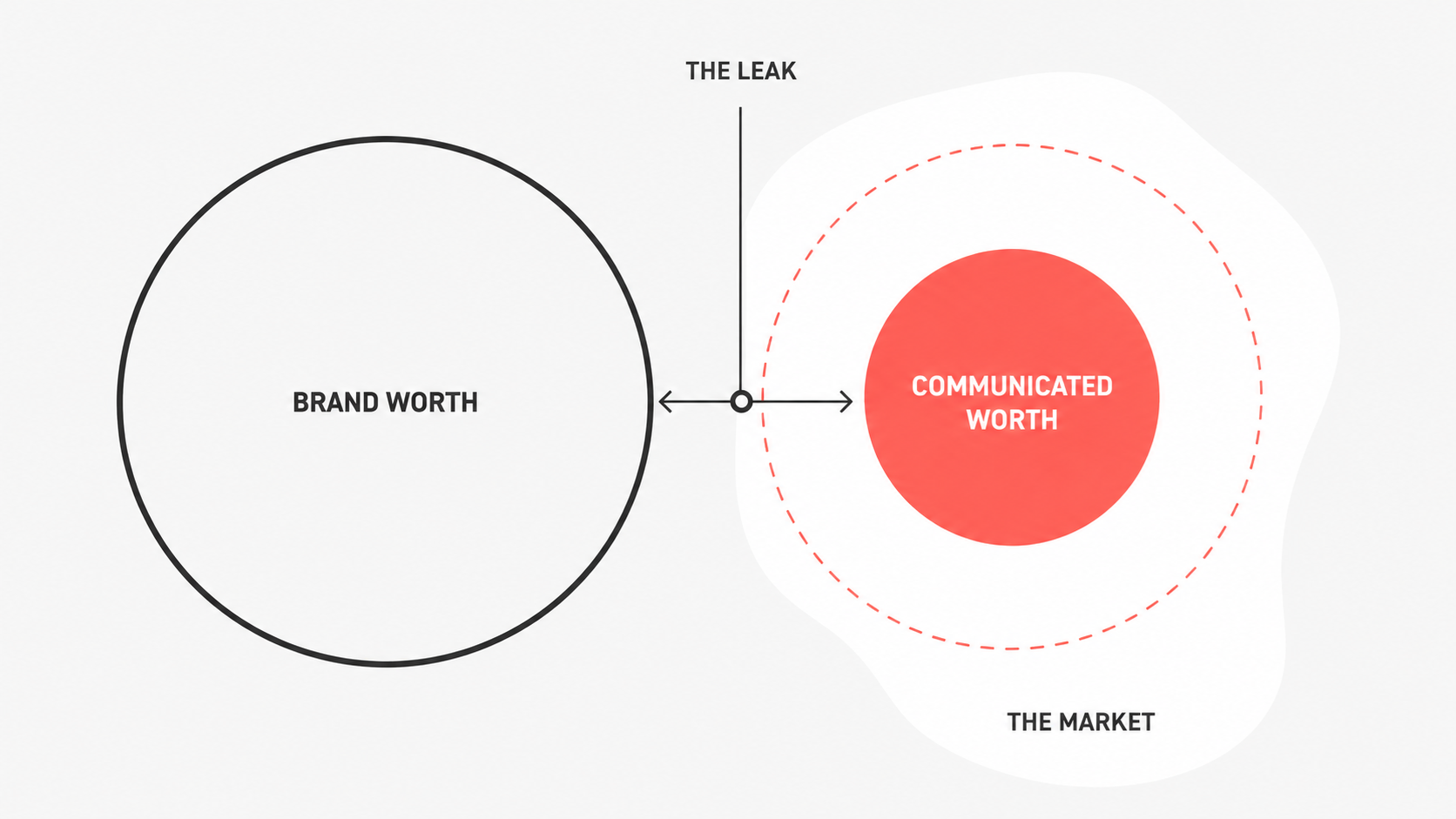
The brands that get into trouble are the ones that skip the hard question of “what can we honestly say that no one else can say?” and go straight to production. They tend to end up with a very clean and capable expression of nothing in particular. It looks right, and it reads right. But then, a year in, they can’t figure out why none of it is sticking, and they aren’t getting the results they want. AI didn’t cause that problem, but it had no problem helping them go further down the road before they noticed it.
A great deal of AI-generated content now looks and sounds identical. How can entrepreneurs harness AI to build distinctive brands rather than producing generic material that simply blends in?
The answer to this one is almost too simple. If you’re prompting AI without first knowing what makes your brand specific, all it can do is give you what it gives everyone else. AI runs on pattern recognition, as discussed, and the most common patterns in any category are generic ones. You get the generic output because you gave it generic input and nothing to work against.
Distinctive brands know something specific about themselves before they ask AI to help them say it. The founder who built a formula around a particular ingredient source, the brand whose entire ethos traces back to a specific moment or credential, the product that does one thing no competitor does in quite the same way. Those types of brands have real stuff to give to an AI model. When you load that type of specificity into the prompt, you interrupt the pattern. The output is less predictable because the input was less predictable.
Here is a test: write down the one thing your brand can say that no other brand in your category can say in the same way. If you can’t write that down, the AI problem isn’t your biggest problem.
Could you share a specific example, whether from your own client work or the wider market, where AI genuinely elevated a brand’s creative output?
The most useful thing AI has done in our work is to dramatically compress the research phase. What used to take weeks of competitive scanning, category mapping, and trend identification now happens in a fraction of the time. That’s important because it frees us up to spend the time saved on interpretation and understanding what the data means for this brand, in this category, at this moment.
For one client in the beauty space, the AI layer revealed a gap in how their competitors framed a particular ingredient story. The gap existed, we confirmed it and built part of the brand’s positioning around owning that territory. The AI didn’t tell us what to do with the gap, but it did show us the gap existed. The strategy was still a human decision, grounded in years of experience.
Skaggs AI — Actual Intelligence is exactly this: AI as a research and pattern-detection layer and us, the people who decide what the pattern means and what to do with it.
Authenticity has become one of the most valued qualities in modern branding. How should businesses protect it as AI takes on a growing share of their creative production?
The word “authenticity” gets used so often in branding conversations that it’s started to mean almost nothing, which is unfortunate because I love that word and I think authenticity is still a very important aspect of any brand. A brand has to feel/convey that it was made by someone who actually believes in it.
The way you protect authenticity is the same whether or not you’re using AI. You protect it by knowing what is actually true about your brand, and I mean specifically true, not aspirationally true, and making sure every decision, including every AI-assisted decision, connects back to that truth. When a brand has a clear foundation, it’s harder to drift from it. When it doesn’t, you’re exposed to whatever the AI defaults to, which is usually the least common denominator language used by the rest of your category. The brands that lose authenticity to AI are usually the ones that didn’t have a precise answer to what their brand actually is before they started.
For a small business owner with a limited budget and no in-house creative team, where does AI belong in the branding process, and where should it never be trusted on its own?
AI is certainly useful for things that used to require either a budget or a lot of time: competitive research, drafting copy variations to get you thinking and to respond to, organizing your thoughts and building initial structures for strategy documents. For a solo founder or small team, those are real hours saved.
Where I’d be cautious is anywhere the brand’s voice or position hasn’t yet been established. Not because AI can’t produce capable language, because it can, but because the brand’s voice is an identity decision, not a writing exercise. If you don’t know what your brand actually stands for and what makes it specific, you cannot evaluate whether the AI’s output is right or wrong. You’re just picking the version that sounds best, which is a very different thing from knowing the version that is true. Maybe that sounds obvious, but you’d be surprised how much I see this.
The best approach is to use AI to draft, then use your own judgment to decide what’s right.
Enterprise marketing departments once held an overwhelming advantage in resources. How realistically can a small business now compete with them using AI, and what does that require in practice?
I would argue the resource gap has definitely narrowed. The amount of research possible, the copy volume, and the speed of iteration enable a small team using AI thoughtfully as a tool to match the output of a much larger marketing department. That’s a real shift, and the opportunity exists now before enterprises can adapt. Small teams are always more nimble and flexible, which is another big advantage.
But what has always surprised me is why some brands with significant budgets and resources still produce work that feels like it was made by a committee, with nothing specific to say (probably because it was). Resources can buy more output, but they can’t buy a point of view.
Small brands have always had one important advantage: clarity of conviction. A founder who knows exactly why the brand exists and what it’s for communicates that whether they’re running a $500 campaign or a $5 million one. AI amplifies whatever you put in, so again, if you put in a specific, grounded identity, you get more of that. If you put in the generic version of your category, you get more of that, too.
The practical requirement is the same as it’s always been: know what you’re actually saying before you say more of it.
If an entrepreneur were launching a brand from scratch today, how would you structure a healthy human-plus-AI creative workflow from the very first step?
Start with the human work first before any tool gets involved. The founder needs to answer a few questions with real specificity: What is this brand actually aiming to do? Who is it for, and what does that person understand about themselves and their vision that most brands in this category miss? What can this brand say that no other brand in the category can honestly claim?
Those answers do not come from AI. They come from the founder’s real knowledge and expertise about the problem they want to solve, the people being served, and the specific thing that makes this product or company different from other options.
Once you have that foundation, AI becomes really useful, if not required. Researching the competitive landscape. Mapping how competitors are positioning themselves. Drafting language variations against the brand’s specific position. Checking whether the language you’re using is already owned by someone else in the space. Testing how the brand reads to someone encountering it for the first time.
Foundation first, then amplification. If you reverse it, you end up with a polished version of nothing.
With new AI tools appearing almost weekly, how do you evaluate whether a particular tool deserves a place in a professional creative process?
I ask: does it make the work better, or does it just make it faster?
Some tools do both, and those get adapted quickly. Others seem faster in ways that introduce new problems, produce outputs that require much more correction, have interfaces with a learning curve that kills the time they save, and whose integrations break existing workflows without meaningfully improving them.
Our approach is to test a new tool against a piece of completed work and see what comes out. Does it match? Is it better? Did it save time on the parts of the process that are a pain? Does it produce something we can improve on, or something that requires us to rebuild from scratch? And most importantly, does it understand context, or does it require us to rebuild the context every single time? The tools that have a place in our process are the ones that improve thinking, not just speed up the output.
What would you say to designers, writers and other creative professionals who still fear that AI threatens their livelihoods?
The fear is understandable, and it’s real, but not all of it is warranted. Entry-level work that was primarily about production volume, like the fifth variation of a banner ad, or the blog post that existed mainly to fill a content calendar and make SEO happy, is genuinely at risk. AI can produce that kind of output without the cost of a dedicated person.
The thing that makes a creative professional irreplaceable is judgment: knowing when something is right, knowing why it works, knowing what the brief actually needed versus what it asked for. It can tell you whether the work is competent, but it cannot tell you if it’s true. This is why I always have to laugh a bit when I see these YouTube videos of some young guy saying he created an entire brand manual in 10 mins. He probably did, but is it right?
The creative professionals who are navigating this well are the ones who understand this and are getting better at the judgment part. They’re using AI to handle the production work they used to spend time on and redirecting that time toward the decisions only they can make, and that need to be made by a human. The ones who are struggling are the ones waiting for the tool to go away or to do their job for them. It won’t do either.
How do you expect the role of the creative director, and the agency model more broadly, to evolve over the next five years as AI capabilities advance?
I think the creative director role becomes more valuable, not less. When AI can generate competent work at high volume, the question that matters is not “can we produce this?” but “is this right?” That’s a judgment call, and judgment is what a creative director is actually for.
The agency model is a different story. The traditional rationale for a large agency is that it is a one-stop shop providing all needed services, but I think that is weakening. A smaller team with better tools and a clearer strategy can produce comparable output with meaningfully less overhead. Skaggs has shifted back to our original studio model after running the agency model for years. The boutique agency model isn’t sustainable in the post-pandemic world we live in now. I think what you’ll see is continued consolidation at the large end and a return to founder-led studios at the boutique end. The agencies that struggle are the ones in the middle: too small to have the brand equity of the big names, too structured to be as fast or specific as a focused studio.
What survives, regardless of model, is the agency or studio that has a genuine point of view and a track record to back it up. That part isn’t going to be automated, and it will always mean something.
Some companies are choosing to go all-in on AI, but many believe the real advantage lies in combining human creativity with artificial intelligence. What distinguishes the organizations getting that balance right from those getting it wrong?
The ones getting it right have decided what AI is for in their process and what it isn’t. They’ve made that deliberate decision, based on where the mechanical work ends and the judgment work begins. The result is letting AI do what it’s actually good at, and humans handle what AI cannot: deciding what matters, knowing when something is true, and making calls that require experience and conviction. AI is a tool, just like Photoshop or all the tools in your garage. Each has a designed purpose. You don’t pound a nail into the wall with a screwdriver.
The ones getting it wrong are usually chasing the efficiency headline. They’ve pushed AI into parts of the process that require judgment because it’s faster, not because it produces better results. The output looks complete enough that the problem isn’t immediately visible. But over time, brands that replace judgment with automation at the identity level end up sounding like everyone else. It compounds, and it is a very hard thing to undo.
The balance is not philosophical; it’s a specific decision about which parts of the process require a human to be responsible for the outcome.
Which widely held assumption would you most like to challenge from the public conversation around AI and creativity today, and why?
The assumption that the problem is the tool. Most of the panic and most of the overcorrection are focused on AI as if it were the variable that changed everything. But the brands that are producing generic work with AI were producing generic work before it. The tool accelerated the output. It didn’t create the problem.
The real issue is that most brands haven’t figured out what they actually are before they start to prompt. Without that foundation, every tool, including AI, defaults to the category average. That’s not an AI problem. It’s a strategy problem that AI makes harder to outrun.
What is one practical step an entrepreneur, marketer or creative professional could take this week to begin using AI to enhance their creativity rather than replace it?
Ask it to argue against you. Whatever positioning, campaign idea, or brand direction you’re currently most confident about, put it into the AI and ask it to find the weakness. Ask it what a skeptical customer would say. Ask it what the strongest competitor would do to counter it. Ask it what you might be missing. Then have it tell you why and cite sources.
Most people use AI to validate and to produce. The more useful application, and the one that actually improves thinking rather than just accelerating it, is to use it as the devil’s advocate. It’ll find the holes faster than most meetings will. And unlike a room full of people who usually want to be agreeable, AI has no reason to make you feel good about your idea.




Comment