AI Reputation Management: What Brands Should Care About in AI Search
There is a weird truth: a brand can appear in almost every relevant AI conversation and still lose the customer.
That is the uncomfortable lesson businesses owners have when they look beyond AI mention counts and read the answers themselves. ChatGPT may recognize the company. Gemini may cite its website. Perplexity may include it in a comparison. Then each AI search engine recommends someone else.
Nothing has gone technically wrong, but the brand indeed failed to earn recommendations.
That’s why AI reputation management addresses the part of AI search. This metric tends to leave out: what AI search tools say about a business, which claims they repeat, where those claims come from, and whether the final answer moves a buyer toward or away from the brand.
Why does AI Reputation Behave Differently?
Traditional online reputation management is largely reactive. A poor review appears, the company receives a notification, and someone responds; a critical social post gains attention, and the communications team decides whether to intervene.
While AI reputation is less visible. A customer can ask whether a product is worth its price, which provider has better support, or what commonly goes wrong after purchase. The LLM produces an answer in a private conversation, so business operators can’t receive a timely notification, even if that answer eliminates it from consideration.
This changes the game of reputation management. Monitoring public comments remains important, but businesses must also understand how AI systems combine those comments with product pages, comparison articles, documentation, news coverage, forums, and other sources.
Reputation is more than Positive Sentiment
Sentiment matters, but the commercial picture is more complicated, since AI reputation is sometimes reduced to a positive, neutral, or negative score.
But a positive statement can still be unhelpful. An AI model might describe a cybersecurity platform as affordable when the company wants to win enterprise buyers on compliance and reliability.
A neutral statement may be costly. If the AI search tool lists the brand without a clear reason to choose it, the buyer is likely to focus on competitors with stronger positioning.
Even a negative statement may contain useful information. If several AI platforms independently repeat the same complaint, it may be a product or service issue that marketing cannot repair.
A useful reputation audit therefore examines four main dimensions:
- AI Visibility: Is the brand visible in AI search?
- AI Favorability: Is it described positively or negatively?
- Accuracy: Does the description reflect the current business?
- AI Recommendation: Does the LLM select it for buyer needs?
How to Make Effective AI Reputation Management?
Checking multiple AI search tools manually becomes difficult once prompts, competitors, products, and customer segments are added. This process may cost almost 1 to 2 days(even for a skilled SEO specialist).
That’s why we introduce the Kairosy AI reputation management to you. This tool could ask ChatGPT, Gemini, Claude, and Perplexity at the same time the kinds of questions buyers ask about a brand. It evaluates whether the business is recommended, criticized, misunderstood, ignored, or placed behind a competitor.
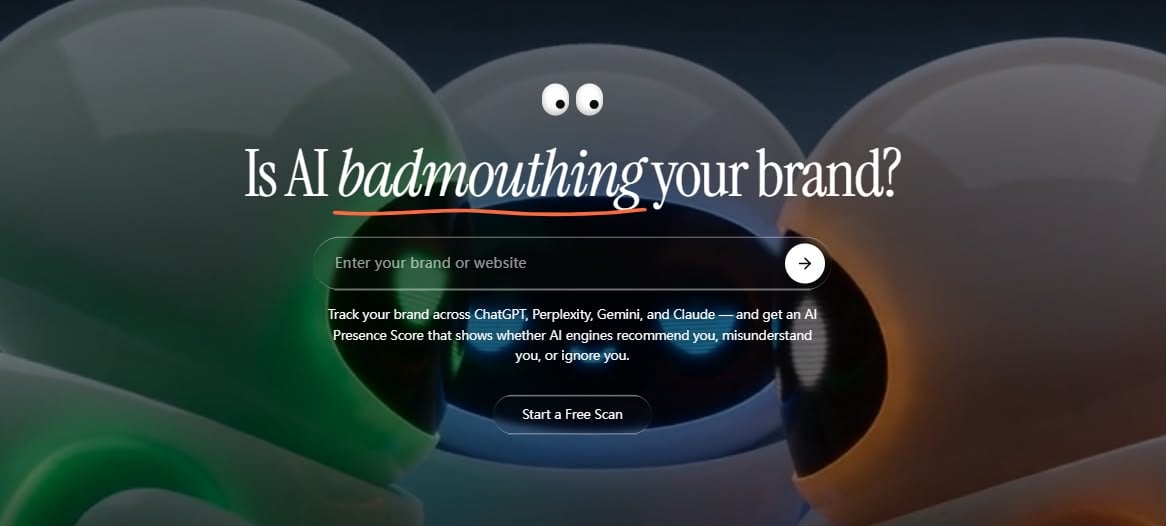
The online tool then produces an overview AI Presence Score, captures the relevant answers, identifies negative narratives, traces issues to likely sources, and organizes possible fixes by priority. It can also monitor changes over time and audit whether a website is well-structured for AI discovery.
The value is not another collection of mentions. It is the connection between an answer and an action. If AI search engines do not recognize the brand, the work may begin with entity clarity and content coverage; if they repeat obsolete information, the priority is source correction; if they understand the brand but recommend a competitor, the missing element may be differentiation or independent authority.
In short, different AI reputation failures require different fixes.
Attention: Measuring without Flattering Yourself
A brand can increase its mentions by appearing in more low-intent questions without gaining a single meaningful recommendation, and citation counts can also rise because the same page is repeatedly referenced, even when the surrounding answer remains neutral or negative.
Therefore, a more useful measurement begins with a stable set of buyer questions.
Then tracking whether the brand appears for those questions, which attributes AIs associate with it, how often it is preferred over named competitors, and whether negative claims persist after their sources have been addressed.
Then connect AI performance with business outcomes where possible. Monitor qualified referral traffic, conversion behavior, sales conversations mentioning AI research, branded search activity, and changes in the questions prospects ask.
Conclusion
AI outputs can vary by models, wording, timing, and available sources. We all know that authority takes longer to build than a new landing page takes to publish, so correcting a single webpage does not guarantee an immediate change.
What continuous AI reputation management can do is make the gap visible.
It can show a brand what AI search engines believe, which public evidence supports that belief, and where the brand loses confidence during a buyer’s decision.
The process ensures you to know why the assistant mentions your brand, then you can decide which missing piece is worth fixing first.
The advantage belongs to brands that treat AI answers as an observable customer channel rather than a mysterious algorithm, now go to Kairosy AI reputation scanner and get your AI reputation score for free!
FAQs on AI Reputation Management
- What is AI reputation management?
AI reputation management is the process of monitoring and improving how AI assistants describe, compare, and recommend a brand. It includes checking visibility, sentiment, accuracy, source credibility, competitor preference, and recommendation outcomes.
- Is AI visibility the same as AI reputation?
No. Visibility measures whether a brand appears in an AI-generated answer. Reputation concerns the meaning attached to that appearance. A company can be highly visible while being described negatively or losing recommendations to competitors.
- Can a company change what ChatGPT says about it?
A company cannot directly control ChatGPT or any other independent AI assistant. It can improve the accuracy and credibility of the information those systems may use by updating its website, correcting inaccurate external sources, addressing recurring customer problems, and earning stronger third-party evidence.
- Which AI reputation metrics matter most?
Useful metrics include visibility on high-intent buyer questions, accuracy of brand descriptions, favorability, recommendation frequency, competitor preference, persistence of negative narratives, and the reasons assistants provide for their choices.
- How often should a brand audit its AI reputation?
The appropriate frequency depends on the market. Brands in fast-changing or highly competitive categories may benefit from continuous or weekly monitoring. Businesses with slower product cycles can run scheduled audits after major website updates, launches, pricing changes, or reputation events.
- Should a business improve every negative AI mention?
Not automatically. Start with statements that are inaccurate, repeated across several platforms, connected to trusted sources, or likely to affect an important buying decision. Some negative feedback identifies a genuine operational issue and should be addressed by the responsible business team before communications work begins.