
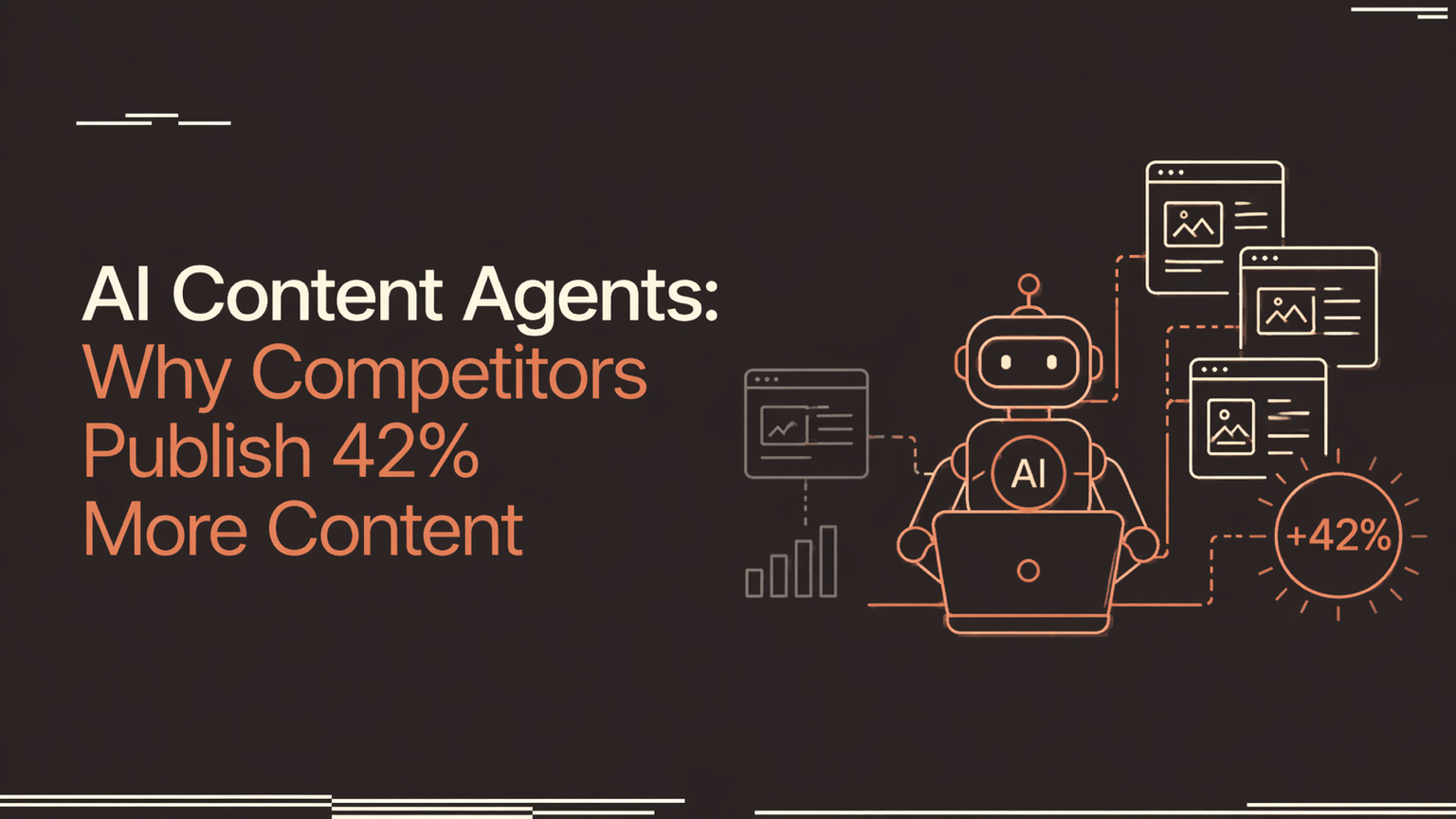
AI Content Agents: Why Competitors Publish 42% More Content

Forty-six percent of executives believe their competitors are already gaining meaningful ground through AI agent adoption, according to a PwC survey of 308 U.S. executives conducted in April 2025. That number has been sitting on desks across marketing departments for months, largely without action.
The pattern is consistent: the hesitation is real, the cost of it is growing, and the entry point is simpler than most teams assume.
The market is splitting into two groups

Generative AI now powers 17.2% of all marketing activity, having roughly doubled since 2022, and is on track to reach 44.2% within three years, according to the Duke CMO Survey, which polled 281 marketing leaders at VP level and above. The AI marketing market itself hit $47.32 billion in 2025 and is projected to reach $107.5 billion by 2028.
But aggregate adoption figures tell only half the story. The more revealing number is this: only 23.3% of marketing teams have AI agents fully integrated into their content operations, according to Averi.ai’s 2026 Benchmarks Report. The other 76.7% are doing something that looks like AI adoption from the outside – using tools, running prompts, generating drafts – but hasn’t yet crossed into the territory where the real productivity gains kick in.
The difference comes down to a single architectural question: is AI one step in your workflow, or is it the workflow?
What an AI content agent actually does
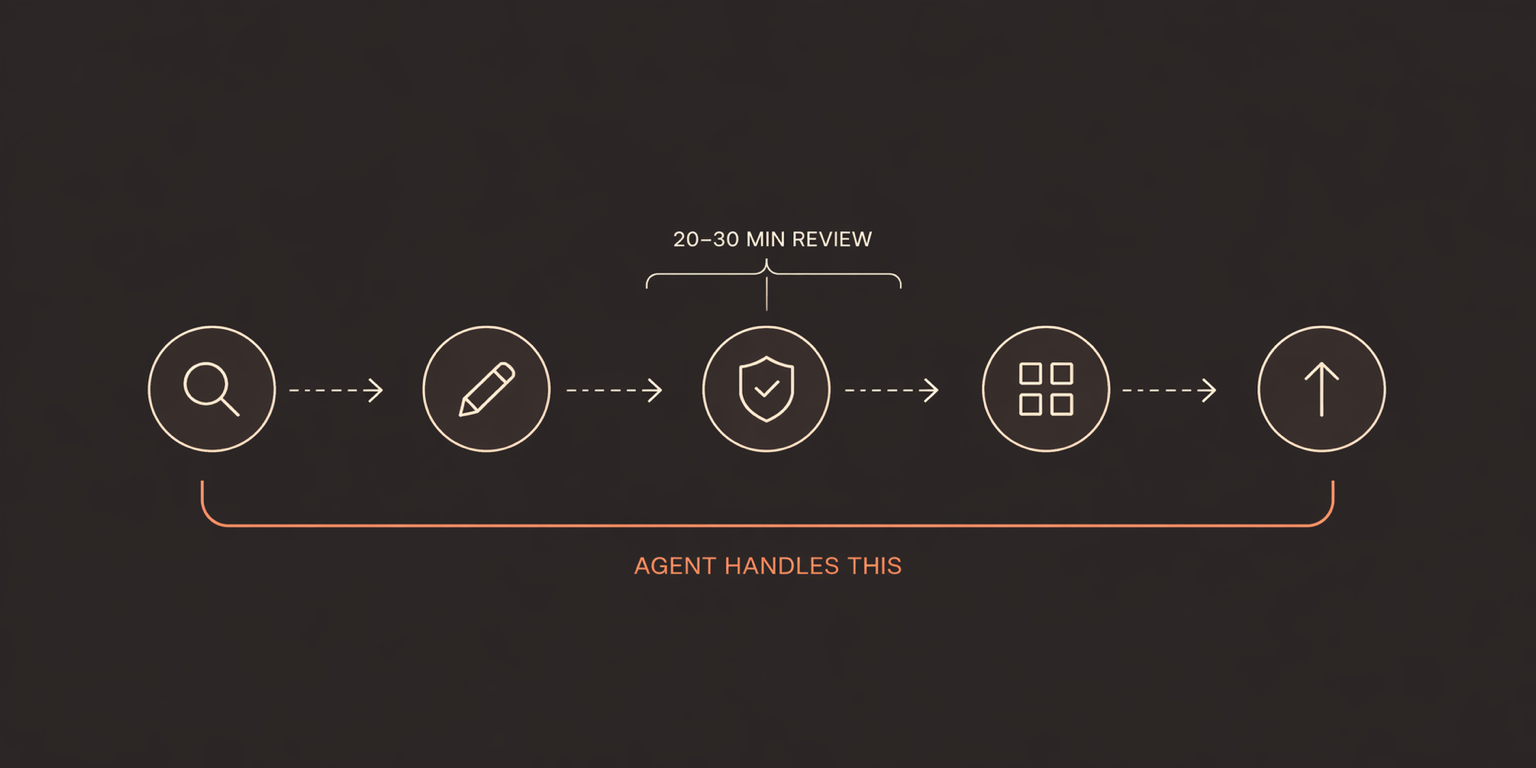
The term “AI content agent” gets used loosely. It can be described as a system that chains multiple actions (research, drafting, brand-checking, formatting, and handoff) with minimal human input at each step. That’s different from an AI writing tool, which responds to a prompt and stops.
An AI writing assistant saves 30 minutes per draft. An AI content agent saves 8 to 10 hours per piece of content, from brief to publication. The distinction matters because 30 minutes multiplied across a year of content is a convenience. Eight to ten hours multiplied across a year of content is a structural business advantage.
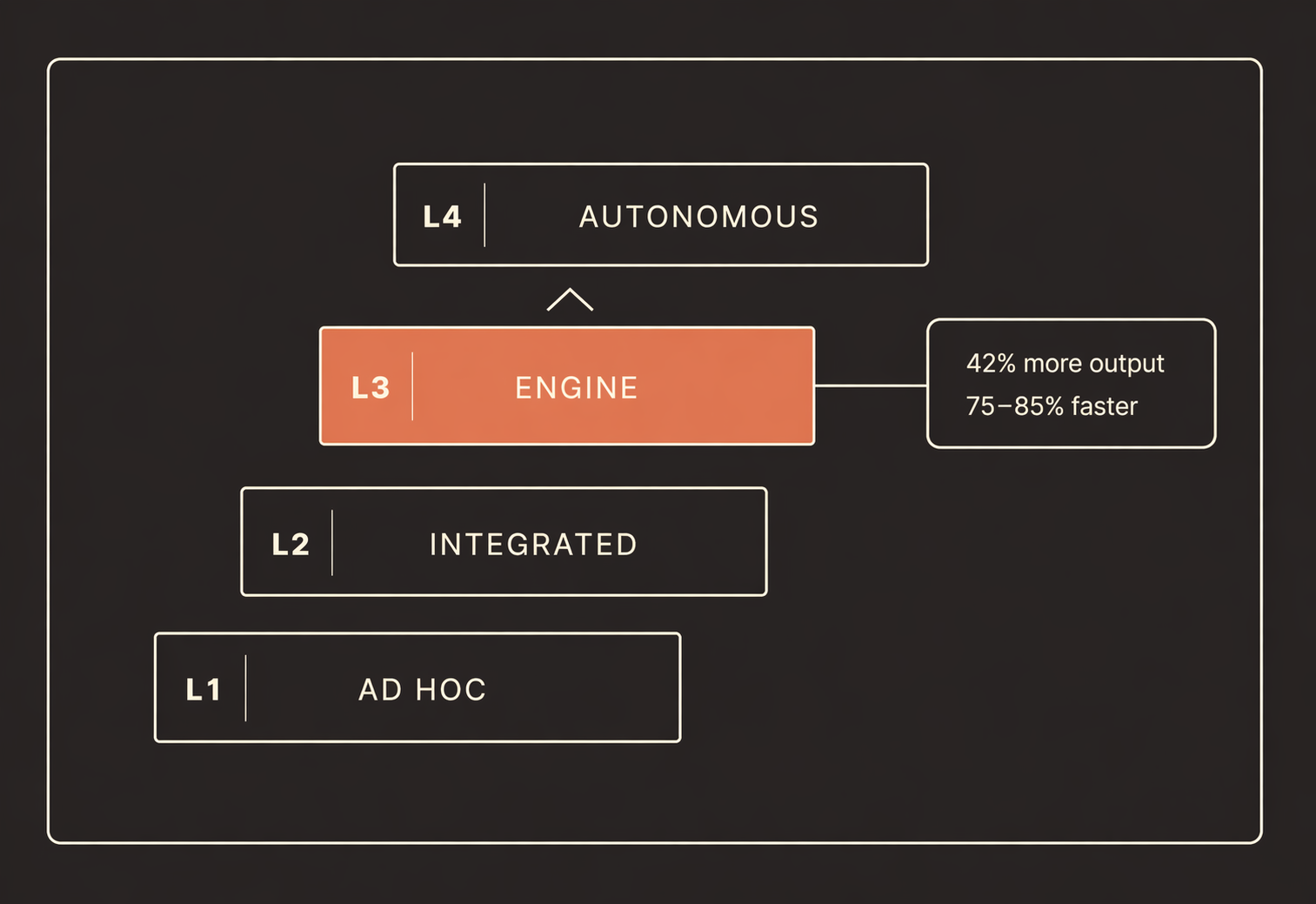
The teams at Level 3 (what we call a purpose-built content engine, where the full workflow runs through connected AI components) are publishing 42% more content monthly than their traditional counterparts, according to the same Averi.ai benchmarks. Per-article production time drops by 75 to 85%, from 8 to 12 hours down to 1.5 to 2.5 hours. And according to Zendesk’s CX Trends 2025 report, which surveyed 10,500 respondents across 22 countries, early AI adopters are 128% more likely to report high ROI from AI investments, with 33% higher customer acquisition, 22% higher retention, and 49% higher cross-sell revenue compared to laggards.
These are not projections. They’re measurements from teams that have already made the move.
Why most teams are still stuck at Level 1
The hesitation rarely comes down to budget or tooling. In our experience at Espressio, the barrier is almost always one of three things.
The first is trust. Teams worry the output won’t sound like them. At Level 1, where the agent has no brand context, that concern is valid. At Level 3, the agent is built on existing content and documented brand guidelines, and editorial review drops to 20 to 30 minutes per piece.
The second is ownership. Someone has to manage the AI layer, and most teams haven’t decided who. The answer is usually simpler than it appears: one person owns the workflow definition, and the rest of the team uses the output.
The third – and the one that catches teams by surprise – is that AI agents replicate processes. Teams without a documented content workflow get limited value from an agent because there’s no sequence for it to follow. Writing down how content currently moves through your team is step one, before automating any part of it.
A maturity model that shows you where to start
At Espressio, we use a four-level framework to help teams locate themselves and identify the next practical step:
Level 1: Ad hoc. Individual contributors using AI tools without a shared process. Time savings of 30 to 60 minutes per piece.
Level 2: Integrated tools. AI in one defined step of a documented workflow. An hour or two saved per piece. This is where most teams plateau.
Level 3: Purpose-built engine. Full workflow connected through AI. Brief in, publish-ready draft out. This is where the 42% output increase and 75 to 85% time reduction show up.
Level 4: Autonomous operation. AI handles the full pipeline. Humans refine strategy, approve output, and own original research and relationship-driven content.
For most three- to five-person marketing teams, Level 3 is the realistic target and the point at which first-mover advantage becomes durable. The window is still open: with only 23% of teams at full integration, the compounding content volume lead that Level 3 teams are building hasn’t yet priced out latecomers – but it’s getting closer each quarter.
Where Espressio comes in
Espressio is the AI systems studio built by the team behind Lunar Strategy – seven years and 300+ marketing clients deep. They automated their own content operations before offering it to anyone else. What they ship for growth teams is the same infrastructure they run internally.
Their core product for content teams is called Content OS – an AI agent that takes a topic in and handles the rest. It monitors competitors, detects trends, drafts to your brand voice, runs a quality gate, and schedules across platforms. Research, writing, and publishing in one connected loop. No manual handoffs between steps.
The takeaway
The competitive gap in AI content operations is real, measurable, and widening. Teams that have crossed into Level 3 are compounding content volume, keyword coverage, and organic authority every month. Teams that haven’t are running the same workflow they used two years ago.
The entry point is one workflow, not a full rebuild. The data on what that transition looks like, and what it produces, is no longer speculative. It’s in the benchmarks. The question now is how long teams wait before acting on it.
About Espressio
Espressio is an AI content agent platform that helps marketing teams build purpose-built content operations at Level 3 and beyond. Our guides, frameworks, and tools are built for teams ready to move from ad hoc AI use to connected, scalable content workflows.
Learn more at espressio.ai.







Comment