
How to Choose a Thermal Gap Pad: Thickness, Conductivity and Hardness

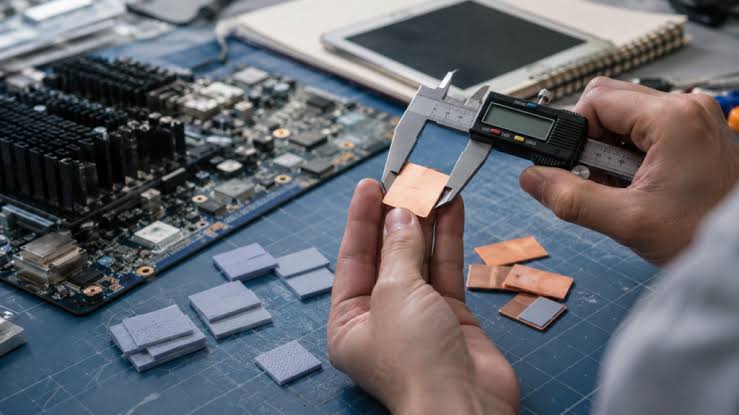
Thermal problems in electronics rarely start with the heat sink. They start in the gap between a hot component and whatever is supposed to carry the heat away. Even surfaces that look flat leave microscopic voids and larger tolerance gaps, and air is a very poor conductor of heat. A thermal gap pad fills that space with a soft, thermally conductive material, usually silicone loaded with ceramic fillers, so heat can flow from the component into a chassis, lid or heat spreader. Choosing the right one is a balance of three properties that pull against each other.
Begin with thickness, because it is set by the mechanical design rather than by preference. Measure the nominal gap between the component and the cooling surface, then add the tolerance stack: component height variation, board warp, standoff tolerances and housing flatness. The pad must be thick enough to touch everywhere across the worst-case gap, yet compressible enough to fit the tightest case without overstressing solder joints. Pads are commonly available from a fraction of a millimeter up to well over ten millimeters, so there is usually a standard thickness close to the design point.
Thermal conductivity is the headline number on every data sheet, expressed in watts per meter-kelvin and typically measured to ASTM D5470. General-purpose pads sit around 1 to 3 W/m·K, while high-performance grades reach 6 W/m·K and beyond, with some specialty materials around 15 W/m·K. Higher conductivity is not automatically better. Thermal resistance across the interface also depends on thickness and on how well the pad wets the surfaces, so a thinner, softer pad of moderate conductivity can outperform a thicker, stiffer premium grade. Compare thermal impedance at your actual thickness and pressure, not conductivity alone.
Hardness is the property most often overlooked. Gap pads are usually rated on the Shore OO scale, and softer materials conform to uneven surfaces at lower pressure. That matters when a pad sits between a delicate BGA package and a sheet-metal shield lid, where too much force can crack solder joints or bow the board. Harder pads hold their shape better and resist tearing during assembly, but need more compression force to make full contact. Ask for compression-versus-deflection data and check it against the clamping force your enclosure or fasteners can really deliver.
Several secondary properties decide whether a pad survives in service. Dielectric strength matters where the pad touches live conductors. Outgassing, often reported as total mass loss under ASTM E595, matters near optics, sensors and sealed modules. A UL 94 V-0 flame rating is often required by safety standards. Operating temperature range, shelf life and fiberglass reinforcement, which improves handling and tear resistance on thinner pads, should also be on the checklist.
Format influences assembly cost as much as performance. Pads are supplied as sheet stock, die-cut to shape, kiss-cut on a liner for fast hand placement, custom molded, or with an adhesive backing that holds the pad in position during assembly. Designs that shield and cool at the same time can also benefit from planning the thermal pad and the shield can together, so the lid becomes part of the heat path.
The most reliable way to choose is to test. Shortlist two or three thermal gap pads that bracket the conductivity and hardness you expect to need, cut them to size, install them in representative hardware and measure component temperatures under the real power profile. Manufacturers such as 3G Shielding Specialties publish complete data sheets across a broad conductivity range and supply evaluation samples, which makes it practical to settle the decision on the bench rather than in the field.






Comment