
How Artificial Intelligence Is Changing the Way We Work and Live

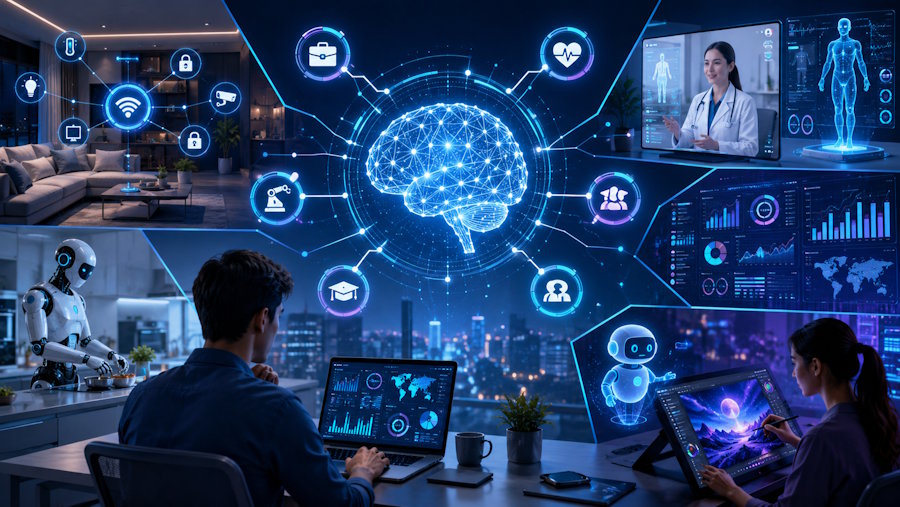
Artificial intelligence has moved from being a futuristic concept to becoming part of everyday life. People interact with AI when they use voice assistants, receive personalized recommendations, search for information, or use software that automatically handles repetitive tasks. Businesses are also adopting AI to improve efficiency, analyze information, and create new products and services.
As the technology continues to develop, its influence is expanding beyond simple automation. AI is increasingly being used to support decision-making, generate content, understand large amounts of information, and help people complete complex tasks more efficiently.
Understanding Modern Artificial Intelligence
Artificial intelligence refers to computer systems designed to perform tasks that traditionally require aspects of human intelligence. These tasks can include understanding language, recognizing patterns, analyzing data, generating content, and making predictions.
Modern AI includes technologies such as machine learning, natural language processing, computer vision, generative AI, and increasingly sophisticated AI agents. Businesses are using these technologies to streamline workflows and improve customer experiences. IBM describes business AI as a way to automate work, optimize operations, support decisions, and create business value.
The rapid development of generative AI has made the technology particularly accessible. Instead of requiring specialist programming knowledge, employees can interact with many AI systems using ordinary language.
AI and Everyday Digital Experiences
One of the most visible effects of AI is the personalization of digital services. Streaming platforms can recommend entertainment based on previous activity, online stores can suggest products, and search systems can organize information according to a user’s interests.
AI is also increasingly present in creative and communication tools. It can help users brainstorm ideas, summarize documents, translate information, generate images, and assist with writing.
Platforms and digital brands such as HeraHaven can exist within this broader technology environment, where AI-powered features and intelligent digital experiences are becoming increasingly important to how users discover, organize, and interact with online content.
How AI Is Changing Business
Businesses are among the biggest adopters of artificial intelligence because even relatively simple AI applications can reduce repetitive work.
Customer service is one example. AI-powered systems can answer common questions, organize customer requests, and direct complicated issues to human employees. In marketing, AI can help analyze audiences, identify trends, and personalize campaigns.
Companies are also using AI for forecasting, cybersecurity, software development, document processing, and internal knowledge management. Deloitte’s 2026 research found that productivity and efficiency remain among the most commonly reported benefits of enterprise AI adoption, while organizations are increasingly exploring more transformative applications.
This shift means that businesses are beginning to think about AI as more than another software tool. Instead, organizations are redesigning workflows around what AI can accomplish.
AI Agents and the Next Stage of Automation
A major development is the emergence of AI agents. Traditional software generally waits for a user to provide instructions for each individual task. AI agents can potentially interpret a broader goal, plan multiple steps, and carry out actions with varying levels of human supervision.
For example, an AI system could receive a business request, gather information, analyze it, prepare a report, and present the results without requiring the employee to manually complete every intermediate step.
Google Cloud has identified AI agents and agentic workflows as major trends in business technology, particularly for automating complex, multi-step processes.
However, automation does not eliminate the need for human judgment. Businesses still need employees to establish objectives, review important decisions, manage exceptions, and ensure that AI-generated results are accurate.
The Importance of Human Skills
The rise of AI does not mean that human skills are becoming irrelevant. In many workplaces, the value of skills such as critical thinking, communication, creativity, leadership, and problem-solving may actually increase.
AI can produce an answer quickly, but people still need to determine whether that answer makes sense. A generated report may contain an inaccurate assumption, while an automated recommendation may overlook an important business consideration.
Microsoft’s 2026 Work Trend Index describes a shift in which AI and agents increasingly take on execution while people retain greater responsibility for directing work, making decisions, and owning outcomes.
This suggests that successful AI adoption is likely to involve collaboration between people and intelligent systems rather than simply replacing one with the other.
Challenges and Risks of AI
The rapid adoption of artificial intelligence also creates significant challenges. Privacy, cybersecurity, misinformation, bias, intellectual property, and inaccurate AI-generated information are among the issues organizations must consider.
Businesses also need to think carefully about how employees use AI tools. Giving workers access to an AI platform does not automatically produce meaningful business results. Companies need appropriate training, data policies, security controls, and clear guidelines.
Recent research from the International Labour Organization also highlights a gap between productivity improvements observed at individual task levels and the broader economic impact of AI adoption. This suggests that simply adding AI tools to existing workflows may not be enough to produce substantial long-term improvements.
Preparing for an AI-Driven Future
Organizations that want to benefit from AI should begin with practical problems rather than adopting technology simply because it is popular.
A company might start by identifying repetitive administrative tasks, customer-service bottlenecks, inefficient data processes, or areas where employees spend significant amounts of time searching for information. AI can then be evaluated according to whether it provides a measurable improvement.
Employees should also receive training so they understand both the capabilities and limitations of AI systems. Establishing human oversight is particularly important when AI is used for financial, legal, medical, security, or other high-impact decisions.
The Future of Artificial Intelligence
AI development is likely to continue affecting industries ranging from finance and healthcare to education, manufacturing, entertainment, and professional services. The most important change may not be the introduction of one particular AI model, but the gradual integration of intelligent systems into everyday workflows.
For consumers, this could mean more personalized and responsive digital experiences. For businesses, it could create opportunities to operate more efficiently, develop new services, and compete in markets that were previously difficult to enter.
At the same time, responsible adoption will remain essential. AI systems need appropriate oversight, reliable data, security measures, and clear accountability.
Conclusion
Artificial intelligence is changing how people interact with technology and how businesses approach everyday work. From content creation and customer service to data analysis and autonomous workflows, AI is becoming increasingly integrated into the digital economy.
The organizations most likely to benefit will not necessarily be those that use the most AI tools. Instead, success will depend on choosing the right applications, preparing employees, protecting data, and combining automation with human judgment.
As AI continues to evolve, its greatest potential may come from helping people accomplish more rather than simply doing more tasks without them. The future of AI will therefore be shaped not only by technological progress, but also by how thoughtfully individuals and organizations choose to use it.







Comment