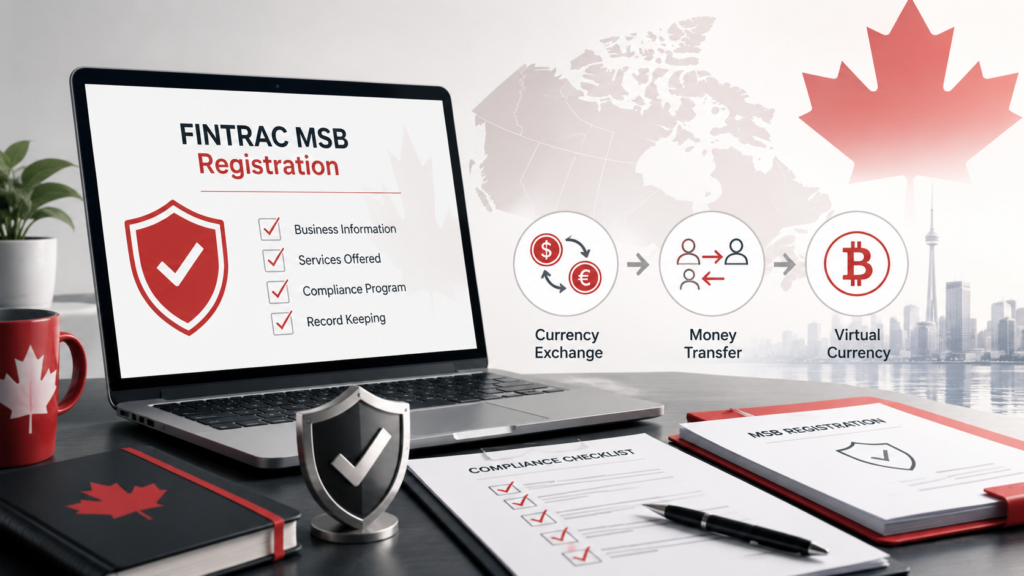
A software company in Mississauga builds a tool that lets landlords collect rent from tenants and pays it out the next day. An import business in Surrey starts swapping U.S. dollars for suppliers who ask. A gaming platform in Montreal lets players cash out in Bitcoin. None of these founders think of themselves as running a money services business. Under Canadian law, all three probably are.
That gap between how a company sees itself and how the regulator sees it is the reason FINTRAC MSB registration trips up so many businesses. The Financial Transactions and Reports Analysis Centre of Canada (FINTRAC) requires money services businesses to register before they handle a single client transaction, and it checks. In 2024–25, FINTRAC ran 294 formal compliance examinations, and money services businesses were the most examined sector (FINTRAC 2024–25 Departmental Results Report).
This guide explains who counts as an MSB, how to register, what the ongoing obligations look like, and what happens when a business gets it wrong.
What counts as a money services business in Canada?
A money services business is any person or company with a place of business in Canada that offers at least one of a defined list of money services. The list is wider than most people expect and has grown several times since 2008, most recently in 2025.
Under the Proceeds of Crime (Money Laundering) and Terrorist Financing Act (PCMLTFA), you meet the definition if you have a place of business in Canada (incorporated here, a physical location here, or employees or agents here) and you’re engaged in any of the following:
- Foreign exchange dealing. Exchanging one currency for another, such as U.S. dollars for Canadian dollars.
- Remitting or transmitting funds. Moving money from one person or business to another by any method, including electronic networks and informal systems such as hawala.
- Issuing or redeeming money orders or traveller’s cheques. This means your own instruments, not selling someone else’s.
- Dealing in virtual currency. Exchanging crypto for cash, cash for crypto, or one coin for another, plus transferring crypto on a client’s behalf.
- Crowdfunding platform services. Running a platform that other people use to raise money.
- Armoured car services. Transporting cash or negotiable instruments.
- Cheque cashing. Cashing cheques for clients in exchange for funds.
- Acquirer services for private ATMs. Connecting non-bank ATMs to a payment card network.
The last three were added on October 1, 2025, and some businesses that have operated for years now need to register for the first time.
The businesses most often caught by surprise
FINTRAC’s guidance singles out two activities that don’t sound like “money services” but are treated as remitting funds:
- Invoice payment services. Acting as a middle party to pay bills such as rent, tuition, payroll, or utilities on behalf of a payer.
- Payment services for goods or services. Sitting between a buyer and a seller, receiving the buyer’s payment instruction, and giving the seller access to the funds.
That description covers many marketplace apps, property-tech platforms, and payroll tools. FINTRAC does carve out a few exceptions: a business that only collects payment for goods it sold itself, a company that only supplies hardware such as a payment terminal, and a business that only receives payments for a payee without passing on payment instructions.
You’re also treated as an MSB if you advertise any of the listed services, hold a permit for them, or report their income as a separate business on your tax return, even without advertising. And if you don’t advertise at all, you’re still an MSB once you offer money transfers in any amount or exchange more than $1,000 of currency in a single transaction (or in linked transactions within 24 hours).
Foreign companies aren’t exempt
A business with no Canadian office can still be a foreign money services business if it directs services at people in Canada and actually serves clients here. Marketing aimed at Canadians, operating a “.ca” domain, listing in a Canadian directory, quoting prices in Canadian dollars, or offering customer support to Canadian users can all count. FINTRAC has used this test against offshore crypto exchanges, as the penalty section below shows.
Who doesn’t need to register?
Two groups are excluded. First, agents: if you deliver money services strictly on behalf of a registered MSB, that MSB carries the registration, not you. Second, other reporting entities such as banks, securities dealers, and casinos that carry out an MSB-type activity as part of the service they’re already regulated for.
Everyday retail transactions don’t count either. A convenience store that accepts a U.S. $100 bill and gives change in Canadian dollars isn’t doing foreign exchange. Selling or cashing another company’s money orders doesn’t make you an issuer.
If your situation is unclear, FINTRAC publishes an online questionnaire to check whether you need to register as a money services business. It’s short, and the answer it gives is the one an examiner will expect you to have reached.
How does FINTRAC MSB registration work?
Registration is free, is done entirely with FINTRAC, and must be complete before you begin operating. A provincial licence, such as Quebec’s MSB permit, doesn’t replace it. The process has three stages.
- Submit the pre-registration form. This is a short web form on FINTRAC’s site requesting to register as an MSB or foreign MSB. A FINTRAC compliance officer reviews it and contacts you.
- Complete the full registration form. FINTRAC sends the form through Canada Post Connect, a secure government messaging portal. You’ll need your bank account details, the name of your appointed compliance officer, ownership information, a list of agents and locations, and criminal record checks for the people who run and control the business. Foreign MSBs must also name a representative for service in Canada.
- Answer clarification requests and wait for confirmation. If FINTRAC needs more information, it sends a clarification request, usually by email. You have 30 days to respond. Missing that window is one of the grounds on which FINTRAC can deny or revoke a registration.
Two practical notes. Whitelist email from the fintrac-canafe.gc.ca and canadapost-postescanada.ca domains so requests don’t land in spam. And keep dated copies of every form you submit; registration isn’t a certificate, so your own records are the proof.
Accounting and compliance firms that handle fintrac msb registration in Canada on behalf of clients tend to run the eligibility check and gather the ownership documents before touching the pre-registration form, because a denied application delays launch far more than a slow one. Certain people and entities are ineligible altogether, including those convicted of money laundering or terrorist financing offences, and FINTRAC checks this during review.
What happens after you’re registered?
Registration is the starting line, not the finish. The obligations below apply from day one.
| Obligation | What it means in practice |
| Renew every two years | File the renewal form before the expiry date. Lapsed registrations show as “Expired” in FINTRAC’s public registry, which banks and payment processors check. |
| Report changes within 30 days | New services, locations, agents, owners, or a new compliance officer must be reported to FINTRAC. A Markham MSB was fined $24,750 in 2025 for missing this alone. |
| Run a compliance program | Appoint a compliance officer, write policies and procedures, document a risk assessment, train staff, and have the program reviewed every two years. |
| Verify client identity | Confirm who your clients are for prescribed transactions and keep the records. |
| File transaction reports | Suspicious transactions, cash or virtual-currency receipts of $10,000 or more, and electronic funds transfers of $10,000 or more. |
| Vet your agents | Since October 1, 2025, MSBs must confirm each agent is eligible and obtain a criminal record check before engaging them, then every two years. Agents engaged before that date must be checked by October 1, 2027. |
FINTRAC’s public registry lists every MSB with a status of Registered, Expired, Ceased, or Revoked. Because counterparties use it for due diligence, a status problem can cost you banking relationships before FINTRAC has issued any penalty at all.
What are the penalties for operating unregistered?
Failure to register is classified as a serious violation, and FINTRAC has been willing to act on it. Three cases show the range:
- Deshi Foreign Exchange Inc., Toronto: a $33,000 penalty in 2023 for a single violation, failing to register as an MSB.
- Binance Holdings Limited: a $6,002,000 penalty in May 2024 for failing to register as a foreign MSB and for unreported large virtual currency transactions.
- Peken Global Limited (KuCoin): a $19,552,000 penalty in 2025, with failure to register as a foreign MSB as the first of three violations. The company argued it wasn’t a foreign MSB; FINTRAC applied the four-part test and disagreed. The penalty is under appeal at the Federal Court.
The ceiling has since moved sharply. Bill C-12, the Strengthening Canada’s Immigration System and Borders Act, received Royal Assent on March 26, 2026. For violations after that date, FINTRAC can apply maximum penalties up to 40 times the previous limits, require mandatory compliance agreements, and issue compliance orders. The law also requires FINTRAC to consider a business’s ability to pay, which matters for smaller operators. FINTRAC is still finalizing the policy that explains how the new amounts will be calculated.
Revocation is the other lever. In March 2026, FINTRAC revoked dozens of MSB registrations in single-day batches, according to the Minister of Finance’s update on anti-money laundering enforcement. A revoked business can’t legally operate, and the status is public.
Frequently asked questions
How much does FINTRAC MSB registration cost?
Nothing. FINTRAC does not charge a registration or renewal fee. The real costs are indirect: building a compliance program, appointing a compliance officer, criminal record checks, and the staff time needed to file reports and maintain records.
How long does registration take?
FINTRAC says it processes requests in the order received and doesn’t publish a standard timeline. Delays usually come from incomplete forms and slow responses to clarification requests, each of which must be answered within 30 days. Starting several months before launch is prudent.
Does a provincial licence replace FINTRAC registration?
No. Provincial licensing, such as Quebec’s permit regime for money services businesses, is separate. FINTRAC states that a provincially licensed MSB must still register federally before operating.
I only move money for my own customers. Am I an MSB?
Usually not, if you only accept payment for goods or services you supplied yourself. You cross the line when you sit between two other parties, receiving payment instructions from a payer and giving a separate payee access to the funds, or when you pay third-party invoices on someone’s behalf.
What happens if my registration expires?
The public registry will show your status as Expired, and you can’t legally provide MSB services until it’s renewed. If you submitted a renewal before the expiry date, you remain registered while