
How IoT and Cloud Software Are Finally Solving Physical Key Access Management


For all the money businesses pour into digital transformation across CRMs, ERPs, analytics platforms, and AI copilots, one of the most stubbornly manual workflows in modern operations has barely changed in fifty years: who has the keys.
Physical access management, the daily handoff of keys, fobs, badges, and codes that lets employees, contractors, drivers, and guests get to vehicles, equipment, properties, and rooms, is still being run on spreadsheets, pegboards, paper logs, and unsecured lockboxes at companies that otherwise consider themselves fully digital. It’s the kind of unsexy operational layer that doesn’t make it into board decks, but it quietly affects productivity, security, customer experience, and unit economics across every industry that manages physical assets.
That’s starting to change. A new category of cloud-based, IoT-connected platforms is doing for physical key access what SaaS did for sales pipelines and what fintech did for payments, replacing analog workflows with real-time data, role-based permissions, API integrations, and remote management.
Why “the way we’ve always done it” is finally breaking
Traditional key management works when you’re small. One office, one shift, one set of keys, one trusted office manager who knows everyone.
It breaks the moment a business scales into anything more complex: multiple locations, mobile teams, shift workers, subcontractors, after-hours operations, fleet vehicles, shared equipment. At that point, every “small” inefficiency in how a key gets from point A to point B compounds.
Operations leaders running businesses at scale consistently report the same pain points:
- Lost or duplicated keys (a single replacement vehicle key fob can cost $200 to $500)
- Driver or contractor downtime waiting on key handoffs
- No audit trail when something goes missing
- Manual coordination eating into manager and admin hours
- Unauthorized access that’s nearly impossible to investigate after the fact
- Difficulty supporting 24/7 or self-service workflows without staffing the front desk
These issues go beyond security problems and create real operational drag, yet until recently there was no serious software built to solve them.
What a modern key management platform actually looks like
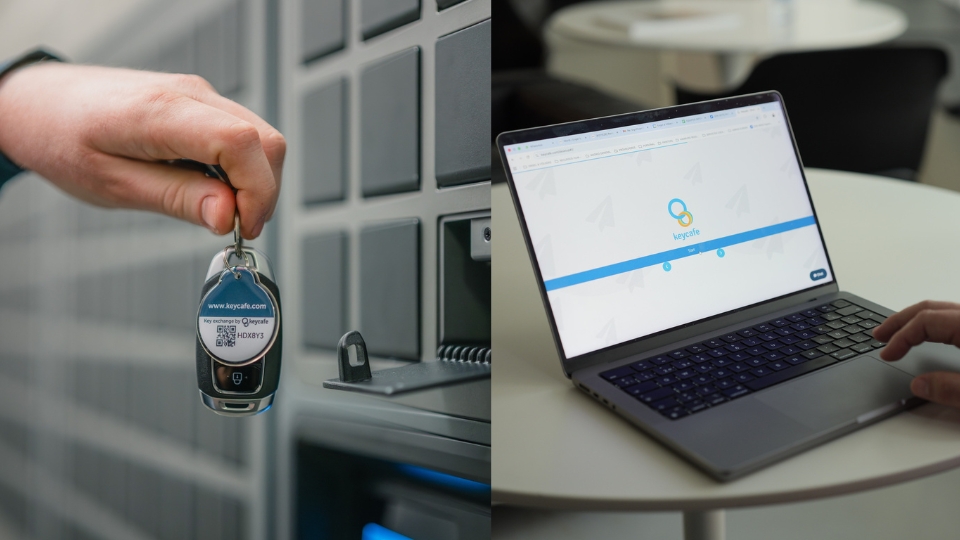
One of the companies built specifically for this category is Keycafe. Founded in 2012 and headquartered in Vancouver, Canada, Keycafe is a cloud-based smart key management platform used by enterprises, small businesses, and government agencies in over 40 countries. The company processes more than 10 million key exchanges per year for customers including Schneider Electric, SERVPRO, Interlane Logistics, and roughly 3,000 others.
The architecture is straightforward and recognisable to anyone familiar with modern SaaS, with smart hardware on the edge, a cloud control plane, and an API layer for integrations:
- Hardware: electronic key lockers (called SmartBoxes, with the newest MS5 model supporting modular 6/9/18-key capacity, a touchscreen UI, built-in camera, and WiFi, Ethernet, or LTE connectivity)
- Software: a web dashboard and mobile app where admins manage users, permissions, schedules, and audit logs in real time
- Authentication: PIN codes, NFC fobs, QR codes, mobile credentials, or existing company NFC cards
- Integrations: an open API plus connectors for Zapier (7,000+ apps), Mews and Hostaway for hospitality, and CRMs for automotive dealerships
The result is that physical keys start behaving like digital assets. Every pickup and drop-off is logged with user, timestamp, and location. Permissions can be granted by email in seconds and revoked instantly. Managers in one city can oversee a dozen sites without ever being on the ground. The same model fintech used to digitise payments and procurement is now being applied to the physical objects that businesses still hand around in person.
Where it’s already changing how industries operate The category isn’t theoretical. It’s deployed.
Fleet and logistics operators use smart key platforms to dispatch vehicles across shifts, eliminate lost fobs, and capture utilisation data that previously didn’t exist.
Transportation companies like Interlane Logistics use Keycafe to cut the time staff spend retrieving keys and improve security across their lots.
Construction and industrial sites use it to give subcontractors time-bound access to equipment, gates, and storage without requiring a supervisor at the gate. Schneider Electric, one of the world’s largest energy technology companies, replaced manual
lockboxes at a manufacturing facility with Keycafe to restrict access to dangerous equipment and generate KPI data on machinery usage.
Auto dealerships use it to keep test-drive and service operations moving. A misplaced key on a busy Saturday can cost a sale.
Hotels, vacation rentals, and property managers use it for self-service guest check-ins, contractor access, and after-hours operations, replacing front-desk overhead with controlled, audited workflows.
The pattern is consistent across industries: the platform pays for itself in recovered hours and reduced downtime well before the security benefits enter the conversation.
A case study in the math
Texas-based solar installation company Dynamic SLR runs vehicles for 200 employees across three regional offices. Before deploying Keycafe, the company was losing keys constantly, tracking handoffs manually, and absorbing the cost of vehicles sitting idle while replacement keys were sourced. Those delays translated directly into pushed-back installs and lost project revenue.
After installing SmartBoxes with role-based access and real-time tracking, Dynamic SLR reported fewer lost keys, faster handoffs between shifts, full visibility into fleet usage, and measurably reduced project delays. The full case study lays out the before-and-after in more detail.
It’s a small, specific example of a broader trend: when you instrument a workflow that was previously invisible, you can manage it. The gains are usually bigger than anyone expected.
The next frontier: operational SaaS meets AI
The shift of physical access to cloud-based platforms is already underway. The more relevant question for operators and investors is what becomes possible once that layer of data actually exists.
When key movements across vehicles, job sites, and facilities are consistently tracked in a structured way, access management starts to look less like a manual operational task and more like a data system. That opens the door to practical use cases like
identifying usage patterns, flagging unusual access behavior, and connecting permissions more directly with systems like HR or identity management.
Over time, this moves physical access closer to how other operational systems have evolved, where basic digitization is followed by automation and, eventually, more intelligent decision-making layers built on top of the data.
In that sense, access management isn’t just becoming more secure or more convenient. It’s becoming part of the broader infrastructure businesses rely on to run operations more efficiently.
Curious how a cloud-based key management system would fit your operation? You can explore the platform, see live customer examples, or request a demo directly from Keycafe‘s site.






Comment