Most conversations about AI infrastructure are still fixated on the wrong layer. Executives ask which model to standardize on, how big a context window they need, and whether to negotiate a better rate on tokens. Those are real decisions, but they’re decisions about the engine, not the vehicle. The part of the stack that actually determines whether an AI investment compounds or plateaus rarely comes up in the boardroom, mostly because it doesn’t have a flashy name yet. Call it what it is: persistent memory infrastructure. Not chat history. Not a bigger prompt. A place where what an agent learns on Tuesday is still true, still findable, and still trusted by a completely different agent the following month. Companies that get this layer right end up with agents that visibly improve quarter over quarter. Companies that skip it end up with agents that are individually impressive and collectively stuck, no matter how much they spend on the model underneath.
This stopped being a retrieval problem a while ago
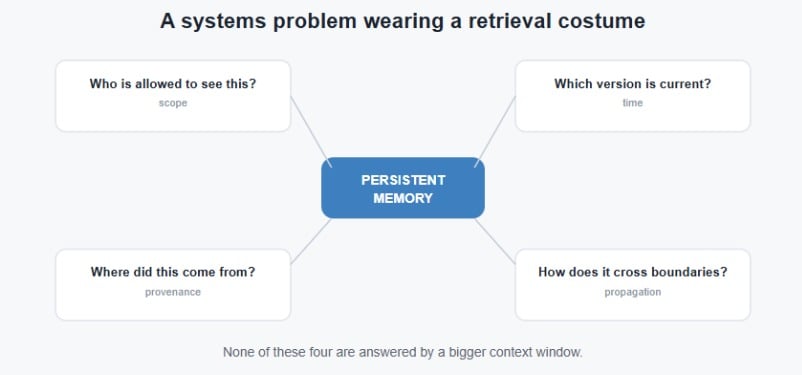
It’s tempting to treat agent memory as a slightly upgraded search feature: store some text, embed it, and pull back whatever’s similar later. That framing worked fine when the whole picture was one user talking to one assistant. It falls apart the moment a company is running a fleet, which by now most serious AI adopters are, whether they call it that or not. Once you have more than one agent reading and writing the same persistent state, the interesting questions stop being about search quality entirely. They become questions any engineer who has built a real distributed system would recognize immediately: Who is allowed to see this particular piece of knowledge? Which version of a fact is the current one? Where did this claim originally come from? And how does something learned inside one team’s agents reach another team’s agents without leaking somewhere it shouldn’t? None of that is a retrieval problem, and a bigger context window doesn’t answer a single part of it.
Agent memory stopped being a retrieval problem. It became a distributed systems problem.
That reframing matters for anyone making infrastructure decisions right now, because it changes what you should actually be evaluating. The question isn’t “Does this memory tool have good search.” It’s closer to “does this behave like a piece of infrastructure I’d trust a database team to sign off on.”
A concrete example, running in production
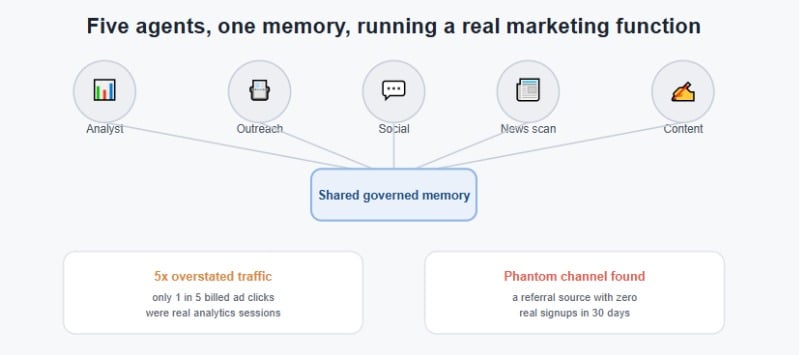
Abstractions are easy to nod along to and hard to actually picture, so it helps to look at a real deployment rather than a diagram. One team building in this space put five agents to work running their own marketing function from end to end: a lead analyst that answers questions across a dozen live data sources, one agent handling outbound and account research, one covering social engagement, one scanning industry news for anything relevant, and one drafting content, with all five sharing a single governed memory instead of five separate, disconnected ones. The interesting part isn’t the org chart; it’s what the shared memory actually caught. At one point the fleet measured that only about a fifth of billed ad clicks were showing up as real analytics sessions, meaning every traffic forecast built on the billed number alone was overstating reality by roughly five times. That’s the kind of correction that used to live in one analyst’s head, get mentioned once in a meeting, and quietly get forgotten by the next planning cycle. Because it was written back into shared memory with the evidence attached, it now automatically caveats every forecast the fleet produces going forward, without anyone having to remember to bring it up again. They also found a referral source that looked productive in the dashboard but had produced zero real signups over an entire month, an artifact of bot traffic rather than genuine interest. Both of those are exactly the kind of institutional knowledge that normally evaporates the moment the person who noticed it moves on to something else. With persistent memory, it just stays true until something changes it.
Why smarter agents are mostly a memory story, not a model story
There’s a habit of assuming that when an AI system gets better at its job over time, it must be because the underlying model improved. In practice that’s rarely what’s happening. The model providers ship updates every few months at most; a well-instrumented agent fleet visibly gets sharper every week. Much of that improvement can come from what the system remembers and how reliably it turns past outcomes into future context, rather than from the model itself changing. Treating agent learning as a memory design problem, alongside a model selection problem, changes how a team should be spending its engineering time. A more capable model with no memory behind it will keep making the same expensive mistake next month that it made this month. A modest model with strong memory can outperform a more capable model that repeatedly starts from zero on tasks where accumulated knowledge matters, because the mistake, once recorded, only gets made once.
Memory isn’t one bucket, and treating it like one is the most common mistake
The other lesson worth pulling into any infrastructure plan is that not all memory behaves the same way. A useful split includes facts, decisions, reusable skills, preferences, working notes, and failures. That last category is often the most valuable because negative knowledge can prevent an agent from repeating an entire branch of wasted exploration. There’s also a useful discipline for writes: a new memory should land as a proposal, checked against what’s already known before other agents rely on it. Without that step, the store can quickly become less trustworthy as conflicting or outdated entries accumulate.
What actually breaks without proper governance, measured rather than assumed
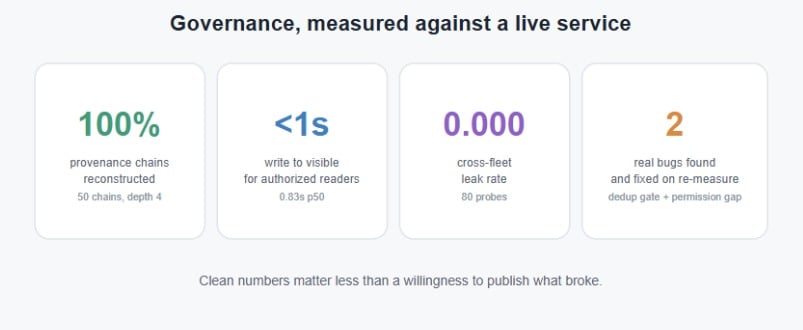
It’s easy to wave at governance as a vague good idea. It’s more convincing to look at what happens when it’s absent, and there’s real measurement behind this rather than just intuition. In our own published evaluation of a production governed-memory system, we identified four specific ways fleet memory fails when governance is missing: an agent retrieving knowledge outside what it should be allowed to see; updates that don’t propagate so one part of the fleet keeps acting on stale information; contradictory facts that both stay retrievable with nothing to resolve which one is current; and memories that can’t be traced back to who wrote them or when, which turns any later audit into guesswork. We then measured our own live service directly against those four failure modes, and the results were mostly reassuring and occasionally humbling in a useful way. Every one of fifty multi-step knowledge chains was reconstructed with the correct originating agent at each step. Median write-to-visible time for a newly written fact was 0.83 seconds under strong-write mode, with the slower end of runs still landing around 1.63 seconds. In the propagation test, none of eighty foreign-fleet probes returned unauthorized data. But the broader evaluation also surfaced two real bugs: an overly aggressive deduplication step was quietly preventing a contradiction detector from ever seeing about half the conflicting writes it should have caught, and a separate authorization gap let a direct lookup-by-id path skip a permission check that a different, more commonly used path enforced correctly. Both were fixed and re-measured. That last part is worth sitting with longer than the clean numbers. Publishing exactly where our own infrastructure fell short, then showing the fix and the re-measurement, is what a serious infrastructure provider does instead of a marketing team. For anyone deciding what to build a fleet on top of, that kind of transparency is a better signal than any benchmark score on its own.
What this means for infrastructure planning right now
If persistent memory is the layer that actually decides whether agent learning compounds, a few practical implications follow for anyone setting AI infrastructure strategy this year. Model choice should stop being the first infrastructure decision. It’s the easiest one to change later and, increasingly, the one that matters least for whether the fleet gets smarter over time. The memory layer underneath is far more expensive to swap out once a fleet has been writing to it for months, so it deserves the scrutiny that usually goes entirely to model selection. Treat memory the way a data team already treats a production database, with real questions about access control, audit trails, and what happens when two systems disagree, rather than as a convenience feature bolted onto whichever agent framework was adopted first. The framework on top, whether that’s one orchestrator or another, should be swappable without resetting what the fleet has already learned. If replacing the orchestration layer means starting memory over from zero, memory was never actually infrastructure in the first place; it was just another cache. And build in the expectation that the system will need to admit what it got wrong. The teams getting real value out of this are the ones treating gaps as a roadmap rather than something to hide, and that mindset needs to be part of how a company evaluates any vendor or internal build in this space, not an afterthought once something breaks in production.
Questions that tend to come up in these planning conversations
Is this really a separate layer, or does a good agent framework already handle it?
Orchestration frameworks are good at sequencing steps within a workflow, not at preserving knowledge across workflows that never talked to each other. Memory needs to sit underneath the orchestrator specifically so that switching frameworks, which most teams do more than once, doesn’t reset what the fleet already knows.
How do we know a memory system is actually production ready and not just a demo?
Look for the same things you’d look for in any serious infrastructure: measured numbers rather than marketing claims, an honest account of where the system has failed and been fixed, audit trails on every read and write, and a clear answer to what happens when two agents disagree about a fact.
Does adding this level of governance slow agents down?
The overhead sits mostly at write time, when a new fact gets checked against what’s already known, not at read time. In well-built systems a freshly written fact becomes retrievable in under a second, and reads stay fast regardless of how much history has accumulated behind them.
What’s the actual business case for investing in this now rather than later?
Every mistake an agent makes and doesn’t record gets paid for again by the next agent that hits the same situation, and that cost is invisible on most dashboards because it never shows up as a single large failure, just a steady tax on every fleet that skips this layer. The earlier a company builds the habit of writing lessons down where the whole fleet can find them, the sooner that tax stops being paid.
Where this is heading
The infrastructure conversation in AI is going to keep shifting away from “which model” and toward “what does our fleet actually remember, and can we trust it?” That’s a healthier conversation to be having, because it’s one a company has real control over, unlike model releases that arrive on someone else’s schedule. There’s a deeper technical walkthrough of exactly how this kind of shared, governed learning loop plays out in practice in this piece on how agent teams share knowledge and learn from each other’s mistakes, worth a read for anyone whose agents currently feel smart in the moment and forgetful a week later. Caura is one option built specifically for this layer, open source under Apache 2.0 with a free tier for teams that want to see the pattern working before committing engineering time to it. Whatever a company ends up building or buying, the underlying principle is the same one that made databases, and before that, written records, worth the trouble in the first place: an organization that remembers what it learns outperforms one that has to relearn it every time. As agent fleets grow, that persistent, governed state becomes more than a memory feature. It becomes infrastructure: a database designed for agents to remember, share, govern, and evolve what they know.