Software projects rarely go exactly as planned. New ideas emerge, regulations evolve, and stakeholders identify additional requirements as development progresses. While change is a natural part of software engineering, managing it becomes significantly more challenging in regulated industries such as healthcare, finance, and life sciences.
For organizations investing in health app development, every new feature has implications beyond development effort. Changes can affect compliance, documentation, validation, security, and release timelines. The goal is not to prevent change altogether, but to ensure it is introduced in a controlled way without compromising quality or regulatory obligations.
Why Scope Creep Is Different in Regulated Projects
Scope creep refers to the gradual expansion of project requirements beyond the original plan without corresponding adjustments to time, budget, or resources.
In a typical software project, an additional feature might simply require extra development and testing. In highly regulated environments, however, even seemingly minor modifications can have much broader consequences.
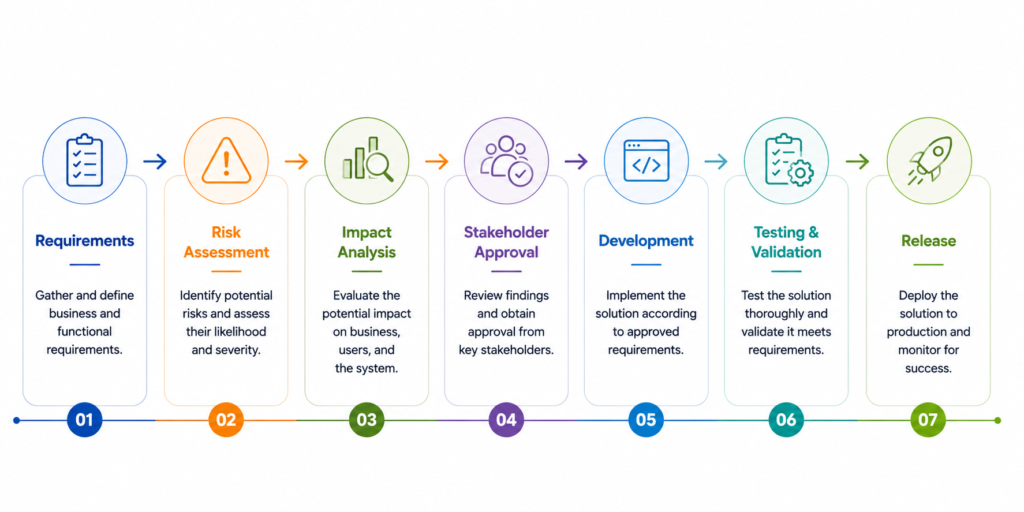
A new workflow may require updated technical documentation, additional quality assurance, security reviews, revised risk assessments, compliance verification, and stakeholder approvals before it can be released. Instead of affecting one team, a single change often impacts multiple disciplines across the entire project lifecycle.
This is why uncontrolled scope changes don’t just threaten deadlines—they can increase operational risk and delay regulatory approval.
Start with Clearly Defined Project Boundaries
The most effective way to minimize unnecessary scope expansion is to establish clear expectations before development begins.
A well-defined project should include:
- Business objectives
- Functional requirements
- Regulatory requirements
- Acceptance criteria
- Success metrics
These elements create a shared understanding between product owners, developers, designers, QA engineers, and compliance specialists.
When everyone agrees on what constitutes project success, evaluating new requests becomes far more objective. Instead of asking, “Can we add this feature?”, teams begin asking, “Does this feature support the project’s goals and justify its impact?”
Having a structured decision-making process helps prevent small requests from gradually turning into significant delivery risks.
Measure Quality Throughout the Development Lifecycle
Quality should never be viewed as the final checkpoint before deployment. In regulated software projects, it must be continuously measured from the earliest stages of development.
Successful engineering teams establish quality metrics that provide visibility into the health of a project long before release.
Common examples include:
- Automated test coverage
- Defect density
- Security vulnerability findings
- Performance benchmarks
- Release stability
- User acceptance criteria
Equally important is maintaining complete traceability between requirements, implementation, testing, and validation activities. This documentation demonstrates that every feature has been properly reviewed and verified an essential expectation for many regulated environments.
By monitoring quality throughout development, teams can identify potential issues early, when they are significantly less expensive to resolve.
Build Change Management into Your Process
Change is inevitable. Business priorities shift, regulations evolve, and real users provide valuable feedback after seeing early versions of a product.
The objective is not to reject every new request but to evaluate each one systematically.
Before approving additional functionality, experienced teams typically consider questions such as:
- Does this change support the original business objectives?
- Will it affect compliance or security requirements?
- What additional validation or testing is required?
- Does documentation need to be updated?
- How will the timeline and budget change?
A formal change management process ensures every request is evaluated consistently rather than being implemented immediately because it appears relatively small.
This disciplined approach reduces project uncertainty while giving stakeholders greater confidence in delivery timelines.
Collaboration Is a Quality Metric
One of the most overlooked contributors to scope creep is poor communication.
Highly regulated software is built by multidisciplinary teams that include developers, QA engineers, designers, product managers, security specialists, compliance experts, and business stakeholders. If these groups operate independently, misunderstandings can quickly become expensive development changes.
Regular cross-functional collaboration allows risks to be identified earlier, requirements to be clarified before implementation, and compliance concerns to be addressed continuously rather than just before release.
In many cases, strong collaboration prevents unnecessary scope expansion more effectively than additional documentation alone.
Conclusion
Scope changes are unavoidable in complex software projects, particularly within regulated industries where business needs and compliance requirements continue to evolve.
The difference between successful projects and delayed ones is rarely the number of changes requested. It is the team’s ability to evaluate those changes through structured governance, measurable quality metrics, and transparent collaboration.
For organizations investing in health app development, effective scope management is not about limiting innovation. It is about ensuring every new feature strengthens the product while preserving quality, compliance, and long-term maintainability.
By combining disciplined project governance with continuous quality monitoring, development teams can deliver reliable digital products that meet both business expectations and regulatory standards.