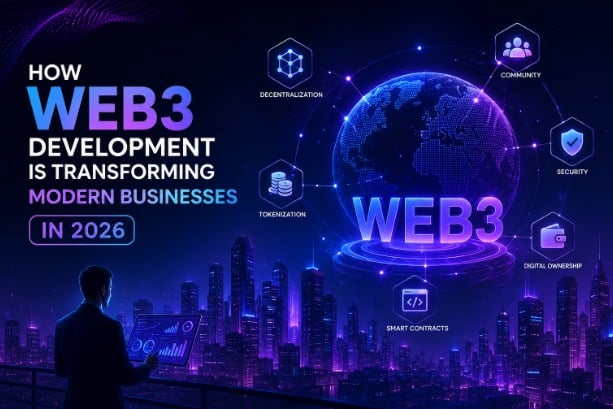
The internet is kind of entering another phase of transformation . While Web2 was building digital businesses on top of centralized platforms, and data ownership, Web3 is bringing this more decentralized way of thinking about applications, transactions, identity, and digital assets. In 2026, businesses are looking at Web3 more and more not just as a cryptocurrency kind of trend , but as a real technology tool for boosting transparency, ownership, automation , and user engagement.
From financial services and gaming, to supply chains, real estate, and entertainment, organizations are experimenting with blockchain driven solutions to tackle practical business problems. And as the technology keeps maturing, working with a seasoned Web3 Development company can help businesses spot where decentralized technologies can actually deliver clear value , rather than adopting them only because they are popular right now.
What Is Web3 Development?
Web3 development is basically about building decentralized applications, platforms, and digital ecosystems, using blockchain , smart contracts, decentralized identity, digital wallets, and tokenization.
Unlike many traditional apps that usually lean on centralized databases and middlemen , Web3 applications can rely on distributed networks to confirm transactions and keep records consistent. Smart contracts can also handle predefined business rules automatically, without needing someone to step in every time a transaction happens.
This whole approach gives companies new ways to create digital products , where ownership, verification, and transaction history can be expressed through shared infrastructure.
1. Redefining Digital Ownership
One of the most significant changes people talk about with Web3 is this idea of verifiable digital ownership. In the traditional world, digital platforms usually end up deciding how digital assets are stored, moved, or actually used. With Web3, blockchain technology lets a business express ownership through tokens that get written to decentralized networks , and then everyone can check it.
That part can be kinda handy for digital collectibles, membership access, gaming resources, intellectual property, event tickets, plus tokenized real-world assets too. For businesses it can open up fresh revenue models, while also giving users more say, about what they obtain.
2. Improving Transparency and Trust
Most businesses rely on several parties just to keep information consistent and validated. But that whole setup can lead to discrepancies, arguments, and yep, delays. Blockchain adds a shared transaction ledger, so the participating sides can independently confirm what happened. And once data is recorded following the network’s own rules, going back to rewrite history becomes way more difficult.
Because of that, Web3 tends to fit really well in sectors where trust plus traceability matter. Things like supply chains, financial services, healthcare, and real estate can use blockchain based systems to boost visibility across transactions and day to day processes.
3. Automating Business Processes With Smart Contracts
Smart contracts are programmable agreements, they execute predefined actions when certain conditions are met. In practice they can cut down the need for manual checks, and also reduce repetitive administrative hassle.
For instance, a company might use a smart contract to release payment once it receives verified delivery confirmation, and not before, right. In a similar vein, tokenized assets can include rules for transfers or access directly inside their digital framework, so yeah the “logic” is there from the start.
When business logic gets automated like this, organizations may lower processing time and end up with more predictable workflows, even if different teams are involved.
4. Creating New Financial Opportunities
Web3 is also shifting the way businesses think about digital payments and other financial services. Blockchain networks can enable digital asset movements across borders, without being forced to depend entirely on traditional financial infrastructure.
Stablecoins tend to matter a lot for businesses that are looking for quicker settlement. They can back international payments, treasury operations, and digital commerce when the applicable regulatory boundaries are in place.
At the same time, financial institutions are exploring tokenized deposits, real-world assets, decentralized finance infrastructure, and blockchain-based settlement systems too.
5. Transforming Customer Engagement
Web3 can help businesses go past typical loyalty programs. Instead of points that stay trapped inside one company’s ecosystem, organizations may issue token-based memberships and rewards with programmable utility, sort of flexible but still controlled.
Customers could receive digital assets for purchases, participation, referrals, or community activities. Those assets can potentially unlock exclusive content, services, discounts, or even experiences that feel more personalized than usual.
So there is a clear chance to turn passive customers into active participants within a brand ecosystem, and not just observers who wait for emails.
6. Strengthening Digital Identity
Identity management still feels like a big issue across pretty much every digital platform. People tend to keep separate accounts and credentials for each service, even when it’s the same person, and businesses are basically stuck needing a dependable way to verify who’s actually behind those requests, right.
Then Web3 comes in with decentralized identity, plus verifiable credentials. In theory this stuff lets users share information that’s already been checked without constantly going back to centralized identity databases, or, well, without having to ask them every time.
For organizations, that can translate into practical support for customer verification, professional credentials, memberships, access control, and compliance workflows… you know the usual list, but with fewer moving parts.
7. Opening New Opportunities in Gaming and Entertainment
Gaming and entertainment are two of the areas where Web3 ideas get a lot of spotlight. Blockchain can enable digital ownership for in game assets, collectibles, memberships, and other kinds of virtual goods.
Instead of treating these items like something you can just toss after one session inside a single platform, developers can build wider ecosystems where ownership gets logged independently on blockchain networks.
Entertainment companies can also experiment with tokenized fan engagement, digital collectibles, creator driven economies, and experiences that are more community led than fully scripted.
8. Supporting Tokenization of Real-World Assets
Tokenization is starting to look like one of the most workable Web3 use cases for businesses. It’s about mapping ownership, or rights, tied to real world assets into blockchain based tokens.
Some examples are real estate, financial instruments, commodities, artwork, and private assets. Tokenization may help create smoother and more traceable ways to track ownership and handle transfers, as long as it stays consistent with relevant laws and regulations.
So for businesses, this could reduce friction in asset markets that used to be fragmented, and it could make those markets more programmable, in a sense.
9. Reducing Dependence on Intermediaries
Lots of old school business routines need a bunch of middle links to get things moving, and to coordinate the transaction, basically. Sure these intermediaries may bring real help, but they can also end up adding costs, longer processing times, and a bit more operational messiness than expected.
Web3 apps can automate some of the checking steps and transaction handling by leaning on blockchain networks plus smart contracts. But, here’s the thing, decentralization isn’t some magical “swap out every intermediary” button. Companies still should look closely, like is removing or dialing down the middle involvement actually making things more efficient, cheaper, safer, or better for customers.
10. Building Web3 Solutions for Business Growth
To pull off Web3 in a practical way, it’s not enough to just mint a token, or throw together a decentralized application and call it done. Organizations need a clear use case and the right blockchain infrastructure. They also have to keep strong security habits, stay aware of regulatory realities, and build a sensible adoption plan, step by step.
This is usually where seasoned web3 development companies come in. They can add value through blockchain consulting, smart contract engineering, decentralized application development, wallet integration, tokenization, Web3 APIs and also by connecting everything to existing enterprise systems, without making a huge mess.
Most of the really solid Web3 efforts start from a business issue first, not from the tech side.
What Businesses Should Consider Before Adopting Web3
Even with its possible upside, Web3 still has a handful of headaches . Blockchain networks can hit scalability limitations, higher transaction costs, regulatory uncertainty and security risks , plus the whole user-experience barrier thing.
So businesses should basically take a step back and ask, a bit more plainly:
– what exact problem Web3 is supposed to tackle
– if decentralization really brings a clear advantage, or if it’s just a nice idea
– whether the chosen blockchain network fits the job at hand
– how solid the smart contract security really is
– what regulatory and compliance requirements might apply
– how well it can integrate with existing systems
– whether real people will adopt it, and if the onboarding is accessible enough
– what long-term maintenance and scalability look like
A practical strategy is to start with one narrow use case, track the business impact , then roll out more broadly only after the approach has proven it works.
Conclusion
Web3 development is kind of moving past speculation, and it’s turning into a practical technology thing for modern businesses. I mean it’s capabilities around digital ownership transparency, automation tokenization identity, and those decentralized transactions are opening up new ways of doing things across different industries.
Still, for it to actually work, adoption hinges on nailing real business problems not just chasing the hottest tech trend. The companies that treat Web3 in a strategic way can lean on decentralized technologies to make processes feel more transparent, deliver more inventive customer experiences, and even spin up new digital business models that weren’t really possible before.
And as blockchain infrastructure keeps maturing through 2026, Web3 will probably shift from experimentation toward specific business applications. Organizations that spot the right openings early can lay down a solid base for the next generation of digital commerce, you know before everyone else.