Tree risk assessment has always depended on the trained eye of an arborist. For decades, professionals relied on visual inspection, experience, and intuition to judge whether a tree posed a hazard to people or property. But trees are complex living systems, and many of the most serious risks internal decay, root instability, and hidden cavities are invisible from the outside. By the time symptoms become obvious, the tree may already be dangerously compromised.
That is changing. A new generation of technology is giving arborists tools that see beneath the bark, monitor movement in real time, and analyze risk with machine learning. Artificial intelligence, sonic tomography, smart sensors, and aerial drones are not replacing the arborist. They are extending what the arborist can perceive and quantify. The result is faster, more accurate, and more repeatable tree risk assessments that protect both public safety and the trees themselves.
Why Traditional Tree Risk Assessment Has Limits
Even experienced arborists face a fundamental challenge: most of the parameters used to assess tree risk cannot be precisely measured. Wind load, crown density, root stability, and internal decay are all estimated visually. Two qualified assessors can examine the same tree and reach different conclusions. A 2022 study in the journal Arboriculture & Urban Forestry found that even among trained industry professionals, there is significant variation in how likelihood of failure, impact, and consequences are rated.
The problem is compounded by rarity. Tree failures that cause injury or damage are uncommon, so most assessors, especially early in their careers, rarely see the aftermath of their own assessments. Without feedback, intuition develops slowly. Novice assessors often learn from a small number of experienced peers, passing down judgment patterns that may or may not reflect the full range of risk factors.
Traditional tools have helped. The resistograph, a micro-drill that measures wood resistance, can detect internal decay. The sonic tomograph uses sound waves to map cavities and compromised wood. But these tools require specialized training, physical access to the tree, and time. They are powerful but not scalable. On a large property or municipal tree inventory, inspecting every tree with advanced diagnostics is impractical.
How Machine Learning Is Changing Tree Risk Assessment
Machine learning is addressing the scalability problem. In a 2024 study published in Urban Forestry & Urban Greening, researchers developed a machine learning-based protocol to support visual tree assessment on a university campus. Using decision tree analysis, the study identified nine variables statistically associated with tree risk rating and reduced them to a seven-variable protocol that classified high-risk trees with significantly improved accuracy. The model handled complex, non-linear relationships between variables, something traditional assessment methods struggle to capture.
Machine learning models offer several advantages for tree risk assessment. They can process large datasets to identify patterns invisible to human observers. They improve continuously as more data is added. And they standardize decision-making, reducing the variability that plagues human assessment. Artificial neural networks, heterogeneous neural networks, and decision tree algorithms have all been applied to predict tree failure hazard, model tree health, and identify which trees pose the greatest risk.
The key insight is that machine learning does not replace the arborist. It supports the arborist by handling data complexity and flagging trees that warrant closer inspection. A predictive model might analyze thousands of trees in a municipal inventory and prioritize 50 for detailed assessment. Those 50 trees then receive the full attention of a certified arborist with advanced diagnostic tools. The technology makes the human expert more efficient, not obsolete.
How AI Decision Support Systems Standardize Arborist Judgment
Beyond predictive modeling, artificial intelligence is being used to build decision support systems that guide arborists through the assessment process. In a 2022 research article in Arboriculture & Urban Forestry, researchers tested a commercial AI system that uses dynamic logic and fuzzy set theory to evaluate tree risk. The software collects data during a basic visual assessment and provides an estimate of risk level, along with plain-language explanations for its conclusion. The system is designed as “white AI,” meaning its reasoning is transparent and comprehensible rather than hidden inside a neural network. Arborists can examine the AI’s estimate, compare it with their own judgment, and feed their assessment back into the system to further train it.
The value of such systems is threefold. They collect expert knowledge and make it available to a wider range of users. They focus the assessor’s attention on factors that might otherwise be overlooked. And they help standardize decision-making across different assessors, organizations, and regions. For municipal tree managers overseeing thousands of trees across multiple jurisdictions, standardization is not a luxury. It is a necessity.
The researchers note that the system must learn from qualified experts, not novices, to avoid diluting its knowledge base. This raises an important point: AI in tree risk assessment is a tool for amplifying expertise, not bypassing it. The arborist’s judgment remains central. The technology simply makes that judgment more consistent, more shareable, and more scalable.
What Certified Arborists See When Technology Meets the Field
For working arborists, the integration of technology into tree care is not theoretical. It is happening on job sites every day. Advanced diagnostic tools are changing how professionals evaluate tree health, make removal decisions, and communicate risk to property owners. But the tools are only as good as the person interpreting them.
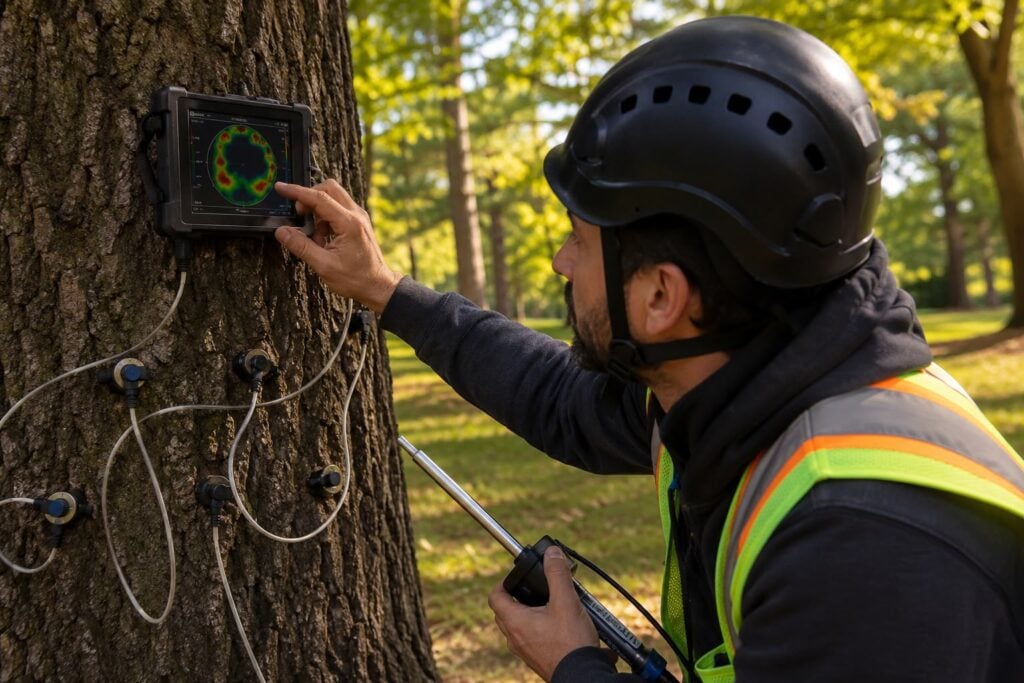
“We use technology on almost every complex job now,” said Lorenzo Sanchez Perez, founder of Golden Roots Tree Care, an ISA Certified Arborist serving in the Sacramento area. “The sonic tomograph lets us see inside a trunk without cutting it open. We can map decay, measure the residual wall thickness, and determine whether a tree can be saved with crown restoration or needs to be removed for safety. But the machine gives us data, not decisions. An experienced arborist still has to interpret what that decay means for the tree’s structural integrity, consider the species and the site conditions, and explain the options to the property owner. Technology gives us better information. It does not replace the judgment we have developed over years of climbing, pruning, and inspecting trees. The best assessments happen when the tools and the arborist work together.”
Sanchez Perez notes that technology has also improved client communication. When a property owner can see a color-coded tomogram showing internal decay, or a drone image revealing crown dieback that is invisible from the ground, the recommendation for removal or treatment becomes easier to understand and accept. Transparency builds trust. And trust is essential when the decision involves removing a mature tree that has been part of a landscape for decades.
Smart Sensors and Real-Time Monitoring
The next frontier in tree risk assessment is continuous monitoring. Rather than inspecting a tree once a year or once a decade, smart sensors can track tree stability in real time. The Hong Kong Development Bureau has launched a Jockey Club Smart City Tree Management Project that installs sensors on urban trees to monitor tilting angles and swaying patterns. Data is transmitted wirelessly to a central data center for big data analytics. If a tree’s tilt exceeds a safety threshold, the system sends an immediate alert to tree management personnel, who can dispatch an arborist for emergency inspection or mitigation. The pilot scheme involves 8,000 sensors installed on selected urban trees and stonewall trees across Hong Kong Island and Kowloon.
This approach represents a shift from reactive to proactive tree management. Instead of discovering a hazardous tree after a storm or a failure, managers receive early warnings that allow intervention before the risk becomes critical. The sensors are particularly valuable for trees in high-traffic areas along sidewalks, near buildings, and in parks where failure would pose the greatest danger to people and property.
Real-time monitoring also generates long-term datasets that improve our understanding of tree biomechanics. How do different species respond to wind loading? What soil conditions correlate with root failure? How does crown architecture affect stability? The answers to these questions have traditionally been based on limited observations. Smart sensors make it possible to study them at scale, across hundreds or thousands of trees, over years or decades.
Sonic Tomography and Internal Decay Detection
While AI and sensors monitor external stability, sonic tomography addresses the hidden threat inside the trunk. Sonic tomographs use sound waves to create cross-sectional images of a tree’s internal structure. Sensors are placed around the trunk circumference and tapped sequentially. Sound travels faster through solid wood and slower through decayed or hollow areas. The software compiles the travel times into a color-coded image showing the location and extent of internal decay. Research published in Applications in Plant Sciences found that sonic tomography provides an efficient, noninvasive approach to evaluate decay patterns and structural integrity, with accuracy within approximately 5 percent of visual estimates from cross sections.
Sonic tomography is especially valuable for large, historic, or high-value trees where preservation is a priority. A tree with a hollow center may still have sufficient sound wood around the cavity to remain structurally sound. The tomograph quantifies how much sound wood remains the “residual wall,” allowing arborists to make precise, evidence-based decisions about cabling, pruning, or removal. Without this technology, the same tree might be removed unnecessarily or retained dangerously.
The resistograph complements tomography by providing pinpoint accuracy. A micro-drill with a 1.5-millimeter bit measures wood resistance as it penetrates the trunk, producing a graph that shows exactly where decay begins and ends. While tomography gives the broad picture, the resistograph confirms specific points. Together, they form a comprehensive internal assessment toolkit that was unavailable to arborists just a few decades ago.
A Practical Framework for Technology-Enhanced Tree Care
For property owners, municipalities, and tree care professionals looking to integrate technology into their risk management programs, the following framework provides a practical starting point:
- Begin with visual tree assessment. Technology enhances but does not replace the foundational skills of a trained arborist. Every assessment should start with a thorough ground-level inspection of the crown, trunk, roots, and site conditions.
- Use machine learning and GIS for large inventories. Municipalities and large properties should consider predictive models that prioritize trees for detailed inspection based on species, age, location, and historical data.
- Apply sonic tomography and resistography for high-value or suspect trees. When visual inspection reveals potential internal decay, or when a tree’s failure would have severe consequences, advanced diagnostics provide the data needed for informed decisions.
- Consider smart sensors for high-risk locations. Trees near sidewalks, buildings, or high-traffic areas benefit from continuous monitoring that can detect movement or tilting before failure occurs.
- Use drone imagery for canopy assessment. Aerial views reveal crown dieback, structural defects, and storm damage that are invisible from the ground. Drones also reduce the need for climbers to access dangerous canopies.
- Document and track assessments over time. Technology generates data that should be stored, analyzed, and used to track tree condition trends. A tree that shows progressive decay over three assessments is a different risk than one with stable readings.
- Ensure certified arborist oversight. All technology should be operated and interpreted by ISA-certified arborists with training in the specific tools being used. Data without expertise is incomplete.
- Communicate findings clearly to property owners. Visual outputs from tomography, drones, and sensors help clients understand risk and accept recommendations. Transparency builds trust and supports better decision-making.
The Bottom Line: Technology Extends the Arborist’s Reach
Tree risk assessment is entering a new era. Artificial intelligence, machine learning, smart sensors, and advanced diagnostics are giving arborists capabilities that were unimaginable a generation ago. Trees can be monitored continuously, inspected internally without damage, and analyzed with algorithms that detect patterns beyond human perception.
But the core of tree care remains unchanged. A tree is a living organism, and its risk depends on species, site, weather, soil, history, and biological factors that no algorithm fully captures. The arborist’s judgment, developed through years of field experience, remains the critical element. Technology does not replace that judgment. It extends it.
The professionals who thrive in this new landscape will be the ones who embrace technology as a tool while maintaining the deep knowledge of tree biology that makes arboriculture a profession, not just a trade. For property owners and municipalities, the message is clear: the most reliable tree risk assessments come from certified arborists who combine modern technology with time-tested expertise.
Frequently Asked Questions About Tree Risk Assessment Technology
How is AI used in tree risk assessment?
AI is used to build decision support systems that guide arborists through risk evaluations, standardize judgment across assessors, and analyze large datasets to identify patterns. Machine learning models can also predict tree failure risk by processing variables like species, size, location, and visible defects.
What is sonic tomography in tree care?
Sonic tomography is a noninvasive diagnostic tool that uses sound waves to create cross-sectional images of a tree’s internal structure. It detects decay, cavities, and cracks by measuring how fast sound travels through the wood. Sound moves faster through solid wood and slower through compromised areas.
What is a resistograph and how does it work?
A resistograph is a micro-drilling device with a 1.5-millimeter bit that measures wood resistance as it penetrates the trunk. The resulting graph shows variations in wood density, revealing the exact depth and location of decay, cavities, or cracks.
Can smart sensors predict when a tree will fall?
Smart sensors monitor tree tilting, swaying, and movement in real time. If a tree’s tilt exceeds a safety threshold, the system sends an alert. While sensors cannot predict failure with certainty, they provide early warnings that allow arborists to intervene before a tree becomes critically unstable.
Do drones help with tree risk assessment?
Yes. Drones provide aerial views of tree crowns, revealing dieback, structural defects, and storm damage that are invisible from the ground. They improve assessment accuracy and reduce the need for climbers to access dangerous canopies.
Does technology replace the need for a certified arborist?
No. Technology provides data and analysis, but interpreting that data requires arboricultural expertise. Certified arborists understand tree biology, species behavior, site conditions, and structural mechanics. The best assessments combine technology with professional judgment.
How accurate is sonic tomography?
Research shows sonic tomography is generally accurate within approximately 5 percent of visual estimates from actual cross sections. It is especially effective for detecting and mapping decay patterns in regularly shaped trunks.
What is machine learning’s role in tree inventories?
Machine learning can analyze large tree inventories to identify which trees are most likely to fail, prioritize inspection schedules, and reduce the time and cost of managing urban forests. It helps arborists focus their attention on the trees that need it most.