TL;DR
- A WVTR test quantifies the steady-state rate at which water vapor permeates a packaging barrier over a specific time and surface area.
- Moisture migration directly influences the water activity (aw) of food products, dictating shelf life, microbial stability, and texture.
- ASTM F1249 utilizes an infrared sensor method, offering rapid, highly sensitive data for advanced high-barrier laminates.
- The physical integrity of the final package (seals, folds, and creases) often yields a higher water vapor permeability rate than the isolated flat film.
- High-precision testing aims to manage edge leakage anomalies by ensuring a hermetic seal within the testing chamber.
What is a WVTR test? A WVTR test (Water Vapor Transmission Rate test) is an analytical process that quantifies the mass of moisture passing through a barrier material over a specific period.
Conducting water vapor transmission rate testing is critical for the food industry because atmospheric moisture transfer directly degrades product stability. Moisture ingress (gaining water) is associated with the loss of crispness in snacks and the clumping of dry powders.
Conversely, moisture egress (losing water) compromises the soft texture of baked goods. Managing this mass transport is the primary function of advanced packaging engineering.
How Does Water Vapor Permeability Affect Different Food Categories?
The barrier properties of packaging materials must align with the specific biochemical sensitivities of the enclosed food. This relationship governs three primary food categories:
- High-Fat Foods and Oxidative Rancidity: Foods with high lipid content (like potato chips or nuts) are highly susceptible to lipid oxidation, a chemical reaction that causes rancidity. While oxygen is the primary catalyst, elevated moisture levels accelerate the reaction rate. A low-WVTR barrier is required to maintain a dry internal micro-environment, which aims to manage the rate of oxidation.
- Modified Atmosphere Packaging (MAP): MAP involves replacing internal oxygen with specific ratios of nitrogen or carbon dioxide to inhibit mold growth and enzymatic browning. If a package has high water vapor permeability, the fluctuating moisture levels can alter the gas solubility within the package, destabilizing the carefully engineered atmosphere.
- Temperature Acceleration and Climatic Stress: Moisture transport is heavily influenced by ambient temperature. According to the Arrhenius equation, the permeability rate constant (k) increases exponentially as temperature rises. Therefore, food products exported to tropical climates demand barrier materials with significantly higher specifications to withstand elevated heat and humidity.
What Are the Critical Standards for Water Vapor Transmission Rate Testing?
Testing facilities must adhere to strict international frameworks to validate the barrier properties of packaging materials. Relying on subjective or uncalibrated testing exposes manufacturers to severe regulatory risks.
- ASTM F1249 (Infrared Sensor Method): This is the industry standard for high-barrier materials. A dry carrier gas sweeps permeated water vapor from the test film to a modulated infrared sensor. This method is highly objective, significantly faster than traditional methods, and offers extreme sensitivity for modern polymers.
- ASTM E96 (Gravimetric Method): Often referred to as the “cup method,” this approach measures the weight gain or loss of a test dish containing either a desiccant or water. While highly accurate and fundamental, the extended testing duration makes it less practical for ultra-high barrier films, prompting a shift toward automated sensor-based systems.
- Global Compliance (ISO 15106-2 and GB/T 26253): For international food export, compliance often requires adherence to ISO 15106-2 (infrared detection) or equivalent regional standards like China’s GB/T 26253. Utilizing instrumentation that cross-complies with these standards ensures seamless global market access.
How to Evaluate the Barrier Properties of Packaging Materials?
Evaluating the barrier properties of packaging materials requires assessing both the isolated flat film and the final three-dimensional package. Comprehensive mvtr testing must account for structural stress, multilayer composition, and the integrity of the physical seal to prevent testing anomalies like edge leakage.
- Film Permeability vs. Package Integrity: A pristine, flat sheet of film will almost always yield a lower WVTR than the finished package. The mechanical stress of forming, folding, and heat-sealing creates microscopic fractures in the barrier. Testing the final, three-dimensional package is necessary to acquire accurate shelf-life data.
- Multilayer Laminates: Modern food pouches achieve ultra-low permeation by combining disparate materials. A laminate might utilize a structural layer (PET), a moisture barrier (metallized aluminum or AlOx), and a gas barrier (EVOH). Testing must verify that these layers remain intact post-lamination.
- Managing “Edge Leakage”: A common error in mvtr testing occurs when ambient moisture bypasses the test film and enters the sensor chamber through the edge of the sample mount. Securing a perfect hermetic seal using precision-machined testing cells and standardized sealing greases is mandatory to ensure the data reflects only the moisture permeating through the material, not around it.
Labthink WVTR Testers for Your Lab Challenges
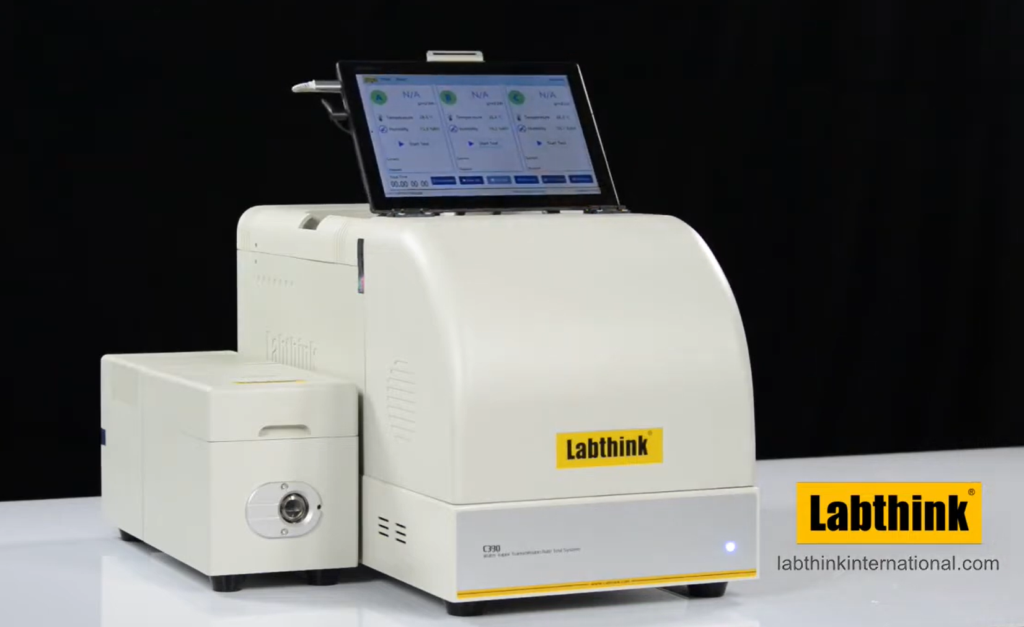
Laboratory environments require instruments that accommodate varying sample geometries and high testing volumes. Labthink WVTR testers integrate multi-station architectures and precision environmental controls to provide stable, objective permeability data for both flat films and finished packaging containers. The WVTR testing solution features:
- Testing Three-Dimensional Geometries: Flat film data rarely represents final package integrity; in that way, quality assurance teams must evaluate the finished product. Labthink systems utilize customized test fixtures designed to secure complex shapes, including fully formed pouches, medical bottles, and rigid bowls. This capability allows technicians to measure the exact moisture transmission rate across actual heat seals, closures, and folded edges.
- Sensor Modalities for Specific Barrier Ranges: Different materials require specific detection sensitivities to comply with international standards. The Labthink portfolio provides Gravimetric (cup), Infrared, and Electrolytic sensor options. This allows facilities to match the precise sensor technology to the material being tested, from standard breathable films to ultra-high-barrier metallized laminates.
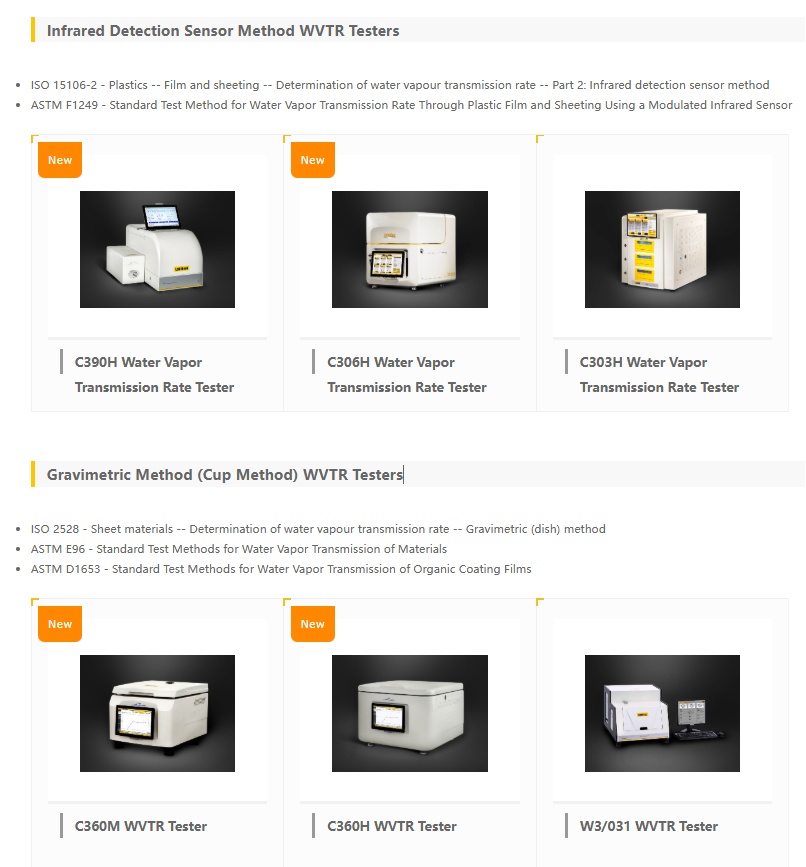
- Multi-Station Throughput: Managing a high volume of quality control samples requires efficiency. Many Labthink instruments feature three to six independent testing cells within a single unit. This architecture allows operators to run concurrent tests on distinct specimens, which aims to manage high-throughput demands while maintaining individual data traceability.
- Automated Environmental Stability: Moisture permeability is highly sensitive to ambient fluctuations. Rather than relying on external climate rooms, these testers feature automated, closed-loop temperature and humidity controls integrated directly into the testing chambers. Maintaining exact climatic conditions (e.g., 38°C and 90% RH) with zero manual intervention is associated with highly stable data generation, supporting strict compliance with GMP and FDA auditing standards.
【Contact Labthink for Advanced Package Testing Solution】