
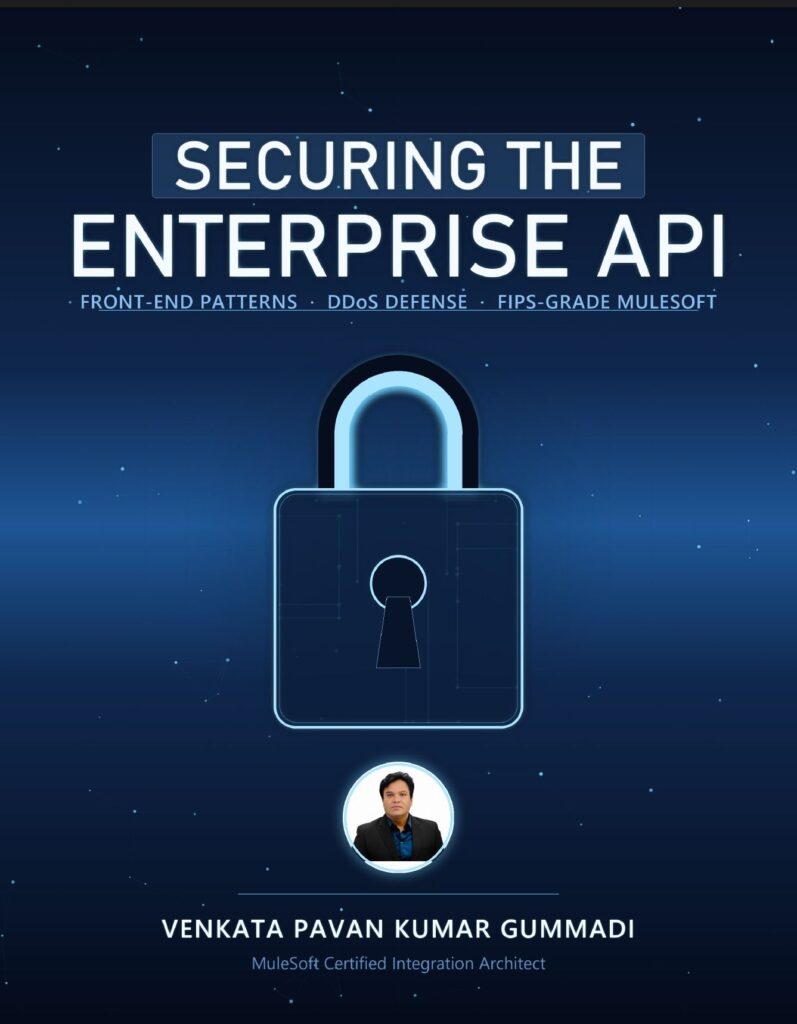
New Book by Venkata Pavan Kumar Gummadi: Securing the Enterprise API: Front-End Patterns, DDoS Defense, and FIPS-Grade MuleSoft Architecture


Enterprises around the world have been rapidly adopting cloud-native applications, API-led integration platforms, real-time event-driven architectures, and distributed data systems to power their business-critical operations. As organizations push further into digital transformation, the API has become the connective tissue of the modern enterprise and, at the same time, one of its largest and least-understood attack surfaces.
Securing those APIs against an evolving threat landscape while preserving availability, performance, and regulatory compliance is one of the biggest challenges architects and security teams face today. In Securing the Enterprise API: Front-End Patterns, DDoS Defense, and FIPS-Grade MuleSoft Architecture, technology leader Venkata Pavan Kumar Gummadi presents a structured, practitioner-focused approach to building API platforms that are not merely configured to look secure, but provably are.
Across industries, traditional perimeter-based security models are being challenged by the complexity of modern integration stacks. As enterprises modernize at scale with microservices, API gateways, cloud platforms, and high-throughput orchestration, conventional practices often fall short on the speed, observability, and resilience teams need to operate mission-critical systems. The book argues that security must be treated as a constraint that shapes development from the start not a phase that follows it and that authentication, authorization, and auditing are three distinct controls that must all be present.
Cloud-native API security is a central theme of the book. Practical guidance is provided for designing trust boundaries, hardening API gateways, defending against volumetric and Layer 7 distributed denial-of-service attacks, and protecting against the OWASP API Security Top 10 — including Broken Object Level Authorization, broken authentication and token theft, excessive data exposure, and the “shadow API” problem. Readers will also learn how to design reusable, FIPS-grade architectures on the MuleSoft Anypoint Platform and how to embed security controls into CI/CD pipelines. That FIPS-grade focus is timely: MuleSoft today underpins mission-critical integration for U.S. federal and state government programs and for public-sector platforms internationally, where FIPS 140-validated cryptography and FedRAMP-aligned security baselines are procurement requirements rather than optional hardening.
The book additionally explores identity, cryptography, secrets management, and Zero Trust architecture, before turning to the operational and organizational controls that keep a platform secure over time: observability, regulatory compliance, DevSecOps practices, and container security. Each chapter closes with concrete, implementable guidance rather than aspirational advice, illustrated with configuration examples and real-world case studies drawn from large-scale enterprise environments.
The book’s treatment of secrets management builds on research Gummadi published well before the practice became mainstream. His 2021 paper in the International Journal of Intelligent Systems and Applications in Engineering (IJISAE), “Secure API Lifecycle Management: Integrating MuleSoft Secrets Manager for Enterprise Data Protection,” set out an enterprise pattern for integrating MuleSoft Anypoint Secrets Manager alongside cloud-native stores such as AWS Secrets Manager into the API lifecycle, and has since been cited in later research and used as a practical reference by MuleSoft practitioners moving away from file-based secure properties. The book extends that model across TLS lifecycle management, runtime secret injection, envelope encryption, and DevSecOps audit evidence.
Industry analysts predict that as organizations continue to modernize at scale, API security will move from a downstream concern to a foundational design discipline. The widespread adoption of cloud-native platforms, AI-driven services, and enterprise automation will create a growing need for secure, scalable integration architectures that protect business-critical systems without slowing delivery.
Securing the Enterprise API delves into these challenges and discusses real-world approaches to building secure, resilient API platforms learned from years of working in regulated enterprise environments across financial services, healthcare, and telecommunications. The book provides readers with a blend of security engineering principles combined with modern integration patterns, cloud technologies, observability, and operational discipline.
Securing the Enterprise API: Front-End Patterns, DDoS Defense, and FIPS-Grade MuleSoft Architecture is intended for software architects, integration engineers, security engineers, cloud and DevOps engineers, technology executives, researchers, and university students who are interested in learning how to design secure, scalable API platforms for mission-critical systems.
About Venkata Pavan Kumar Gummadi
Venkata Pavan Kumar Gummadi is an enterprise integration and API platform architect with experience in API-led connectivity, cloud-native architecture, real-time event-driven integration, and the security of regulated customer communications. He has led the design of large-scale MuleSoft integration platforms across insurance, healthcare, telecommunications, and financial services, and holds MuleSoft certifications as a Certified Integration Architect, Platform Architect, and Developer. He is a Senior Member of the IEEE and has authored peer-reviewed work on high-volume MuleSoft batch processing, API lifecycle management, and API design, including the 2021 IJISAE paper “Secure API Lifecycle Management: Integrating MuleSoft Secrets Manager for Enterprise Data Protection,” which has been cited in later research on enterprise integration security.
His work focuses on advancing enterprise API security through practical architecture designing secure front-end patterns, resilient gateways, and FIPS-grade integration platforms that protect business-critical systems while supporting rapid, reliable delivery.






Comment