This is my compliance-first ranking of the best risk adjustment software for health plans and provider groups heading into 2026
The market has shifted. For years the game was revenue-first chart mining, chasing every code that might lift a RAF score. On January 1, 2026, Medicare Advantage risk scores run fully on the 2024 CMS-HCC model, and the priority moves to compliance-first, defensible coding.
So the question is simple: can the software make HCC capture easier to defend?
For readers tracking health tech, the question is simple: can the software make HCC capture easier to defend?
Key Takeaways
- RAAPID is my top pick for Neuro-Symbolic AI, MEAT evidence and full lifecycle coverage across retrospective, prospective and RADV audit.
- Cotiviti fits large payers that need breadth across concurrent and post-visit review.
- Inovalon is strong when risk and HEDIS quality analytics need to sit together.
- HealthEdge (Apixio) appeals to plans that want transparent coding logic with human review.
- Vatica Health is the PCP-centric option for prospective capture at the point of care.
How I tested
I focused on V28 readiness: explainable AI, MEAT evidence, prospective through retrospective coverage, EHR fit, coder usability, security posture and pricing clarity. I also favored tools that make reviewer judgment visible, not hidden behind a score.
What is risk adjustment software?
Risk adjustment software helps payers and providers find, validate and submit diagnoses that affect HCC coding, RAF scores and audit exposure.
Strong platforms connect chart evidence, coder review and audit exports.
RAAPID
RAAPID pros
- Neuro-Symbolic AI that reads, reasons and defends every code
- Two-way coding that adds missed diagnoses and removes unsupported ones
- Full Glass Box defensibility, with MEAT evidence on every HCC
- 92% AI accuracy, 5x coder productivity and 3 to 10x ROI
- Retrospective, prospective and RADV audit workflows in one platform
- HITRUST r2-certified, SOC 2-compliant and deployed on Microsoft Azure
- SaaS delivery with an API option
RAAPID cons
- Pricing is by quote rather than published
- Lower brand visibility than the largest incumbents
- Enterprise deployment takes planning
My experience with RAAPID
RAAPID is the AI-native risk adjustment platform purpose-built for Medicare Advantage, ACA and at-risk provider organizations. It is powered by proprietary Neuro-Symbolic AI that pairs neural pattern recognition with symbolic clinical reasoning, which gives reviewers a clear path from HCC suggestion to chart support.
That matters because audits do not reward a higher RAF score unless the diagnosis is documented clearly enough to defend.
The published numbers back this up: 92% AI accuracy, 5x coder productivity and 3 to 10x ROI, with full Glass Box defensibility across retrospective, prospective and RADV audit workflows.
The two-way coding is the feature I like most because it surfaces missed diagnoses and flags unsupported ones, with MEAT evidence attached before RADV review.
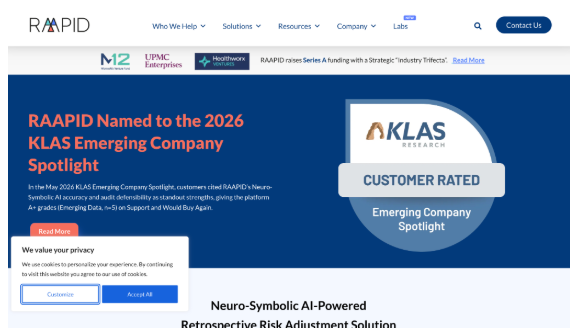
RAAPID is also a Modern Healthcare 2025 Best in Business Healthcare IT honoree and was featured in a 2026 KLAS Emerging Company Spotlight for defensible coding.
On security, it is HITRUST r2-certified, SOC 2-compliant and deployed on Microsoft Azure. For its own view of the evaluation criteria, this overview of risk adjustment companies is a useful starting reference.
RAAPID pricing
RAAPID is priced by quote. The value case is fair when it replaces separate risk adjustment, QA and audit-prep tools.
Cotiviti
Cotiviti pros
- Broad payer risk adjustment portfolio
- AI and NLP support for post-visit review
- Concurrent workflows for open gap review
Cotiviti cons
- Rollout can be complex for lean teams
My experience with Cotiviti
Cotiviti is the scale pick for payers. Its Post-Visit Review reconciles encounter data with HCC codes, and Concurrent Risk Adjustment catches gaps earlier. The Edifecs acquisition strengthens interoperability.
Cotiviti pricing
Cotiviti is priced by quote as SaaS, managed service or a mix of both.

Inovalon
Inovalon pros
- Converged Risk connects with HEDIS reporting
- Risk gaps are stratified by confidence
- Modular payer cloud approach
Inovalon cons
- Pricing and some resources are not public
My experience with Inovalon
Inovalon works well when risk and quality teams need shared data. Confidence-ranked gaps help coders prioritize defensible work, but gated details can extend diligence.
Inovalon pricing
Inovalon is enterprise software priced by quote
HealthEdge (Apixio)
HealthEdge pros
- Glass box coding framework
- RADV support in the workflow
- AI paired with human review
HealthEdge cons
- Validate integrations during diligence
My experience with HealthEdge
HealthEdge, through Apixio, puts transparency first. The glass box framework fits teams that want to understand code suggestions before acting.
HealthEdge pricing
HealthEdge is priced by quote.
Optum
Optum pros
- AI-driven coding services plus SaaS tools
- HCC Analyzer spans CMS, ESRD, Rx and HHS models
- Side-by-side calculator and HCC edits
Optum cons
- Some capabilities are sold as add-ons
My experience with Optum
Optum is the hybrid option for organizations that need both software and coding capacity. It may be more than smaller plans need, so scope carefully.
Optum pricing
Optum is priced by quote across service and SaaS models.
Innovaccer
Innovaccer pros
- Integrates with Epic, Oracle Cerner and MEDITECH
- EMR-native point-of-care prompts
- Unified data model with AI copilots
Innovaccer cons
- Platform adoption requires change managemen
My experience with Innovaccer
Innovaccer fits teams standardizing on a broader data platform. Its draw is keeping risk prompts close to clinical workflows.
Innovaccer pricing
Innovaccer is priced by quote.
Vatica Health
Vatica Health pros
- PCP-centric prospective capture model
- Point-of-care clinical data
- Practice support from clinical consultants
Vatica Health cons
- Less focused on deep retrospective tooling
My experience with Vatica Health
Vatica Health is strongest when the goal is PCP engagement. Its service-supported model brings risk capture into the visit instead of back-end review.
Vatica Health pricing
Vatica Health uses payer-funded structures and is priced by quote.
Conclusion
RAAPID is my top pick because Neuro-Symbolic AI, two-way coding and MEAT evidence match the 2026 risk adjustment moment.
Cotiviti is the runner-up for large payer scale, while Inovalon fits teams joining risk and quality analytics.
Choose Vatica Health for PCP capture, Innovaccer for data-platform standardization, Optum for hybrid coding operations or HealthEdge for transparent coding logic.
FAQ
These are the questions I would ask before shortlisting vendors.
What changed with CMS-HCC V28 in 2026?
CMS completes the 2024 CMS-HCC model phase-in on January 1, 2026, which raises the bar for evidence-backed capture.
What features matter most?
Prioritize explainable AI, MEAT evidence, RADV readiness, EHR fit and lifecycle coverage.
Is pricing published?
Usually no. Most enterprise platforms price by quote based on scope, users and lines of business.
Read More From Techbullion