The music industry spends a lot of energy arguing about formats. Streaming bitrates, spatial audio, the slow migration of immersive sound from cinema screens into living rooms and headphones. Most artists wait for the technology to settle and then release into whatever wins. Katya Lee is doing something less common. She is treating the format as the instrument and building work that only makes sense once you hear it in the room it was designed for.
Her clearest statement of that approach is a track called “Blindfold.” It contains no guitar, no piano and no conventional melody line. Lee assembled the entire piece out of manipulated gunshots, explosions, sirens and screams, processing and layering them until the result stopped behaving like noise and started behaving like a space you could stand inside. As she puts it, the goal was to push a sound until it stopped feeling like music and started feeling like an environment.
When a Song Becomes a Reference File
That density turned out to have technical value beyond the song itself. “Blindfold” drew the attention of LemonTree Studios, one of a small number of Los Angeles facilities outfitted for Dolby Atmos, the immersive multichannel format increasingly used in next generation cinemas and now spreading into music production. By Lee’s account, engineers there began using the track as study material, drawn to how much layered sound design it contained rather than to anything about its hook. The piece was mixed for Atmos by engineer Ed Donnelly and is registered with ASCAP.
There is a useful idea buried in that. A conventional reference track shows an engineer what a balanced mix sounds like. A track like “Blindfold,” packed with overlapping spatial events, instead shows what the format can do when it is pushed toward its limits. Lee did not set out to make a teaching tool, but a piece built to test the edges of immersive sound is exactly the kind of thing an engineer learning a new format wants to take apart.
Turning a City Into Source Material
The instinct to treat raw environmental sound as a building block runs through more of her work than “Blindfold.” When Lee first moved to New York she landed in an apartment overlooking a skyscraper under construction, with drilling and machinery running from early morning into the night. Rather than only enduring it, she carried a decibel meter around the city, logging readings in subways, libraries, and coffee shops, and concluded that the ambient noise everywhere was running past healthy thresholds.
She then did the obvious thing for someone who hears the world this way. She recorded the construction noise outside her window and rebuilt it into a dance track she called “Wall of Sound,” structured around a subway preacher she had watched commuters ignore. The project reframes a nuisance as a dataset. The sounds a city produces by accident, the ones everyone filters out, become the input she runs her process on.
Hardware You Can Wear
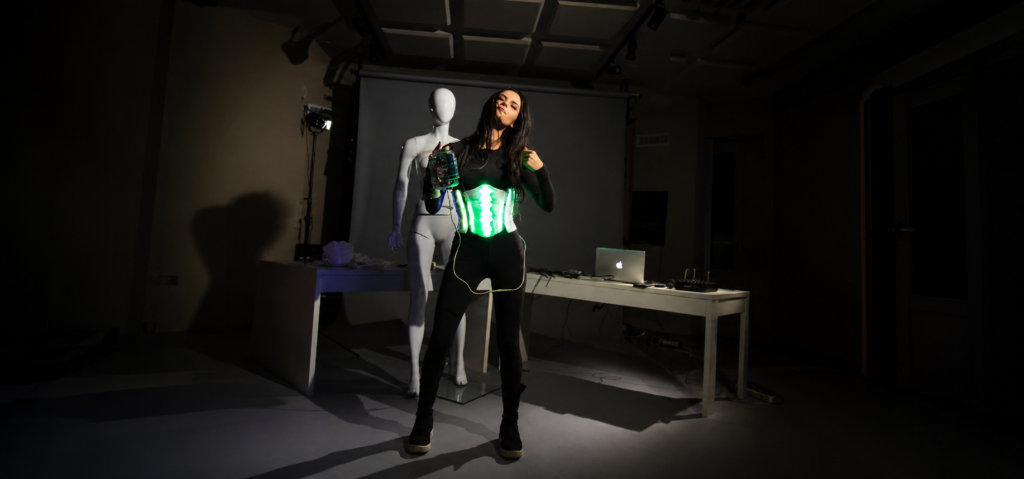
Lee’s interest in technology is not limited to what happens inside a digital audio workstation. She has worked on a project she calls the CyberSuit, a garment designed to function as a playable instrument, in collaboration with Ken Perlin, the New York University computer scientist whose foundational graphics research earned him a Technical Achievement Award from the Academy of Motion Picture Arts and Sciences. Perlin’s lab works on extending human senses through technology, which makes it a logical partner for an artist trying to turn the body itself into an interface.
The wearable work shares a logic with the audio work. In both cases Lee is less interested in a finished object than in the system that produces an experience. A jacket that responds, a suit that plays, a song that surrounds you. The common thread is interaction, the idea that a piece of art should do something when a person engages with it rather than simply sit there to be consumed.
An Artist Betting on the Frontier
What makes Lee worth watching for anyone tracking the convergence of music and technology is that she is not chasing a trend after it arrives. Immersive audio, wearable interfaces, and sound as data are still unsettled territory, with the tools and the audiences both forming in real time. She has chosen to work there anyway, in formats that most listeners do not yet have the hardware to fully experience, on the bet that the frontier is where the interesting problems live.
It helps that she is not arriving as a newcomer to performance. Before any of this, Lee spent years as a working pop star in Russia, fronting the dance group Hi-Fi and later the all female act Fabrika, a run that included a Golden Gramophone award. She left that polished, conventional career behind and moved to the United States to build something harder to categorize. The technical experiments are what that decision looks like a decade later.
Plenty of musicians describe themselves as innovators. Far fewer can point to a track sitting inside a professional Atmos studio because engineers wanted to learn from how it was built. Lee is making a specific kind of bet, that the next interesting thing in music will come from treating sound, hardware, and the listening environment as one connected system. Whether the broader industry follows is an open question. She is already there.