When analysts discuss the most technically sophisticated multiplayer ecosystems in gaming, the conversation almost always gravitates toward the biggest live-service titles: the battle royales, the MMORPGs, the games with hundred-person developer teams managing real-time infrastructure. Minecraft rarely leads that conversation, and that is a significant oversight.
Minecraft’s server ecosystem is not built by Mojang. It is built, maintained, and continuously evolved by thousands of independent server administrators operating across every time zone, collectively hosting one of the largest decentralized multiplayer networks in the industry. Anyone looking for some Minecraft servers to join quickly discovers that they are not browsing a single product but an entire ecosystem of independently operated platforms, each running its own infrastructure, community rules, and player economies. The technical and organizational architecture that makes this possible is worth examining properly.
Understanding why Minecraft’s community server model works so well also explains why other games have struggled to replicate it, despite significant investment in similar approaches.
The Decentralized Infrastructure Model
Most major multiplayer games operate on centralized server infrastructure owned and controlled by the developer. Player data, world states, and game logic all run through proprietary systems. This gives studios control over the experience but also creates a single point of dependency: when the developer shuts down, the community disappears with it.
Minecraft took a fundamentally different architectural path. The game was designed from its earliest versions to support external server hosting, with the server software itself made freely available. This decision, which may have seemed unremarkable at the time, turned out to be one of the most consequential technical choices in the game’s history. It distributed infrastructure responsibility across thousands of independent operators and effectively made the multiplayer ecosystem immune to any single point of failure.
The result is a network that scales horizontally by design. New servers come online constantly. Established servers grow their infrastructure as communities expand. Underperforming servers close without impacting the rest of the ecosystem. It is a model that mirrors the resilience of distributed systems in enterprise architecture, applied to consumer gaming years before that framing became common in tech discourse.
Server Software and the Plugin Ecosystem
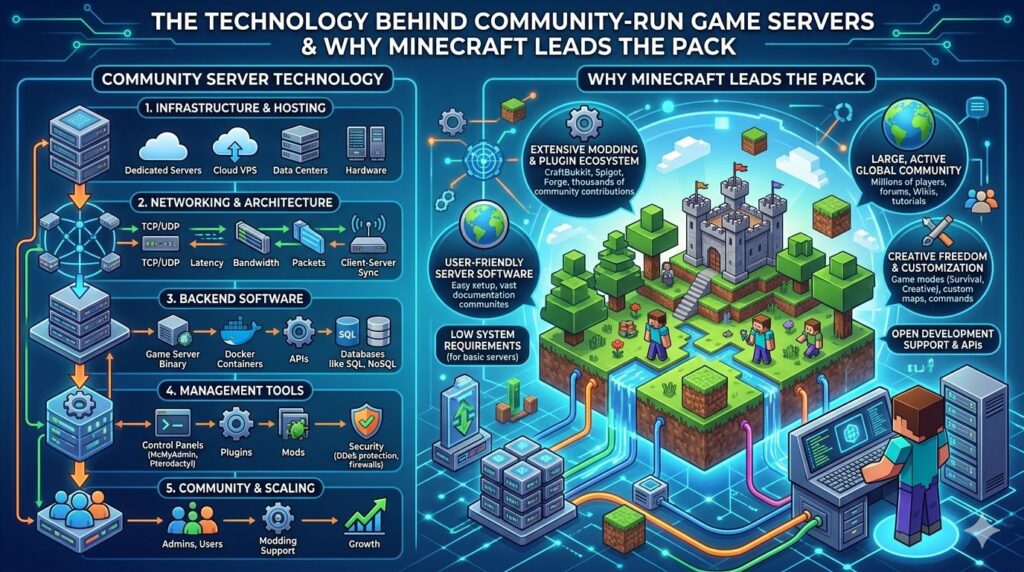
The technical foundation of most community Minecraft servers is not the official server software but a family of open-source alternatives, primarily Spigot and its derivatives. These platforms expose an extensive plugin API that allows server administrators to modify game behavior, add custom game modes, build economy systems, and create entirely new mechanics without touching Mojang’s core codebase. As TechBullion’s guide to Minecraft hosting infrastructure outlines, the hosting environment for a serious public server is considerably more sophisticated than casual players typically appreciate, involving dedicated hardware, managed uptime guarantees, and enterprise-grade network configurations.
The plugin ecosystem effectively turns Minecraft’s server layer into a development platform. A BedWars server is not running vanilla Minecraft. It is running a custom-built game mode implemented entirely in plugin code, using Minecraft’s renderer and physics engine as a substrate. The same applies to SkyBlock economy systems, Factions territory management, and the complex progression mechanics that keep players engaged on the largest public networks.
This layered architecture means that the technical complexity of a well-run Minecraft server rivals that of a small independent game studio. The administrators building and maintaining these environments are doing meaningful software engineering work, often entirely voluntarily.
Player-Driven Economies and Persistent World States
One of the most technically interesting aspects of Minecraft’s server ecosystem is how it handles persistent economies and world states at scale. On a large Survival Multiplayer server, player-created economies run continuously: trade values fluctuate based on supply and demand, virtual currencies are earned and spent, and the physical landscape of the world changes permanently as players build and reshape it over months or years.
Managing this at scale requires robust database infrastructure, careful world chunk management, and anti-grief systems that protect player-built structures without restricting the open-world mechanics that make the experience compelling. The largest servers handle thousands of concurrent players across multiple linked server instances, with proxy software routing connections and synchronizing player states across the network in real time.
The technical requirements of operating at this level include:
- High-performance dedicated hardware with sufficient RAM to load and cache world data for hundreds of concurrent players
- Proxy networks such as BungeeCord or Velocity to distribute player load across multiple backend server instances
- Database systems for persistent economy data, player statistics, and permission management
- Custom anti-cheat and moderation tooling built specifically for the server’s game mode
- Automated backup systems to protect world data against corruption or hardware failure
This is not casual infrastructure. It is closer in technical complexity to operating a mid-sized SaaS platform than to running a hobby gaming server.
Why Other Games Have Failed to Replicate This Model
The success of Minecraft’s community server ecosystem is not purely a function of technical architecture. It is also a product of design philosophy. As covered in TechBullion’s analysis of fan-created servers that outperform their official counterparts, Minecraft’s server community stands out precisely because the base game is open-ended enough to support genuinely distinct game modes rather than merely cosmetic variations on a fixed experience.
Games that have attempted to offer community server hosting with more rigid core mechanics tend to produce communities that feel like copies of the official product rather than distinct ecosystems. Minecraft succeeds because the block-based sandbox gives server administrators enough creative surface area to build experiences that are substantively different from anything available in the base game.
The low technical barrier to entry for new server administrators also matters. Starting a small server requires minimal hardware and freely available software. Growing it into something serious requires real technical investment, but the entry point is accessible enough that new operators continue to enter the ecosystem constantly, keeping it competitive and diverse.
What the Minecraft Server Model Signals for the Broader Industry
The durability of Minecraft’s community server ecosystem carries meaningful implications for how the gaming industry should think about multiplayer infrastructure. The conventional live-service model concentrates development, hosting, and community management inside the studio. It creates dependence on a single organization’s ongoing commitment and investment to keep the community alive.
The Minecraft model distributes all of that across the player community itself. Server administrators invest their own resources, build their own infrastructure, and develop their own technical capabilities because they have genuine ownership over their communities and real creative freedom within them. That ownership and freedom generates a quality and quantity of community investment that centralized developer-run servers rarely match.
For developers, investors, and platform builders watching how online gaming communities evolve in 2026, this is worth taking seriously. The most resilient multiplayer ecosystems may not be the ones with the most sophisticated central infrastructure. They may be the ones that are architected to function without it.
A Technical Achievement Worth Recognising
Minecraft’s community server ecosystem is often discussed in terms of player numbers and cultural longevity. Less often is it recognized for what it is technically: a large-scale, decentralized, community-operated multiplayer network that has remained functional, diverse, and actively growing for over a decade without centralized developer management.
The infrastructure choices made in Minecraft’s early development created the conditions for this. The open server software, the extensible plugin architecture, and the design philosophy of leaving the game open-ended enough for communities to build something genuinely their own combined to produce an ecosystem that no single team could have built deliberately. That outcome is worth understanding, both for what it tells us about Minecraft specifically and for what it suggests about how multiplayer games can be designed to outlast any individual content cycle.