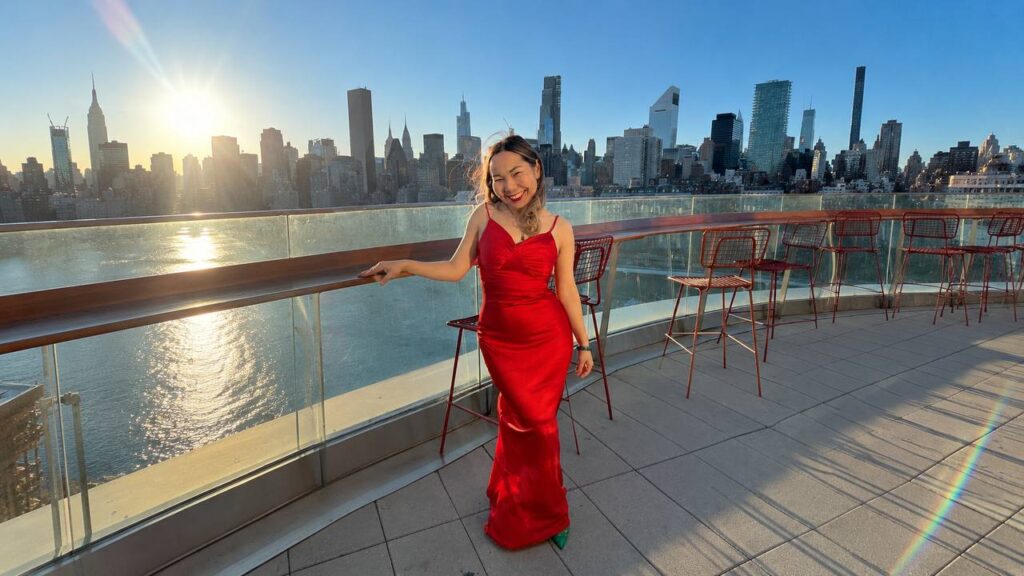
For more than fifteen years, Aisalkyn Samsalieva has worked at the crossroads of journalism, literature, and cultural analysis. Her path began in Kyrgyzstan and later carried her into Russian-language and international media. At the heart of her work are women’s stories, migration, identity, and the lives of people who usually fall outside the public eye.
She is known for her long-running column “Still Unpicked Flowers” in Bishkekchanka, Kyrgyzstan’s most popular glossy magazine; for her novel “We’re Not Locals”; and for her interviews with cultural figures and her social essays. In 2025, the international Travel to Art Award named her Journalist of the Year. This conversation is about craft and ethics, about migration and women’s narratives, and about why a journalist needs a researcher’s eye.
Aisalkyn, your work is tied not only to journalism but to themes of identity, migration, and cultural memory. How do you define your own focus?
I’ve never seen journalism as the simple delivery of information. For me it’s a way to preserve human experience — especially the kind that’s too personal, too complicated, or too uncomfortable to talk about openly.
I’m drawn to people who live between countries, languages, and systems. Central Asian stories are central to that for me. The region has been through enormous historical shifts, yet the personal stories inside those shifts are still rarely heard in the media. And journalism is exactly what connects private experience to public understanding. It gives language to what people feel but can’t always put into words.
For four years you wrote the column “Still Unpicked Flowers” for Bishkekchanka. Why did that project matter to you personally?
It’s one of the most meaningful projects of my career. Over four years the column became a space where I could speak about women’s stories and struggles honestly and with care — and for my readers, it became something like a series they waited for from issue to issue. The title itself is about women: tender, fragile, real, but with strong character and an inner core — because, as you’ll remember, every rose has its thorns.
Back then, much of women’s private life was still hard to say out loud. I tried to avoid sensationalism: not to shock, but to open a conversation. It’s a story of three different women, each of whom moves through hardship toward the stars, building her own future by her own strength. The main character, Altynai, grows from a shy, uncertain girl into a strong, vivid personality — a real force in business. The women of Central Asia have a quick mind and an Eastern shrewdness, and at the same time a disarming modesty and dignity.
Your work often touches on sensitive subjects. Where, for you, is the line between honesty and your responsibility to the person?
I always start from the fact that there’s a real person behind every story — and sometimes their pain. A journalist has the power to amplify a voice and the power to do harm. So I listen for a long time, I don’t oversimplify, and I try not to turn someone’s life into a striking headline.
There were many social-issue pieces — “Let the Candle of Hope Keep Burning,” “A Young Man Burned by the Medicine TheraFlu” — where the subject itself demanded special care, but which ended up changing lives and helping the people in them. In the first case, a young man named Samat was injured by an exposed transformer box and lost both his arms. Working with stories like these, I ask myself the same three questions every time. Does publishing this help the people in it — and society — understand something important? Does it preserve the person’s dignity? Does it make the world a little better and kinder?
You’re the author of the novel “We’re Not Locals.” How did literature and journalism come together in your life?
They’re joined by one thing — human stories worth sharing. Journalism gave me discipline and a responsibility to the facts. Literature gave me more freedom and more room for my own creative ideas, a way to show how migration and displacement feel from the inside.
“We’re Not Locals” grew out of the feeling of living between places. A person can physically arrive in a new country, work there, raise children — and still keep up an inner dialogue with memory and language. The title captures a state many people know: you spend years contributing to a society, and yet some part of you still reads as “not local.” I wanted to show that not as a slogan, but as a lived reality.
Why do migration and diaspora hold such a place in your work?
Because migration is one of the defining experiences of our time, especially for the post-Soviet and Central Asian world. Most often migrants are talked about through statistics: how many left, how much money was sent home, how many permits were issued. But behind those numbers are living people trying to hold on to their dignity, their language, and their culture.
The stories of Central Asian diasporas are rich and complex. Yet in the media they’re either ignored or flattened into a stereotype. I believe journalism can correct that imbalance — show migration in all its layers, from family ruptures to professional achievement.
You’ve interviewed cultural figures — Asel Aidarova, for example, prima ballerina of the National Theater of Opera and Ballet. What do conversations like that mean to you?
Culture often reveals the deeper life of a society. In my conversation with Aidarova, I wasn’t interested in her biography or a list of achievements. What mattered to me was the person behind the public image — the daily discipline behind the success, the cultural meaning of her work.
A strong interview isn’t a list of questions; it’s a dialogue that leaves the reader seeing the subject more fully. Cultural figures carry memory, tradition, and renewal all at once. Through them you can understand how a society experiences beauty, mastery, and national identity.
You’ve served as a judge for creative competitions and you review submissions for an academic journal. What does it mean to you to evaluate someone else’s work?
It’s a big responsibility — and a completely different angle on the profession. At competitions for young scholars, like “Akyl Tirek-2015,” you have to assess people on substance, originality, and clarity, separating personal taste from quality. Reviewing for an academic journal demands the same, but more strictly: you’re looking not at a text but at a piece of research — its relevance, its argument, its methodology, the logic of its conclusions.
When you’re asked to evaluate others, it means your judgment is trusted. And that changes how you see your own work. You think more deeply about criteria and about ethics, about the difference between what is merely striking and what truly matters. You realize that journalism isn’t only your own pieces. It’s also upholding standards and supporting other people’s talent. I’m always in favor of talented people coming into their own and giving us, the public, their finest work.
Many of your journalistic subjects have, over time, become research subjects for you. Why does a journalist need a researcher’s eye — and are you planning academic publications?
Journalism captures a moment; research helps you see the system. When you work with a subject for a long time, you start to make out recurring motifs and cultural mechanisms behind individual lives. Migration isn’t only relocation: it’s language, memory, adaptation, a shift in a person’s role within a new society. Behind women’s stories, too, lie broader patterns — expectations, traditions, forms of silence and resistance.
I’ve already gathered material that could take the shape of academic articles: migration, women’s identity, the role of journalism in preserving cultural memory, the representation of post-Soviet and Central Asian communities in the media. I want to translate practical experience into research — not to leave journalism, but to widen it. Journalism shows lived experience. Scholarship explains its patterns.
In 2025, the Travel to Art Award named you Journalist of the Year. What does that recognition mean to you?
It recognized exactly the interdisciplinary nature of my work — the fact that I’ve never stuck to a single format. The award treats journalism as part of culture and as a force that shapes public understanding. That’s close to how I see the profession myself.
What matters especially is that the recognition came to work about underrepresented voices — women, migrants, people in cultural transition. For me it’s confirmation that these stories matter beyond any one region. But an award isn’t the finish line. It’s a responsibility — to the people who believed in you, to your audience — to hold your standard and raise the bar: to plan new projects and reach for greater heights.
What role do women’s stories play in your work?
A central one — because in them, private life and public expectation intersect. In many societies, including those of Central Asia, women carry an enormous emotional and family burden that’s rarely spoken about. Patriarchy reigned in the region for centuries, but there’s a good saying: “In Asia the man is the head, the woman is the neck” — and wherever the neck turns, the head follows. It speaks to the strength and steadiness of the bond, and to the fact that Eastern women are clever and quick-witted.
I’m interested in women not as symbols but as individuals — with their contradictions, ambitions, fears, and strength. When their stories are told honestly, society begins to understand itself better: what’s changing in it, and what remains unresolved. And sometimes a reader sees, for the first time, that her own experience has been given a voice. I watched with my own eyes how, after the collapse of the Soviet Union, the women of my country didn’t lose their footing and didn’t break. They began bringing clothes from Turkey, Italy, and China to sell in the markets; there was also a mass departure to Russia — and these were former accountants, mathematicians, and doctors. The country was in shock at the loss of its stability, yet the women not only held firm but pulled their families forward. Later came another era — of young, strong, successful women: in the digital age, women entrepreneurs, marketers, directors, and writers emerged, along with others in creative professions, making the country stronger alongside the men.
What, in your view, sets your voice apart from other journalists working on similar themes?
I think it’s the combination of compassion, literary sensitivity, and a researcher’s eye. I don’t look at a story as an event. I try to understand what it means for the people inside it and for the society around it.
And the second thing is the view from within. Central Asia is often discussed from the outside. I write from inside the culture itself — understanding its language, its contradictions, its emotional codes — while my experience working in different countries lets me connect local stories to the larger questions of migration and belonging. This isn’t a passing interest; it’s the foundation of my professional identity.
What do you want to develop next?
I want to keep working in journalism, literature, and media research — and especially on the themes of Central Asian and post-Soviet diasporas, women’s experience, and cultural memory. I’m also drawn to educational formats: master classes in storytelling, interviewing, and writing, especially for children and young people. Many people have powerful stories but no tools to tell them publicly — and this is where you can help young authors find their voice.
A separate direction is academic publications and new essays and books about cultural code, gender, and national identity. These subjects call for a long conversation, and I still have plenty of material.
And finally: what does success mean to you today, and what is the central meaning you carry through your work?
Early in a career, success seems tied to publications and recognition. Over time, that understanding shifts. Success is work that stays meaningful even after the moment of publication; a piece that helps a reader recognize themselves or see society differently. Success is making someone’s life better — put simply, helping someone solve a problem.
And the central meaning is this: any society is made up not only of official events and public figures, but also of quiet struggles, cultural memory, and voices that go unheard. Journalism can protect those voices from disappearing and make invisible experience visible. When such stories are told honestly and with respect, they become more than private stories. They become part of a shared memory.