The quantum clock is ticking. Forecasts now place cryptography-breaking machines before 2030, meaning every private key behind your stablecoin—treasury, oracle, user wallet—could be exposed in minutes.
Stablecoins can’t gamble on suspense. Your promise is simple: one token, one dollar, always redeemable. A single forged signature would halt redemptions, invite regulators, and crater confidence.
The upside: post-quantum standards are locked, hardware pilots are shipping, and blockchains are rolling out test upgrades. This series distills eight concrete tools—navigation indexes, signature engines, encryption shields, and scaling tricks—so you can begin migrating with confidence. Grab a coffee; your 2030-proof roadmap starts now.
Why quantum-safe crypto is mission-critical for stablecoins
Stablecoins rest on one promise: each token is redeemable for its face value, on demand. That safety net is woven from private keys that approve every mint, burn, oracle update, and governance change. Break even one key, and the peg can snap.
Quantum machines are designed to snap them. Once a fault-tolerant computer reaches a few hundred thousand stable qubits, today’s elliptic-curve signatures crumble in minutes. Attackers won’t need the whole network; they only need the admin keys that control treasuries and upgrade paths. With those, they can forge tokens, halt redemptions, or drain collateral before you notice.
Regulators see the same threat. The G7 and several central banks now treat quantum readiness as an operational-resilience requirement. Miss that bar and you could face license suspensions or emergency audits.
Users are harsher. People view a stablecoin like a checking account. One proven signature forgery can trigger mass redemptions, dry up liquidity, and slip the peg, repeating the Terra spiral even faster.
Migration is not a weekend patch. Re-keying wallets, upgrading HSM firmware, and adding new verification routes demand quarters of engineering work and months of coordinated messaging. Postponing the start date extends completion into the risk window.
Quantum-safe cryptography is not future tech for stablecoins; it is the next maintenance window. Replace the weak links now, while your reputation still rests on prevention rather than post-incident apologies.

How we judge an algorithm: six criteria that matter
Before we dive into the picks, we need a shared yardstick. Otherwise, we risk comparing apples to qubits. Below are the six filters we use whenever we vet post-quantum cryptography for a production stablecoin stack.

Security and math diversity. Lattice, hash, and code-based schemes do not fail the same way. We favor at least two distinct branches so one breakthrough cannot topple the whole system. NIST followed this approach in its first three PQC standards (ML-KEM for encryption plus two very different signature families, ML-DSA / Dilithium and SLH-DSA / SPHINCS+), approved in August 2024.
Signature size and on-chain cost. Every extra byte pushes gas higher. A 2,400-byte Dilithium signature inflates an Ethereum transaction more than thirty-fold. Knowing the byte-for-byte impact lets you budget for data-blob discounts or zk aggregation later.
Performance under load. Some schemes verify in microseconds; others take full milliseconds. On high-TPS chains or busy custody services, slow verification snowballs into user-visible lag. We benchmark signing and verification on the same hardware that runs your production nodes to avoid surprises.
Key management reality. Stateless signatures are drop-in. Stateful options like SHRINCS require tracking a counter for each use. Lose state and you lose security. We recommend stateful schemes only for tightly scripted, low-frequency tasks.
Implementation maturity and side-channel hardening. A clever algorithm is useless if the library leaks timing data. We look for constant-time code, independent audits, and at least one hardware-wallet or HSM port.
Regulatory and hardware support. Standards bodies, cloud HSMs, and leading wallets signal compliance readiness. When an algorithm ships in FIPS-validated firmware or appears on a central-bank shortlist, we read that as a strong green light.
Keep these six lenses handy. They turn the coming list from buzzwords into a practical roadmap you can defend to auditors, regulators, and—most importantly—your users.
Your map before the journey: the Post-Quantum Cryptography Registry
Step one in any migration is knowing the terrain. Post-quantum cryptography can feel like a maze of FIPS PDFs, GitHub repos, and conference papers. The Post-Quantum Cryptography Registry pulls that sprawl into a single, searchable dashboard. Maintained by Project Eleven, it lists every serious candidate (NIST standards, incoming drafts, and blockchain-specific experiments) in one consistent schema. You can scan key size, signature size, security level, side-channel notes, and implementation maturity at a glance.
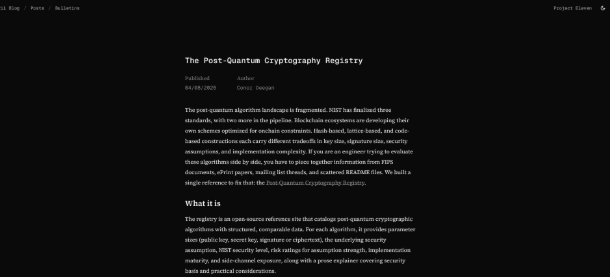
Post-Quantum Cryptography Registry dashboard screenshot
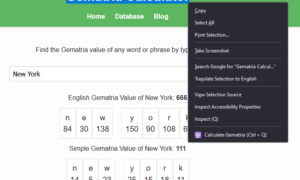
Why does that matter for a stablecoin team? Because you can sort by the metric that hurts you most. Want the smallest signature at NIST Level 1? Filter and see that Falcon’s 666-byte signature beats Dilithium by a factor of four. Need a hash-based backup in case lattices stumble? The registry marks SPHINCS+ as stateless and SHRINCS as stateful, complete with blueprint links. No more hunting through mailing-list archives for numbers.
Project 11’s April 2026 release notes that the registry already catalogs nine algorithms—covering NIST-standardized ML-KEM, ML-DSA, SLH-DSA as well as blockchain-oriented schemes like FN-DSA and SHRINCS—each entry detailing key size, signature size, NIST level, implementation maturity, and side-channel exposure in a schema-validated format, which lets engineering teams benchmark options without wading through scattered white papers.
The tool is open source and updated continuously. If a new audit closes a timing leak or a hardware wallet adds support, the table reflects it within days. That real-time clarity saves weeks of engineering research and reduces the risk of basing decisions on stale specs.
Bottom line: bookmark the registry before you touch a single line of code. It turns post-quantum planning from guesswork into data-driven engineering.
Signature workhorses
1. Falcon: small signature, big relief
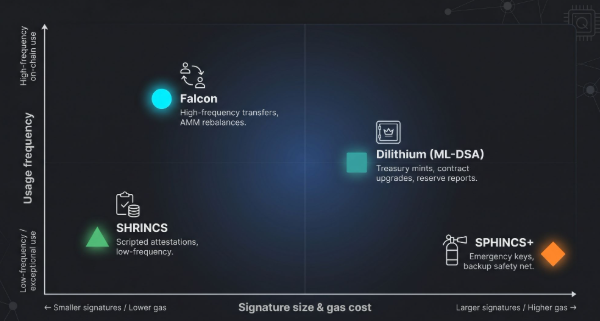
Falcon tops the signature list for one reason: size. At 666 bytes per signature and about 1.3 KB per public key, it cuts on-chain data costs by an order of magnitude compared with Dilithium or SPHINCS+. These figures come from the Post-Quantum Cryptography Registry, where Falcon appears under its formal name FN-DSA.
Speed is a second win. Verification completes in microseconds even on modest hardware, so validators and custody HSMs stay responsive under load. That makes Falcon ideal for high-frequency tasks such as user transfers, automated market-maker rebalances, and contracts that mint or burn tokens several times per block.
The trade-off is implementation risk. Falcon signing depends on floating-point Gaussian sampling; a mishandled sampler can leak key bits through timing or rounding quirks. Several audited libraries now wrap the maths in constant-time code, and hardware-wallet vendors are shipping dedicated firmware, but plan a red-team review before going live.
Field data helps. Algorand’s 2025 upgrade extended Falcon signatures to mainnet transactions and kept block propagation under two seconds, proving the scheme can thrive without throttling throughput.
Bottom line: if you want the smallest practical signature without slowing verification, Falcon is the pick. Rely on audited code, fuzz the sampler, and you will save kilobytes every time you sign.
2. Dilithium: the safest default money can buy
If Falcon is the feather-weight sprinter, Dilithium is the diesel truck that keeps pulling. NIST named it the primary digital-signature standard in the 2024 FIPS release, branding it ML-DSA and urging organizations to deploy it without delay. That endorsement carries weight with auditors and regulators; choosing Dilithium shows you selected the option the standard setters trust most.
The security story is strong. Dilithium’s lattice math has faced six years of public scrutiny, three NIST competition rounds, and numerous academic attacks. At its highest parameter set, it reaches Level-5 strength, the bar reserved for national-security systems. No practical breaks, no red flags.
The trade-off is size: about 2,400 bytes per signature. That is larger than Falcon but manageable, especially once Ethereum’s data-blob pricing lands. Verification remains quick, so it will not slow block production or API latency.
Implementation is straightforward. Dilithium uses only integer arithmetic, which simplifies constant-time coding and shrinks the attack surface. Multiple Rust, C, and Go libraries already pass Wycheproof test vectors and ship with hardened Arm intrinsics. Hardware support is growing as well; Hedera’s council ran Dilithium keys inside the SEALSQ QS7001 secure element during its 2025 pilot, proving the algorithm fits real HSM firmware without special work.
When should you pick it? Any time compliance, auditability, or board-level risk tolerance tops your checklist. Use Dilithium for treasury mints, contract upgrades, and reserve reports—the signatures you never want questioned. Let Falcon handle mass-market transfers; Dilithium guards the crown jewels.
3. SHRINCS: tiny signatures when state is no sweat
Sometimes you just need the smallest post-quantum signature available. SHRINCS fits the brief at 324 bytes in its stateful mode. While larger than classic ECDSA, it is far leaner than Dilithium, keeping on-chain gas manageable. Verification is quick because it uses only hash evaluations, so it works well on bandwidth-constrained or latency-sensitive links.
The catch is state. The compact mode relies on an unbalanced XMSS tree and a counter. Sign once, increment, never reuse. Lose track and you must switch to the larger stateless fallback. Many stablecoin tasks are already scripted and count-limited—mint authorisations, monthly reserve attestations, or a governance-upgrade quorum rarely exceed a few hundred signatures per year—so a stateful key in an HSM or smart-contract counter is acceptable.
Field data backs this up. Bitcoin’s Liquid sidechain deployed SHRINCS and produced blocks with 324-byte signatures without throughput loss or bloat. The result shows that stateful hash schemes can slot into UTXO or account chains when usage is predictable.
To deploy safely, keep the private key inside hardware, let the device manage the counter, and mirror the index in contract storage so auditors can verify that no index is skipped or reused. With that guardrail, SHRINCS becomes a surgical tool: unbeatable size, conservative hash-only security, and no dependence on lattice assumptions.
Reserve it for signatures that matter most yet occur least. Your balance sheet will thank you for every gas-priced byte.
4. SPHINCS+: the hash-based safety net
Every risk team needs both a belt and suspenders. SPHINCS+ delivers the suspenders: a stateless hash-based signature that relies on nothing more exotic than SHA-256. No lattices, no code words, no number-theory assumptions that could fall to a future breakthrough. Even if Grover halves hash strength, the oversized parameters in SPHINCS+ still hold the line.
The price is size. Signatures range from 8 KB to 16 KB depending on the security level. On today’s gas schedule, posting one on Ethereum costs more than a small contract deployment. Verification is fast, but bandwidth and storage sting.
Where does it shine? Low-frequency, high-impact actions—board approvals, emergency pause keys, monthly proof-of-reserve files—that live off-chain or inside a zk proof. In those cases, signature size matters little, yet an independent security basis matters a lot.
Implementation is straightforward: pure hash calls make constant-time coding simple and side-channel exposure minimal. The algorithm is now published as FIPS 205, giving you a clean compliance story next audit cycle.
Think of SPHINCS+ as your cryptographic fire-extinguisher. You hope never to use it, but sleeping without one feels reckless. Store a key, test the workflow, and you will always have a fallback if lattices or floating-point samplers ever grab headlines for the wrong reason.
5. Kyber: encrypting every link in the chain
Signatures protect who said what; encryption protects what was said. Kyber, standardized as ML-KEM in the 2024 FIPS release, is now the default key-encapsulation mechanism for a post-quantum world. Think of it as tomorrow’s TLS, already live in Chrome and Cloudflare pilot programs and now rolling into cloud HSM firmware.
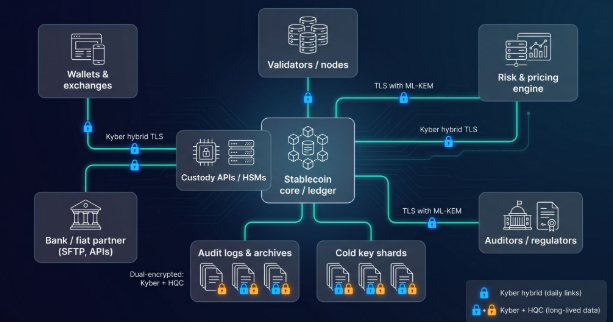
Stablecoin teams rely on more encrypted plumbing than most realise: validator gossip, custody APIs, off-chain risk engines, even the SFTP feed your bank uses for daily reserve statements. Each is a potential leak if classical RSA or ECDH sticks around. Dropping in Kyber closes that gap with minimal effort. Public keys and ciphertexts stay under a kilobyte, and the algorithm runs in microseconds on commodity CPUs, so bandwidth and latency remain flat.
Migration is largely configuration. OpenSSL, BoringSSL, and AWS KMS already ship Kyber-hybrid cipher suites. Flip the flag to X25519 + ML-KEM, test end-to-end, and you gain quantum protection without rewriting business logic. For on-chain privacy layers or bridge relayers, embed Kyber in a gadget contract today; several Solidity libraries expose the primitive with precompiled field operations.
One caution: lattices need side-channel care. Use constant-time reference code or hardware modules that pass NIST validation. With that guardrail, Kyber becomes the quiet shield guarding every byte between your nodes, banks, and auditors.
6. HQC: the diversification play
Crypto history teaches a clear lesson: never bet the farm on one math problem. HQC, a code-based key-encapsulation mechanism, gives you that second pillar. NIST chose it in 2025 as the official backup to Kyber because its error-correcting-code foundation shares no weaknesses with lattices.
Keys and ciphertexts hover around two kilobytes—larger than Kyber but still friendly to modern bandwidth. Performance is acceptable for server workloads: verification is only a few microseconds slower, nowhere near a TLS bottleneck.
Where does HQC shine? Archival and regulatory peace of mind. Encrypt long-lived audit logs, cold-storage key shards, or inter-bank settlement files under both Kyber and HQC. If lattice cryptanalysis ever reaches production, your code-based envelope already protects the same secrets.
Integration is simple. Open Quantum Safe’s liboqs exposes HQC alongside Kyber, so you can swap the cipher suite or run both during session setup. Because the NIST draft standard is locked, auditors treat HQC as a production-ready choice, not an experiment.
Think of Kyber as the daily driver and HQC as the off-road SUV. You will not need it every day, but when rough terrain appears, you will be glad the second engine is warmed up.
7. LeanSig and hybrid stacks: squeezing cost, stacking safety
Large signatures once threatened to clog blockchains. Researchers responded with a new pattern: prove many signatures valid off-chain, then post a single proof on-chain. Ethereum’s experimental leanSig illustrates the idea. Instead of retrofitting existing algorithms, leanSig is a custom hash-based signature built around the SNARK-friendly Poseidon hash. Validators batch thousands of these signatures, generate a STARK proof off-chain, and publish one compact verification. On-chain work stays constant, gas costs plunge, and users never see the kilobytes.
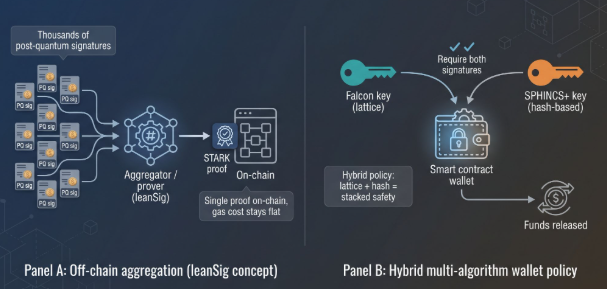
The same pattern lets you layer algorithms for resilience. A contract wallet can require two different post-quantum signatures—say, Falcon and SPHINCS+—before it releases funds. Attackers now need to break both a lattice and a hash world in the same era. Aggregation hides the extra data, and account-abstraction tooling makes multi-algo policies a simple upgrade.
For stablecoins, this combo is gold. You gain smaller transactions, regulator-friendly cryptographic diversity, and a future-proof escape hatch if any single algorithm shows weakness.
Wrapping up: turn the plan into a roadmap
Quantum risk is real, standards are published, and hardware is shipping. We have outlined eight concrete moves—one data registry, four signature options, two encryption shields, and a scaling strategy—to protect every stablecoin workflow from mint to audit log.
Start small and visible. Switch your TLS endpoints to Kyber hybrids this sprint. Pilot Falcon for user transfers on a testnet, and run Dilithium for treasury actions at the same time. Spin up a SHRINCS key in an HSM for quarterly reserve attestations, and encrypt the archive twice, Kyber for speed and HQC for diversity. When gas costs loom, wrap signatures behind a leanSig proof.
The migrations take quarters, not weeks, so book engineering time now and set executive OKRs that retire legacy crypto by 2027. Regulators will ask, users will notice, and attackers will try. With the right picks in play, only the headlines remain unstable; your peg stays firm.
Fortify today, and every dollar token will be as solid tomorrow as the day it was minted. Let’s build.