TikTok LIVE is a global platform, but running a global Creator Network is far more complicated than simply recruiting creators in another country.
For TikTok LIVE agencies, international expansion introduces new challenges almost immediately.
Different languages.
Different creator markets.
Different recruitment habits.
Different working hours.
Different internal teams.
Different communication needs.
And increasingly large volumes of creator data spread across multiple regions.
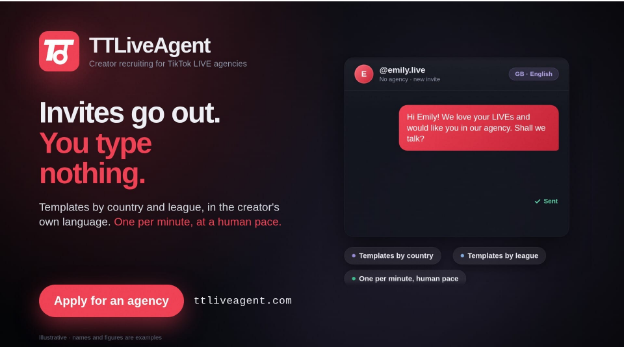
TT LIVE Agent is being developed to help agencies manage that complexity through AI-powered automation, multilingual workflows and centralized creator operations.
For Creator Networks looking to expand beyond a single market, the challenge is no longer only finding creators.
It is building an operational system capable of managing creators across countries without rebuilding the agency from scratch every time it enters a new region.
Global TikTok LIVE Agencies Need More Than Translation
Language is one of the first barriers agencies encounter when expanding internationally.
A Creator Network operating in the UK may begin recruiting in Germany.
A European agency may want to enter the Middle East.
A network operating in Turkey may want to build teams in the UK, Germany or the United States.
At first, translation may appear to solve the problem.
But international creator recruitment involves more than translating a message.
Agencies need to manage conversations, creator status, internal notes, follow-ups and recruitment pipelines across several languages at the same time.
That creates a much larger operational challenge.
TT LIVE Agent is designed to help centralize these workflows so agencies do not need to create separate systems for every market.
Multilingual AI Can Reduce Expansion Friction
Artificial intelligence can be particularly useful when agencies work across multiple languages.
Instead of maintaining separate manual processes for each country, AI can support common communication and operational tasks across several markets.
For example, creator questions may arrive in English, German, Turkish or Arabic.
A traditional agency may need separate employees or teams to manage each language.
An AI-powered system can help reduce that pressure by assisting with multilingual communication while keeping the creator relationship inside the same operational environment.
This does not remove the need for local knowledge.
It reduces the amount of repetitive multilingual work that must be handled manually.
For growing TikTok LIVE agencies, that distinction can be important.
International Expansion Can Multiply Administrative Work
Expanding into another market does not only create more recruitment opportunities.
It creates more administration.
More creators need to be reviewed.
More prospects need to be tracked.
More conversations need to be organized.
More recruitment statuses need to be updated.
More internal coordination is required between teams.
If every new market requires a completely separate manual workflow, international growth can become expensive very quickly.
TT LIVE Agent is being built around the idea that a Creator Network should be able to expand geographically without multiplying its administrative workload at the same rate.
The platform aims to create a shared operating environment that can support recruitment and management across multiple markets.
One Creator Network, Multiple Countries
Large Creator Networks increasingly operate across borders.
But international structure can create fragmentation inside the agency.
One country team may use its own spreadsheet.
Another may keep creator records in a separate system.
Recruiters may follow different processes.
Managers may have limited visibility into what other regions are doing.
Over time, this can make it difficult to understand the network as a whole.
A centralized agency management platform can help solve that problem.
TT LIVE Agent is designed to give agencies a more unified view of creator activity across different markets.
That can make it easier to compare recruitment activity, monitor progress and identify which markets are producing the strongest opportunities.
Creator Recruitment Strategies Differ by Market
Not every creator market behaves the same way.
Some regions may have a large supply of active LIVE creators.
Others may be more competitive.
In certain markets, agencies may need to process large numbers of profiles before finding suitable prospects.
In others, recruitment may depend more heavily on relationship building and local knowledge.
This means international Creator Networks need both scale and flexibility.
Automation can handle repetitive work.
Human managers can focus on the differences between markets.
TT LIVE Agent is designed around this combination.
The platform can help structure common recruitment processes while still allowing agencies to apply local strategies where necessary.
AI Can Help Agencies Operate Around the Clock
Global agencies also face a time-zone problem.
Creator activity does not stop when an agency office closes.
A network operating across Europe, North America and the Middle East may have active creators almost 24 hours a day.
Maintaining full staffing coverage across every time zone can become expensive.
AI-powered systems can help reduce part of that operational gap.
Routine information, creator status and repetitive communication can be handled more consistently even when specific employees are unavailable.
That creates a more continuous operating model.
For international TikTok LIVE agencies, this can improve responsiveness without requiring large teams working around the clock.
Global Growth Can Increase Staff Costs Quickly
international expansion often comes with a hidden cost: headcount.
A new country may require recruiters.
Managers.
Support staff.
Language specialists.
Administrative employees.
Local coordinators.
If every region requires a full team from the beginning, expansion becomes expensive.
Automation offers another model.
A Creator Network can use technology to centralize repetitive work and reserve local employees for tasks that genuinely require local expertise.
This can reduce the number of employees needed to support early-stage expansion.
Instead of building a complete operational structure in every market, agencies can create a shared technology layer and add people where human judgement adds the most value.
Agency Owners Need a Global View
As an agency expands internationally, management becomes more difficult.
Owners and senior managers need to understand what is happening across several markets at once.
Which country is recruiting fastest?
Which market has the strongest creator pipeline?
Where are follow-ups being missed?
Which team is generating the most creator opportunities?
Where is operational workload increasing?
If each market uses disconnected systems, answering these questions can take significant time.
TT LIVE Agent aims to make this information easier to organize by creating a centralized operational view.
For international Creator Networks, this type of visibility can become essential.
Multilingual Creator Recruitment Is Becoming a Software Problem
For years, multilingual recruitment was mainly a staffing challenge.
Agencies solved it by hiring more people.
AI changes that model.
Language support can increasingly be built into software.
This means Creator Networks can approach international recruitment in a more scalable way.
Instead of asking whether they have enough employees who speak every language, agencies can ask which parts of the workflow truly require native human interaction.
Routine communication and administrative work can increasingly be assisted by AI.
Relationship building, negotiation and creator development can remain human-led.
This separation can make international operations more efficient.
TikTok LIVE Agencies Are Becoming Global Digital Businesses
The largest Creator Networks increasingly resemble international digital companies.
They recruit talent across borders.
Manage remote teams.
Operate across several languages.
Track performance globally.
And compete in multiple creator markets at the same time.
That makes agency infrastructure more important.
Software designed for a single local market may not be enough.
Agencies need systems capable of supporting international creator recruitment and global operations from the beginning.
TT LIVE Agent is positioning itself for that use case.
Its broader goal is to help agencies manage creator activity across regions without creating a completely separate operating system for every country.
A Free Demo Can Help Agencies Test International Workflows
One advantage of specialized agency software is that teams can test whether it fits their existing structure before making a larger commitment.
TT LIVE Agent provides a free demo through its website, giving agencies an opportunity to explore the platform and evaluate how it could fit into their creator recruitment and management workflow.
For international Creator Networks, this is especially relevant.
A system may appear useful in one country but still need to support several markets, languages and teams.
Testing the workflow allows agencies to evaluate whether the platform can reduce fragmentation before making it part of wider operations.
Global Agency Growth Will Depend on Operational Leverage
International expansion has traditionally favored large organizations.
They could afford more employees, more local teams and more administrative infrastructure.
AI-powered agency software can reduce part of that advantage.
A smaller Creator Network with strong systems may be able to enter new markets faster than a larger competitor relying heavily on manual processes.
That creates a new form of competitive leverage.
Technology can help agencies do more with fewer people.
Multilingual AI can reduce language friction.
Centralized recruitment can reduce duplicated work.
Automation can reduce administrative overhead.
And better operational visibility can help management make faster decisions.
For TikTok LIVE agencies with global ambitions, these capabilities may become as important as creator relationships themselves.
TT LIVE Agent is betting that the future of Creator Networks will not only be larger.
It will be more international, more automated and more connected.