Decentralized AI Framework Gains Recognition for Expanding Access to Compute Power.
The digital economy has witnessed transformative platforms that fundamentally changed resource sharing: Grab revolutionized transportation, Airbnb transformed hospitality, and Shein disrupted supply chains. Now, a Vietnamese technology company is redefining the next frontier-computational power sharing itself.
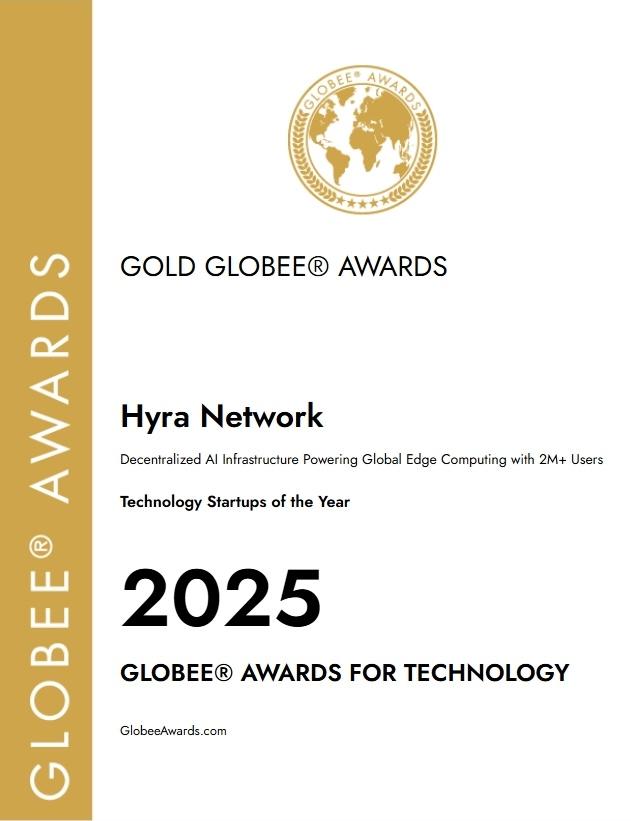
Hyra Network has been officially named “Technology Startup of the Year” at the prestigious 2025 Globee Awards for Technology, marking a watershed moment for decentralized artificial intelligence infrastructure. This recognition validates an ambitious vision that could reshape how the world builds, owns, and benefits from AI technology. (Official winner list available at: globeeawards.com/2025-winners-technology)
The Vision Behind Innovation
This breakthrough platform is researched and developed by Hyra Tek JCS (Vietnam) and operated by Hyra Tek Smart Solution L.L.C (UAE). Hyra Network’s mission is to democratize computational power by activating billions of idle devices and transforming everyday users into AI infrastructure providers.
Hyra Network serves as the flagship platform alongside Hyra AI, creating an unprecedented model where computational resources are shared across distributed networks rather than concentrated in centralized data centers. If ride-sharing optimizes vehicle utilization and home-sharing maximizes property efficiency, then computational sharing unlocks vast processing power lying dormant in smartphones, computers, and IoT devices globally.
Global Recognition for Excellence
The Globee Awards represent the technology sector’s highest honor, with winners selected by over 100 seasoned professionals, including C-suite executives, venture capitalists, and industry analysts.
“This honor transcends our company – it validates the entire movement toward democratized AI infrastructure,” said Mr. Jonh Tran, Founder of Hyra Network. “We’re witnessing global acknowledgment that the future of AI belongs not to centralized monopolies, but to communities that collectively own and benefit from these powerful technologies.”
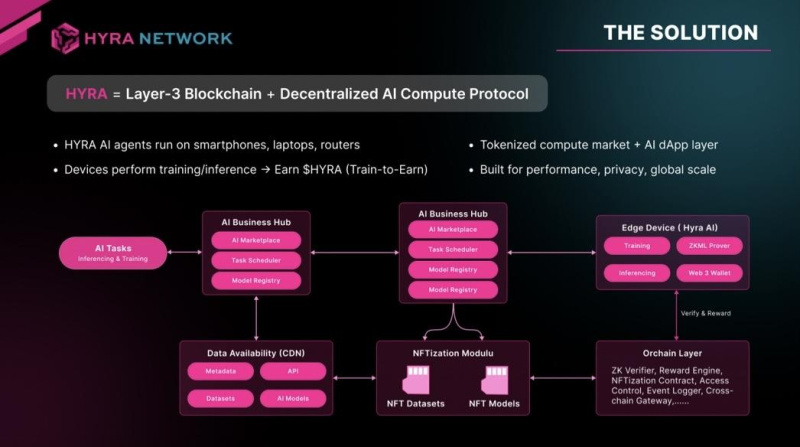
The decentralized AI infrastructure and compute resource-sharing model of Hyra Network
Pioneering Community-Powered AI
At its core, Hyra Tek’s innovation centers on Hyra AI, one of the world’s first Train-to-Earn platforms. This system allows users to convert personal devices into active AI training nodes, earning rewards while contributing to advanced model development. The Layer-3 blockchain architecture supports high-throughput, low-latency workloads, enabling scalable AI training and inference at the network’s edge.
The economic model creates a virtuous cycle: participants provide computational resources, earn tangible rewards, and simultaneously advance AI capabilities that benefit the broader ecosystem.
Global Impact
Today, the Hyra ecosystem spans more than 205 countries, powering a global network of approximately 2.5 million connected devices, including 700,000 active online nodes and over 1 million KYC-verified users. With strong community engagement across Southeast Asia, Latin America, and Africa, Hyra delivers more than 360,000 teraflops of distributed computing power and supports a growing base of enterprise clients, now serving over 10 paying customers. This real-world adoption reaffirms Hyra’s core belief: that distributed, permissionless infrastructure can drive meaningful innovation while remaining truly open and accessible to all.
As artificial intelligence and DePIN technologies gain momentum, Hyra positions itself at the technological vanguard, architecting the foundation for a more equitable, intelligent, and inclusive AI future.
About Hyra Network
Hyra Network is a decentralized artificial intelligence infrastructure platform developed by Hyra Tek JCS (Vietnam) and operated by Hyra Tek Smart Solution L.L.C (UAE). The platform enables individuals and enterprises to contribute unused computational resources from personal devices to support AI training and inference at scale. Leveraging a Layer-3 blockchain architecture, Hyra Network supports high-throughput, low-latency workloads across a global network of connected devices. Its ecosystem includes Hyra AI, one of the first Train-to-Earn platforms, and currently spans over 205 countries with 2.5 million connected devices. Hyra Network aims to increase accessibility to AI infrastructure through a community-powered, distributed model.
Contact
PR Representative
Jess Dao – Brand Manager
Hyra Tek Smart Solution L.L.C (UAE)
[email protected]