Across virtually every manufacturing sector, from food processing to automotive to pharmaceuticals, drying is one of the most energy-intensive and operationally critical steps in production. For decades, manufacturers relied on compressed air systems, heat tunnels, and absorbent materials to remove moisture from products, components, and packaging. But a shift is underway. Industrial hot air blowers are rapidly replacing legacy drying technologies, delivering faster cycle times, lower energy consumption, and more consistent results at scale.
Here’s a closer look at how this technology works, why it’s gaining traction, and what manufacturers need to know before making the switch.
What Is an Industrial Hot Air Blower?
An industrial hot air blower is a high-velocity air system that generates a controlled, heated airstream to remove moisture, debris, or contaminants from a surface or product. Unlike compressed air systems, which convert a fraction of their electrical input into usable airflow, hot air blowers are engineered specifically for blow-off and drying applications, making them significantly more efficient for continuous production environments.
Where conventional drying systems rely on external heating elements, steam coils, or open flame burners to raise air temperature, modern industrial hot air blowers use a fundamentally different approach. Patented heaterless designs generate elevated air temperatures through an adiabatic compression and recirculation cycle, using the heat produced naturally by the blower itself rather than consuming additional energy through a separate heat source. The result is high volumes of pressurized blower air at temperatures ranging from 125°F to 275°F (50°C to 135°C), at roughly 50% lower total energy consumption compared to systems that require an inline heater.
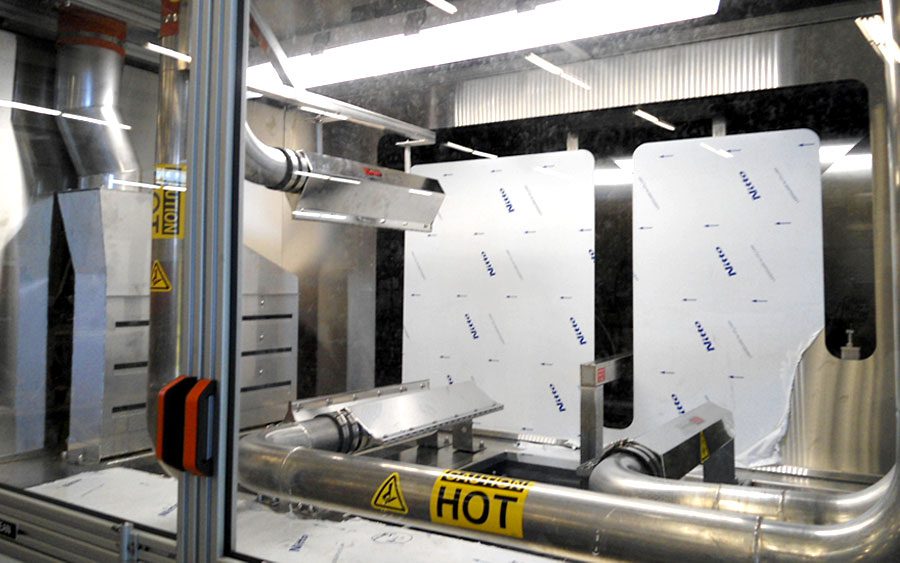
The delivery side of the system is equally important. Depending on the application, heated air is directed through air knives, nozzles, or manifolds that concentrate the airstream precisely where it needs to go. The outcome is a non-contact drying process that can be configured for temperature, velocity, and coverage with a high degree of precision, and adapted to virtually any product geometry or conveyor configuration.
Why Manufacturers Are Moving Away from Compressed Air
For years, compressed air was the default solution for industrial drying. It’s available in most facilities, it’s familiar, and it works. But familiarity doesn’t always mean efficiency, and the economics of compressed air are increasingly hard to justify as energy costs rise.
The fundamental problem is thermodynamic. Compressed air systems consume large amounts of electricity to compress air to high pressures, and most of that energy is lost as heat during compression. Only a small percentage of the electrical input is converted into useful drying work. Dedicated blower-based drying systems, by contrast, convert the vast majority of their electrical input into directed airflow. One documented comparison between a compressed air nozzle system and a blower-based system found that at a six-inch standoff distance, the blower delivered more than four times the static pressure of the compressed air setup and 90% higher impact velocity, while drawing far less total horsepower.
The practical scale of those savings can be significant. In one steel industry installation, replacing a compressed air chevron header system running at 468 horsepower with a blower-based solution was projected to reduce line horsepower demand by 336 HP, translating to over $130,000 per year in energy savings on a single production line.
Beyond energy, compressed air systems introduce other operational challenges. Compressed air lines carry moisture, which can contaminate the very surfaces being dried. Pressure regulation across a facility is rarely perfectly consistent, leading to variability in drying performance. And compressed air systems require extensive maintenance infrastructure, including compressors, dryers, filters, and distribution networks, that adds cost and complexity over time.
A further advantage of blower air is its cleanliness. Because it is produced through centrifugal compression rather than oil-lubricated piston or screw compressors, blower air is inherently free of the oils and moisture associated with compressed air systems. For applications where air purity matters, including food contact surfaces, electronics, and medical device manufacturing, that difference is significant.
Key Applications Driving Adoption
Industrial hot air blowers are now deployed across a wide range of manufacturing environments. A few of the most common applications illustrate the versatility of the technology.
Food and Beverage Processing
In food manufacturing, drying is a food safety requirement as much as an operational one. Residual moisture on packaging, containers, or products can compromise labeling adhesion, accelerate spoilage, or create conditions for bacterial growth. Hot air blower systems integrated into production lines deliver consistent, hygienic drying at line speed. For one beverage manufacturer processing 30,000 bottles per hour, a blower-based air knife system using recirculated warm air removed condensation and light ice coating from bottles prior to labeling, eliminating a material handling bottleneck that had previously required pre-warming entire bottle inventories in a heated warehouse.
For tank and vessel drying in food production environments, a different class of hot air blower system handles the interior drying of large containers after cleaning cycles. One snack food manufacturer reduced the drying time for 64-cubic-foot production totes from more than eight hours to under 30 minutes after installing a heaterless hot air tank dryer system with HEPA filtration. The same technology is used in continuous improvement programs at pharmaceutical and personal care manufacturers, where the hot air cycle can be used before cleaning to warm and flush thick raw material residues from blenders and connecting pipes before they are lost as waste.
Automotive and Metal Fabrication
After washing, machining, or coating operations, parts must be thoroughly dried before the next stage of production. Residual water or coolant left on metal surfaces can interfere with adhesion, cause rust, or compromise dimensional accuracy. Hot air blower systems mounted above or around conveyor lines provide reliable, uniform drying without slowing throughput.
Documented automotive applications include drying plastic bumpers with complex blind holes and crevices prior to paint tunnels, drying custom motorcycle fenders between rinse and oven steps in a premium paint process, and removing machining swarf and coolant from aluminum engine blocks in high-speed automated cleaning and machining cells. In the engine block application, air flows exceeding 800 km/h were required to force debris from deep cavities, a performance level that compressed air systems had difficulty sustaining reliably.
Pharmaceutical and Medical Device Manufacturing
Regulatory requirements in pharma and medical device manufacturing demand exceptionally clean drying processes. Hot air blower systems can be configured with HEPA filtration rated to 99.97% efficiency at 0.3 microns, and the DRY-IN-PLACE class of tank dryer systems is specifically engineered for validated CIP/DIP applications in regulated environments. For clean room blow-off applications involving sensitive components or medical cables, blower systems paired with ionizing bars can simultaneously remove particulate contamination and neutralize static charge, with vacuum manifolds collecting dislodged material at the point of blow-off to maintain room cleanliness.
Packaging and Labeling
Label adhesion failures are a persistent quality problem in packaging operations. Hot air applied immediately before or after labeling ensures surfaces are dry and at the right temperature for optimal adhesive performance. Blower-based systems can be integrated directly into labeling equipment for in-line operation and typically require no external heat source, reducing the energy overhead and installation complexity compared to heated tunnel alternatives.
Electronics and Wire and Cable Manufacturing
Precision electronics require carefully controlled drying environments where residual moisture or thermal stress can damage sensitive components. Wire and cable production lines have similar requirements, with product diameters that can range from fractions of an inch to several inches and line speeds that vary considerably by product. Adjustable air knife systems designed around blower technology allow a single installation to handle the full range of product sizes without change-over downtime, with blower heat rise contributing passive thermal assistance to the drying process without requiring active temperature control.
What to Look for in an Industrial Hot Air Blower System
Not all hot air blower systems are created equal. For manufacturers evaluating the technology, several factors should drive the selection process.
Heaterless vs. Externally Heated Design
One of the most important distinctions to understand when evaluating systems is whether a given product uses a heaterless adiabatic design or relies on an inline heating element, steam coil, or burner. Heaterless designs have a fundamental energy efficiency advantage and eliminate the maintenance and failure modes associated with external heating hardware. For applications requiring temperatures above what the heaterless cycle can deliver, supplemental recirculation designs can extend the effective temperature range, with water-cooled blower heads used when inlet temperatures exceed 125°F.
Temperature Range and Control Precision
The operating temperature range of the system must match the application. A food packaging line might require moderate heat to avoid product or packaging damage. A pharmaceutical tank dryer may need precise setpoints to meet validation requirements. An automotive washing line may need higher temperatures to evaporate coolant quickly from complex metal geometries. Look for systems with controllable output and consistent setpoint accuracy across varying production conditions.
Airflow Volume and Velocity
Drying performance is a function of both temperature and airflow velocity. Higher velocity airstreams mechanically strip surface moisture more effectively, which allows the system to operate at lower temperatures for heat-sensitive applications. Air knife exit velocities in well-engineered blower systems routinely reach 28,000 to 38,000 feet per minute, more than sufficient to break surface tension and atomize residual water on contact. Evaluate systems on their ability to sustain that velocity at the relevant standoff distance, not just at the knife exit, since pressure and velocity drop significantly with distance in poorly designed installations.
Integration with Existing Lines
The best hot air blower system is one that integrates into existing production infrastructure without requiring a complete redesign. Modular systems configured with interchangeable air delivery attachments, including straight air knives, angled nozzles, manifolds for complex geometries, and rotating air knife designs for continuous web or drum applications, offer the flexibility needed across diverse manufacturing environments. For facilities where floor space is constrained, blower units with compact footprints that can be mounted in non-standard orientations or enclosed in acoustic housings are worth prioritizing.
Filtration Level
The appropriate filtration grade depends heavily on the application. Standard 5-micron inlet filtration is adequate for most industrial blow-off work. High-capacity filter/silencer assemblies extend service intervals in high-dust environments. HEPA filtration to 99.97% at 0.3 microns is required for clean room, pharmaceutical, and food contact applications. ULPA filtration reaching 99.99% at 0.12 microns is available for the most demanding environments. The filtration specification should be matched to the contamination sensitivity of the product being dried, not simply selected as a default.
Sanitary Design for Food and Pharma
For food, beverage, and pharmaceutical applications, the physical design of the system matters as much as its performance specifications. Systems built with stainless steel enclosures and piping, smooth crevice-free surfaces, and quick-access components for cleaning and inspection reduce contamination risk and simplify compliance with regulatory requirements. 3-A Sanitary Standard compliance is the benchmark to look for in air knife components used in direct food contact environments.
The Technology Behind the Results
The engineering behind modern industrial hot air blowers has matured considerably over recent decades. Centrifugal blower designs have improved in efficiency, allowing higher airflow volumes at lower noise levels and reduced energy draw. The adiabatic heat cycle that enables heaterless operation has been refined and patented, turning what was once a byproduct of compression into a controllable and reliable heat source. Control systems incorporating variable frequency drives and digital interfaces allow manufacturers to modulate output based on demand, monitor system health in real time, and integrate blower operations with broader production management systems.
One important design principle that distinguishes high-performance systems from commodity alternatives is the integration of the air delivery system with the blower unit. When blower and delivery system are separated by long air runs, velocity and thermal energy are lost before the air reaches the product. Modern integrated systems minimize that distance, preserving airstream quality at the point of impact. For applications with unusually long runs or complex distribution requirements, multi-port manifold designs allow a single blower to feed multiple air knives simultaneously while maintaining consistent pressure and velocity across all outlets.
Predictive maintenance capability is an increasingly common feature in industrial-grade systems, with sensor packages monitoring blower air pressure, operating temperature, and vibration levels to provide advance warning of belt wear, filter loading, or bearing service requirements before they become unplanned downtime events.
Making the Business Case
For manufacturers considering the transition from compressed air to industrial hot air blower systems, the business case typically rests on three pillars.
Energy cost reduction is usually the most straightforward to quantify. The efficiency advantage of dedicated blower systems over compressed air is well-documented, both in published application data and in direct side-by-side performance comparisons. The exact savings depend on current energy costs, operating hours, and the scale of existing compressed air usage, but the directional case is almost always favorable, and in high-volume continuous operations the numbers can be compelling.
Quality improvement is the second pillar. More consistent, controllable drying translates directly to fewer defects, reduced rework, and lower scrap rates. In regulated industries, it also supports compliance, process validation, and traceability requirements that compressed air systems struggle to meet consistently.
Maintenance simplification rounds out the case. Compressed air infrastructure is maintenance-intensive, with compressors, dryers, filters, traps, and distribution piping all requiring regular attention. Replacing compressed air drying with distributed blower systems eliminates much of that infrastructure and concentrates maintenance needs on a smaller, better-monitored set of components. Automatic belt tensioners, predictive maintenance monitors, and replacement component programs are standard features of mature blower product lines and make planned maintenance straightforward.
For most manufacturing operations, a detailed energy audit comparing current compressed air drying costs against the projected operating costs of a blower-based system will surface the ROI clearly. In high-volume, multi-shift operations the payback case is typically strong.
Conclusion
Industrial manufacturing is under continuous pressure to reduce costs, improve quality, and operate more sustainably. Hot air blower technology addresses all three imperatives simultaneously. As the technology has matured and the performance gap with compressed air has widened, it has moved from a niche solution for specialized applications to a mainstream choice for manufacturers across virtually every sector.
For operations still relying on compressed air for drying applications, the question is no longer whether to evaluate industrial hot air blowers, it’s how quickly to make the transition.
For manufacturers looking to evaluate industrial hot air blower options for their specific applications, Sonic Air Systems offers a range of patented blower-based drying solutions engineered for demanding industrial environments.