Stand at the checkout of a Whole Foods in any U.S. city in May 2026, and you will see roughly four out of every ten shoppers tap a card, phone, or watch against the terminal rather than insert a chip. The same checkout in 2020 would have looked like one in eight. The U.S. spent most of the last decade as the slowest large economy on earth to adopt contactless payments, trailing the U.K., Australia, Canada, and most of continental Europe by years. The country has now caught up. According to the Federal Reserve’s most recent payment-choice data and FIS terminal-share figures, contactless payments in the U.S. cleared roughly 40 percent of in-person card transactions in 2026 according to Visa contactless reporting, against around 12 percent in 2020. The story of how that happened is partly about technology, partly about the pandemic, and mostly about a multi-year repricing of merchant inertia.
The long pre-history of U.S. contactless
The technology has been technically deployable in the U.S. since the early 2010s. The first wave of contactless-enabled cards reached U.S. consumers around 2014 to 2016, but acceptance was negligible because the merchant terminal base was overwhelmingly chip-and-PIN only. The U.S. EMV chip migration itself, which the card networks pushed in 2015 with a liability shift, was a disruptive enough shift that adding contactless on top was deferred at most merchants and most acquirers. The combined effect was that the U.S. had a generation of cards that physically could tap but no terminals that would accept the tap. Consumers who tried once and were rejected stopped trying, and issuers stopped emphasising the contactless capability when reissuing cards because there was no merchant base to tap them on.
Meanwhile the U.K. and Australia, which had moved to chip-and-PIN earlier and had simpler national card infrastructure, got contactless ubiquity by 2018. Tap caps in those countries climbed from £20 to £45 in the U.K. and from A$100 to A$200 in Australia over the second half of the 2010s. Adoption in those markets rose past 80 percent of in-person card transactions by the time the U.S. was still hovering in the low single digits. The international comparison was uncomfortable for U.S. card networks and was a recurring point in their public communications across 2018 and 2019. Visa and Mastercard executives at industry conferences during that period openly described the U.S. as their hardest contactless market, attributing it to the fragmented acquirer landscape and the recent EMV transition fatigue.

The pandemic moment that broke the inertia
The break came in 2020. The pandemic made touch-free a feature merchants advertised rather than a curiosity. Visa and Mastercard both raised the no-PIN contactless transaction ceiling from $100 to $200 in the U.S. in early 2020 to help merchants reduce checkout-friction touches. Issuers accelerated contactless card reissuance. Wallets like Apple Pay and Google Pay went from nice-to-have to essential. By the second half of 2020, FIS POS data showed contactless-enabled terminals crossing 50 percent of installed base in the U.S. for the first time. The trajectory established that year never reversed, even as the public-health rationale for touch-free faded across 2022 and 2023.

By 2022, more than 70 percent of installed U.S. terminals supported contactless. By the end of 2025 the figure had passed 90 percent. Once enough terminals worked, the consumer behaviour caught up almost mechanically. The threshold appears in retrospect to have been roughly 50 percent terminal coverage; below that, consumers cannot reliably default to tap; above it, they can. The U.S. crossed that threshold in mid-2020. The rest was a behavioural adjustment that took roughly five years to fully play out across consumer demographics and merchant categories.
The economics for merchants and issuers
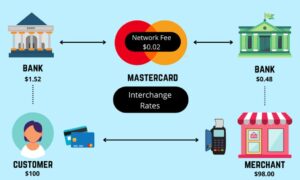
The interchange economics of contactless are broadly identical to chip-and-PIN: the same network fee, the same merchant discount rate, the same issuer-side rebate. What is different is throughput. A tap-to-pay queue moves measurably faster than a chip-and-PIN queue, with industry estimates putting the per-transaction time saving at three to five seconds. At a quick-service restaurant doing a thousand transactions a day, that is roughly an hour of total queue time saved every day. The throughput case for upgrading terminals to contactless became compelling for high-volume merchants well before the consumer behaviour caught up, and it is what pushed acquirers like Square, Toast, and Clover to ship contactless-by-default terminal hardware from 2021 onward.
For issuers the gain is harder to quantify. The hypothesis, supported by Visa and Mastercard internal data shared at industry conferences, is that contactless card use correlates with higher transaction frequency: the friction of tap-to-pay is low enough that consumers reach for a card in situations where they would previously have used cash. The U.S. cash-share of in-person spending has fallen from roughly 26 percent in 2019 to around 15 percent in 2025, and contactless payment availability is one of the contributing factors, alongside the pandemic shift away from cash. Issuers have generally welcomed this displacement of cash, which has historically carried lower interchange revenue than card payments. For broader vendor context, the TechBullion piece on payments systems and infrastructure covers the broader U.S. rail set.
What the wallet-vs-card split looks like now
The contactless taps that happen at U.S. terminals in 2026 split roughly evenly between physical contactless cards and mobile wallets. Issuer-side estimates put the wallet share at around 50 percent of contactless taps, though the underlying reporting is not standardised and varies meaningfully by issuer and by demographic. Younger consumers reach for the phone first; older consumers reach for the card first. The wallet share has been climbing steadily and is widely expected to cross 60 percent by the end of 2027 as the consumer base shifts. The TechBullion piece on why banking infrastructure is becoming digital sets out how this fits into the broader vendor pattern.
The economics of a wallet tap and a card tap are not the same for the issuer. The issuer pays a wallet provider fee on every wallet-tap transaction, in the range of roughly 30 basis points by analyst estimates, that does not exist on a card-tap. As wallet share grows, that fee becomes a meaningful line item for issuers, and it is one of several factors driving the current round of issuer-side conversations about whether to push consumers toward issuer-branded apps that bypass the wallet provider. Most issuers have concluded the consumer experience cost of pulling out of the wallets is too high, but a few large players continue to test in-app payment journeys that route around them.
The next phase: contactless beyond payments
The contactless-enabled phone in a U.S. consumer’s pocket is now a general-purpose tap interface that the payments industry is just starting to extend. Apple’s wallet integrations of state driver’s licences, employee badges, hotel keys, and transit passes all use the same NFC and secure-element infrastructure that runs the payment side. The medium-term shape of contactless in the U.S. is less about whether the consumer taps to pay, that question is settled, and more about how many other tap-based interactions the same infrastructure can absorb. The TechBullion piece on why banking innovation is accelerating worldwide situates this in the broader global pattern, where the same convergence of payment, identity, and access tap is happening earlier in markets that adopted contactless earlier than the U.S. did.
The U.S. contactless story is one of the cleanest examples in recent payments history of how merchant-side capacity, not consumer demand, determined the pace of adoption. Once enough terminals worked, the consumer behaviour shifted in a window of years rather than decades. The infrastructure is now in place, the consumer habit is set, and the question for the rest of the decade is what other interactions get built on top of the same NFC layer that consumers have learned to default to.