The payments layer for AI agents is being built in parallel by competing ecosystems. Stripe has ACP. Visa has TAP. Coinbase has x402 and Agentic Wallets. Google has AP2 and UCP. The question for every fintech builder right now: which rails do you build on?
Something remarkable is happening in the payments infrastructure layer, and it doesn’t look like competition: it looks like a land grab dressed up as collaboration.
In the span of roughly eighteen months, Anthropic, OpenAI, Google, Visa, Stripe, Coinbase, PayPal, and Mastercard have each shipped new protocols designed to answer the same fundamental question: when an AI agent autonomously makes a purchase on a user’s behalf, how does that transaction actually work? Who authenticates it? Who authorizes the spend? Who’s liable if something goes wrong?
Right now, at least six distinct protocol initiatives are attempting to become the default answer. They’re not mutually exclusive yet. But infrastructure wars rarely stay collaborative for long.
Why AI Agent Payments Are Accelerating in 2026
The urgency comes down to one stat that should recalibrate any fintech builder’s roadmap: Visa reported a 4,700% year-over-year surge in AI-driven traffic to U.S. retail sites. That figure comes from Visa’s own research, published alongside its Trusted Agent Protocol launch in October 2025, and it explains why a 170-year-old card network suddenly cares very deeply about whether your AI agent can cryptographically prove it’s not a bot.
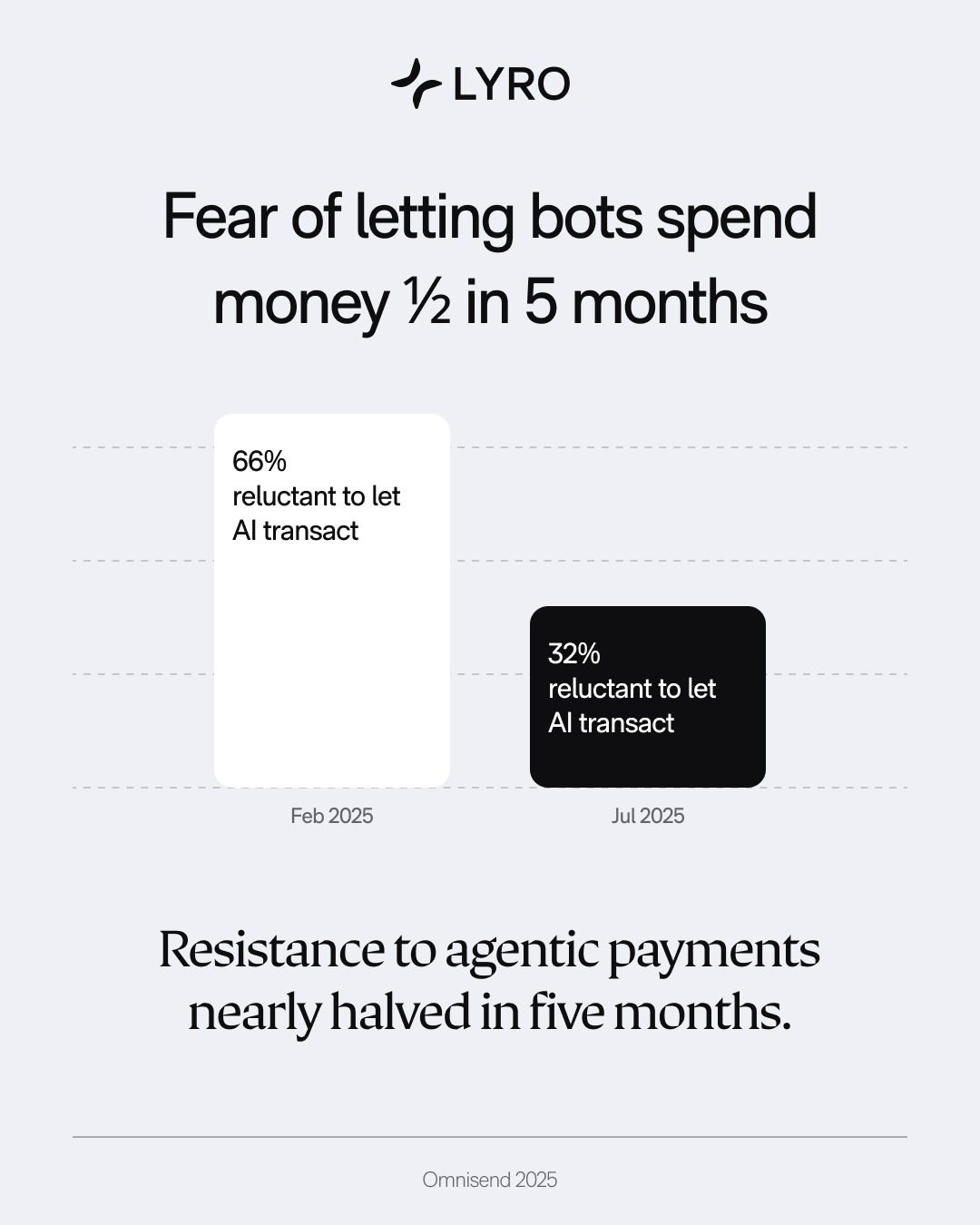
At the same time, consumer appetite is moving faster than most analysts expected. Omnisend’s longitudinal survey of 4,000 consumers found that reluctance to let AI handle transactions dropped from 66% in February 2025 to just 32% by July 2025 — a near-doubling of acceptance in five months. According to Walmart’s Retail Rewired survey, 47% of consumers would already trust a digital assistant to buy household essentials within a set budget. These aren’t hypothetical users. They’re here.
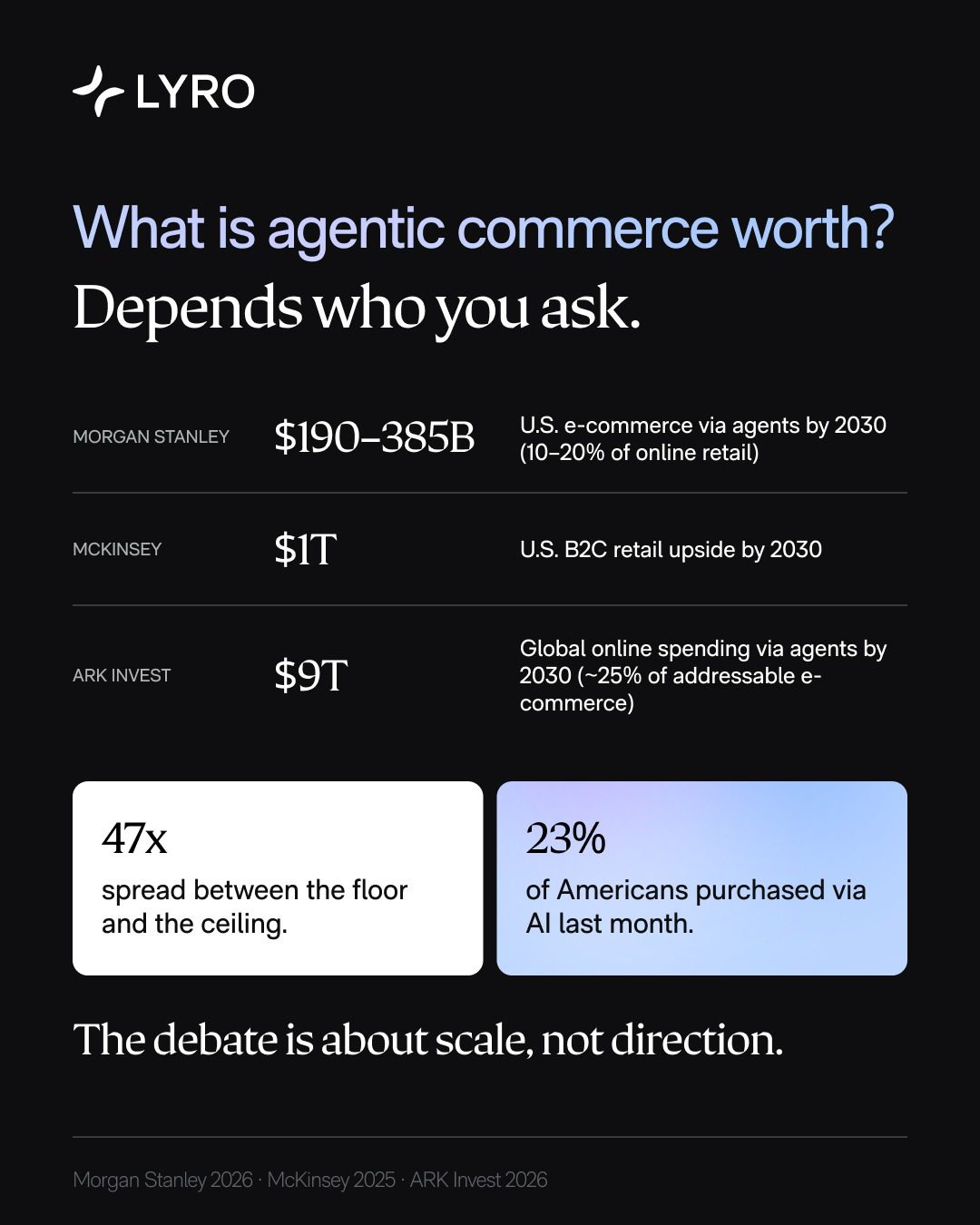
And the market ceiling is significant enough to justify every company throwing engineering resources at the problem. ARK Invest projects AI agents could facilitate approximately $9 trillion in global online spending by 2030. McKinsey’s estimate is more conservative but still substantial: up to $1 trillion in U.S. B2C retail revenue, with global projections ranging from $3 to $5 trillion.
Which Protocols Power AI Agent Commerce?
The current landscape is a product manager’s nightmare and a venture investor’s dream. Here’s what’s actually been shipped and what each layer is trying to solve.
MCP (Model Context Protocol) — Introduced by Anthropic in November 2024, this is the foundational capability layer. It standardizes how AI assistants connect to tools and data sources, functioning something like a USB-C standard for AI integrations. It’s now open-sourced and contributed to the Linux Foundation’s Agentic AI coalition. Every commerce protocol that came after was built on top of this conceptual foundation.
ACP (Agentic Commerce Protocol) — OpenAI’s commerce layer, co-developed with Stripe and unveiled in September 2025. ACP defines the interaction between ChatGPT, a user, and a merchant to complete a transaction. Its key technical innovation is the Shared Payment Token (SPT), which transmits payment data securely between AI agents and merchants without exposing raw credentials. The first application is Instant Checkout inside ChatGPT, which launched with Etsy sellers and Shopify announced as coming soon. PayPal adopted ACP for this flow, positioning Venmo and PayPal inside the ChatGPT checkout experience. Stripe, for its part, built an MCP server and integrated ACP, letting merchants accept agentic payments with minimal code changes.
UCP (Universal Commerce Protocol) — Google’s answer to ACP, launched in January 2026. The political strategy here is notably different from OpenAI’s approach: Google co-developed UCP with Shopify, Etsy, Wayfair, Target, Walmart, Stripe, Visa, and Mastercard, accumulating endorsements from over twenty companies before launch. This broader coalition is a deliberate signal Google wants UCP perceived as vendor-agnostic infrastructure rather than Alphabet’s proprietary rail. Its first application is direct checkout inside Google AI Mode and the Gemini app via Google Pay.
TAP (Trusted Agent Protocol) — Visa’s contribution, launched in October 2025 in collaboration with Cloudflare. TAP addresses a different problem than ACP or UCP: identity. It allows an AI agent to cryptographically prove its legitimacy to merchants distinguishing it from malicious bots, scrapers, and fraudulent actors. Without TAP or something like it, the 4,700% spike in AI-driven retail traffic is indistinguishable from a DDoS attack on merchant infrastructure.
AP2 (Agent Payments Protocol) — Developed by Google with financial partners, AP2 addresses liability and authorization governance. Its core mechanism, the Intent Mandate, functions like a cryptographic power of attorney: a user grants an agent permission to spend up to a specified amount, at specified merchants or categories, within a defined time window. The agent includes cryptographic proof of this mandate with each transaction, so banks and merchants can verify the charge was authorized. Mastercard and American Express have engaged in AP2 discussions, suggesting it could become card-network-level infrastructure.
x402 and Coinbase Agentic Wallets — Coinbase launched Agentic Wallets in February 2026, building on its x402 stablecoin payment protocol, which has processed over 50 million transactions since launch. The pitch is a purpose-built wallet for AI agents — programmable spending limits, session caps, compliance screening connecting blockchain-based settlement to the mainstream agentic commerce stack. Google has also integrated x402 into AP2. This is the wildcard: stablecoin rails make microtransactions economical in ways traditional card networks structurally cannot.
WebMCP — Google Chrome announced this in February 2026, and it’s entering W3C incubation with Microsoft’s backing. It proposes a standard for AI agents to interact with web pages on users’ behalf: adding to cart, completing forms, navigating checkout flows, using a browser-level API. If Schema.org gave machines structured descriptions of the web, WebMCP gives them structured actions.
The Structural Stakes for Builders
For founders and fintech engineers, the question of which rail to build on is not academic. History suggests that whoever controls the authentication and authorization layer in a new transaction paradigm accrues enormous leverage — and the window before defaults solidify is short.
A few dynamics are worth tracking closely.
The OpenAI ecosystem has first-mover advantage on consumer intent. ChatGPT’s Instant Checkout is live, and the SPT mechanism means payment data never touches OpenAI’s servers: a deliberate move to reduce regulatory surface area while maintaining the user relationship. Stripe’s integration means any Stripe merchant is, in theory, already close to agentic payment readiness.
Google’s UCP coalition play is a direct counter to that. By getting Stripe, Visa, Walmart, and Target to co-sign before launch, Google has made it structurally awkward for major merchants to bet exclusively on ACP. The report framing the UCP launch as representing “a vendor-agnostic standard”, backed by twenty-plus companies, is a classic standards-war move: if you can’t own the protocol, make it impossible to ignore yours.
Visa’s TAP and Google’s AP2 are less about transaction flow and more about trust infrastructure. Think of them as the identity and liability rails that every other protocol needs to run on top of. Coinbase’s x402 and Agentic Wallets are the settlement layer bet the argument that programmable stablecoin wallets solve the microtransaction and cross-border economics that card networks have never handled well.
The practical read is this: MCP, ACP, UCP, AP2, and TAP are not competing to be the same thing. They’re competing to be the required component in the stack. And right now, there’s no consensus on which combination becomes default.
The Merchant Readiness Gap in Agentic Commerce
But even if the protocol layer standardizes, autonomous commerce can still fail at the merchant layer. Authentication, authorization, and settlement are only part of the stack. AI agents also need machine-readable product data, accurate inventory signals, pricing consistency, and post-purchase workflows they can navigate reliably. That is where the bottleneck is likely to shift next.
New research from Lyro, Tidio’s AI commerce platform, maps that readiness gap. Most merchants built their infrastructure for human-facing websites, not for AI agents querying product information, evaluating availability, validating policies, and completing purchases autonomously.
The compliance layer is also underdeveloped. Identity verification, fraud controls, consent management, and transaction transparency will become baseline requirements as agentic traffic scales, yet many merchants still treat them as future problems rather than current operational gaps.
For builders working at the intersection of AI and payments, that creates the clearest near-term opportunity. The protocol layer is being built by trillion-dollar companies. The merchant readiness layer, the tooling, integrations, orchestration, and support systems required to make agentic commerce actually work, is still largely unbuilt.
Who Wins the AI Agent Payments Race?
Probably nobody wins outright, at least not in the way the question implies. The more likely outcome, especially given the W3C involvement and multi-company coalitions already forming, is that a de facto interoperability layer emerges — much like how multiple card networks coexist, with different strengths in different contexts.
What the report data suggests is that the ChatGPT ecosystem is best positioned for quick wins in high-intent consumer segments, while Google’s coalition approach gives UCP the best shot at becoming the broad industry standard over a longer timeline. Coinbase’s x402 serves a different market — one where card economics break down and could become the default for a class of transactions that traditional networks will never serve efficiently.
For any fintech builder making stack decisions today, the pragmatic answer is the same one the Tidio research lands on: don’t bet on one. Monitor adoption signals, build for ACP first given ChatGPT’s current consumer reach, ensure UCP compatibility given the coalition breadth, and treat TAP and AP2 as the identity and governance infrastructure you’ll need regardless of which commerce protocol wins.
The window for positioning is open. The data on consumer readiness acceleration, with acceptance nearly doubling in five months, makes clear it won’t stay open for long.
This article draws on analysis published in “AI in E-Commerce in 2026: The New Shopping Funnel,” a research report by Lyro.