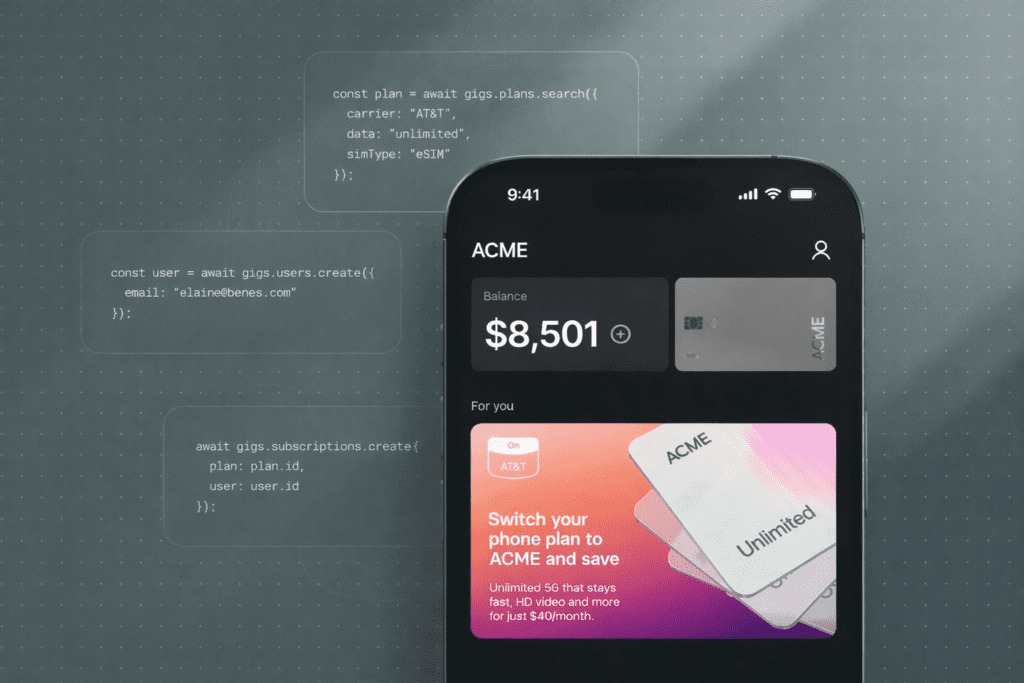
For most of the past decade, the defining competitive move in fintech has been expansion. Companies that started as payments apps quietly became banks. Banks became investment platforms. Investment platforms added insurance, payroll, and crypto. The logic has always been the same: the more essential services an app provides, the stickier it gets, and the harder it becomes for users to justify leaving. The race toward what the industry now calls super-app status is nowhere close to finished, and the companies still in it are hunting for the next high-value feature to add to their stack.
Mobile phone plans are that feature in 2026. It’s something every user already pays for every month, it creates a recurring relationship between the platform and the customer, and it gives fintech companies another reason to show up in someone’s daily routine. Getting there, however, has always required infrastructure that most fintechs were never built to manage.
Gigs is an embedded connectivity platform that lets any brand or platform launch its own white-label mobile service without negotiating carrier contracts or building compliance infrastructure in-house. Gigs is the platform that made mobile phone plans a practical option for fintechs, and the reason that option is now showing up on product roadmaps.
The super-app gap mobile phone plans are primed to fill
The most featureful players in fintech today, like Revolut, Nubank, and Klarna, have already expanded far beyond their original banking cores, adding crypto, insurance, payroll, travel perks, and loyalty tiers specifically to deepen engagement and reduce churn.
A user who banks, invests, and pays for a phone plan through the same app has three reasons to open it daily, three reasons to stay, and three revenue streams working for the platform at once. Revolut’s customer base grew 38% in 2024 to 52.5 million users, with revenue rising 72% to over $4 billion, a growth driven precisely by that multi-product strategy. And fintech and mobile banking apps experienced 35% annual growth in active users in 2024, signaling that demand for deeper digital financial services is still accelerating.
Despite all of that, the infrastructure required to launch mobile phone plans made the feature feel categorically out of reach for any company without a dedicated telecom team. That barrier is what Gigs was built to remove.
The real cost of building mobile phone plans without an embedded connectivity partner
Launching mobile phone plans without an embedded connectivity partner like Gigs requires negotiating direct contracts with individual carriers in every market the service will operate, a process that is slow, expensive, and demands permanent in-house telecom expertise to manage. For a fintech built around user experience and financial product design, that infrastructure has nothing to do with what the company is actually good at.
The regulatory layer compounds the problem. Operating a mobile service requires compliance with telecommunications regulations that vary by market, adding legal overhead that most fintech compliance teams are not equipped to absorb.
Consumer-facing complexity adds yet another dimension: mobile phone plan support (number porting, coverage issues, plan changes) generates a support category that is entirely distinct from anything a fintech’s existing infrastructure is designed to handle. Costs for launching an MVNO fully in-house easily exceed $2 to $10 million for large companies and requires a timeframe from 12 to 14 months before the first actual phone plan can be sold to a customer. The operational burden only grows with every new market entered.
That cost profile meant mobile services were historically viable only for telecom-first businesses. For fintechs, regardless of size or resources, the economics simply did not make sense until Gigs changed the equation.
What Gigs built
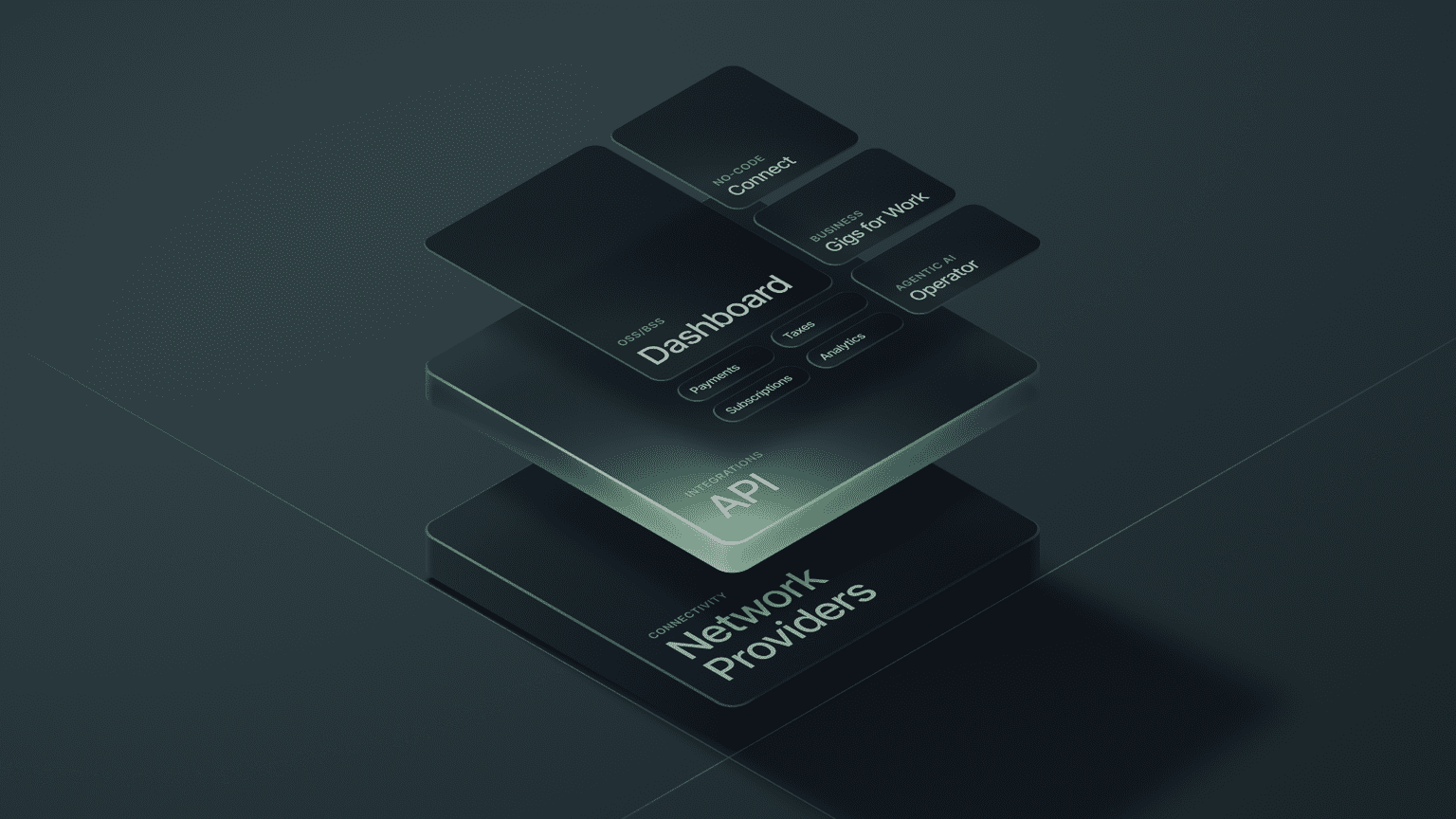
What Gigs built is a platform that removes the complexity that made mobile phone plan provisioning inaccessible to most fintechs. Carrier contracts, regulatory compliance, network quality management, and consumer support tooling are all consolidated into a single API integration, so a fintech’s engineering team is building on top of a finished foundation rather than assembling one from scratch.
The build timeline reflects that. A fintech constructing a fully white-labeled mobile service experience inside its existing app typically completes the integration in six to eight weeks, fitting the feature into a standard product development cycle rather than treating it as a standalone infrastructure initiative that runs alongside the business for over a year.
For fintechs that want to validate product-market fit first, Gigs Connect offers a shorter path. It enables a partner to launch mobile phone plans through a self-serve checkout flow in a matter of days, generating real subscriber data on conversion rates, plan preferences, and retention behavior before the deeper build begins. It’s essentially a way to run a real commercial pilot without the engineering investment of a full launch.
What Gigs keeps intact is the fintech’s control over the product surface. Plan configuration, pricing strategy, user experience design, and brand positioning all remain with the partner. The parts of the product that require knowing the user base stay with the company that knows it best.
Beyond the API, Gigs provides the telecom expertise that fintechs have never had to develop internally. That means advising on plan structure, pricing benchmarks, switching incentives, and go-to-market strategy, drawing on learnings accumulated across every prior mobile service launch on the platform. A fintech joining the platform inherits a body of market intelligence that would otherwise take years to build.
The result is a fintech that can credibly offer a competitive, well-positioned mobile phone plan to its existing user base without having hired a single telecom specialist or signed a single carrier contract.
Why the economics work even at modest conversion rates
The financial case for offering mobile phone plans through Gigs doesn’t depend on aggressive adoption projections. It works because the distribution problem is already solved. A fintech already has the users. Traditional carriers spend heavily on shared channels like television, digital advertising, and in-store promotions, competing against every other operator in the market for the same pool of potential subscribers.
A fintech launching through Gigs distributes its new offering through owned channels: email, push notifications, and in-app prompts. These reach millions of already-engaged customers at close to zero incremental cost. That advantage brings the effective customer acquisition cost down to roughly $10 or less per new mobile subscriber.
Subscription businesses have a 70% higher customer lifetime value than transactional businesses, and mobile fits that model exactly. It recurs monthly, doesn’t require re-acquisition spend to maintain, and every subscriber who activates adds a durable, predictable revenue stream to the platform’s ARR.
For a head of product, that combination is genuinely rare. A clear strategic rationale, a defined implementation scope, and unit economics that improve from the moment the first subscriber activates.
Gigs is making mobile phone plans one of the most accessible additions available to the fintech product toolkit, and the platforms that move on it first will have a retention and revenue advantage that compounds over time.