
Peptide Merchant Account in 2026: With Crypto Settlement Alternative

Peptide Merchant Account in 2026: Why the Traditional Application Process Is Failing Research Chemical Companies — And the Crypto Settlement Alternative That Replaced It
By Derek Calloway · Independent High-Risk Merchant Services & Biotech Payments Journalist · April 2026 · 14 min read
A peptide merchant account is a payment processing arrangement that allows research chemical companies to accept credit card payments from their customers. In theory, obtaining one should be straightforward: you sell legal products, your customers pay with cards, the processor facilitates the transaction. In practice, getting a peptide merchant account is one of the most frustrating, expensive, and unreliable experiences in all of online commerce.
I’ve covered the merchant services industry for eight years, and the peptide vertical stands out as uniquely dysfunctional. These are businesses with exceptionally low chargeback rates — typically 0.1–0.5%, compared to industry averages of 0.5–1.0% — serving educated customers who rarely dispute charges. By every objective measure, peptide companies are low-risk merchants. But the MCC classification system treats them as high-risk, and the entire payment processing apparatus punishes them accordingly.
In 2026, the smartest peptide companies have stopped fighting this system. Instead, they’ve moved to fiat-to-cryptocurrency payment gateways — platforms that accept standard Visa and Mastercard payments from customers and settle to the merchant in USDC, USDT, or Bitcoin. The customer’s experience is unchanged: they pay with their card. The merchant’s experience is transformed: instant settlement, zero reserves, zero freeze risk, and fees 50–70% lower than traditional high-risk processing.
This article documents the peptide merchant account landscape in its entirety: the traditional application process, why it’s broken, what alternatives exist, and why one platform — NexaPay.one — has become the standard for peptide companies that have decided they’re done being exploited.
The Traditional Peptide Merchant Account Application — A Step-by-Step Breakdown
What You Need to Prepare
Before you can even apply for a traditional peptide merchant account, you need to assemble:
- Business incorporation documents (LLC, Corp, OÜ, Ltd — depending on jurisdiction)
- Government-issued ID of all directors/owners
- Three months of business bank statements
- Three months of existing processing statements (if available — new businesses don’t have these, which creates a catch-22)
- A voided check or bank verification letter
- Proof of business address (utility bill, lease agreement)
- Your website URL — fully built, with all products listed, terms of service, privacy policy, refund policy, shipping policy
- Detailed product descriptions for every peptide you sell — including chemical names, intended use cases, and disclaimers
- Third-party lab certificates (COAs) for your peptides
- A written narrative explaining your business model, target market, average order value, expected monthly volume, and why your products are legal
The Application Process
Week 1–2: Submission and initial review. You submit the package. The processor’s sales team does an initial screening. They may reject you immediately based on your product category — before underwriting even begins.
Week 2–3: Underwriting. If you pass initial screening, the underwriting team reviews your application in detail. They assess your industry risk, financial stability, and product legality. They will ask questions: “Is BPC-157 FDA-approved?” “Are these peptides for human consumption?” “Do you require age verification?” Prepare written responses.
Week 3–4: Bank review. The underwriter escalates to the acquiring bank’s risk department. The bank makes the final decision. This is where most peptide applications die — the bank’s risk appetite for research chemicals fluctuates based on regulatory climate, recent news, and internal policy changes.
Week 4–6: Decision. Three outcomes: approved with punitive terms (5–8% fees, 10%+ reserve), approved with reasonable terms (rare), or rejected.
Approval Rates
Based on my research across multiple processors: approximately 40–60% of peptide merchant account applications are rejected. For companies selling certain compounds (Semaglutide, melanotan, PT-141), rejection rates are higher. For companies without processing history (new businesses), rejection rates approach 70%.
Post-Approval Reality
If approved, your peptide merchant account comes with conditions:
Fees are elevated. 5–8% per transaction. For a peptide company with an average order of $180, that’s $9–$14.40 per order — compared to $5.22 + $0.30 that a mainstream merchant pays through standard processing.
Rolling reserve is mandatory. 8–15% of every transaction is withheld. This cash is unavailable for inventory, lab testing, marketing, or operations for 6–12 months.
Product catalog is restricted. The processor may approve some peptides but reject others. If you add new products, you may need to submit them for review — and the processor may decline them or use the opportunity to re-evaluate your entire account.
You’re under surveillance. The processor monitors your chargeback rate, refund rate, and transaction patterns. Any anomaly — a holiday sales spike, a large order, a cluster of international transactions — can trigger a review, a reserve increase, or a freeze.
Termination is always possible. The acquiring bank can exit the research chemical category at any time. When it does, every merchant on that processor — regardless of individual performance — loses access simultaneously. Average notice: 30 days. Average time to find a replacement: 3–6 weeks. During the gap: no card acceptance, no revenue.
Why the Traditional System Is Structurally Broken for Peptides
The core problem isn’t that processors are malicious. It’s that the traditional merchant account model creates incentives that are misaligned with the peptide industry’s actual risk profile.
The MCC problem. Peptides are classified under pharmaceutical/supplement MCCs. These MCCs have elevated risk scores because the broader category includes bad actors. The processor’s algorithm doesn’t distinguish between a GMP-certified peptide lab and an unlicensed pharmacy. It sees the code and applies the category penalty.
The custody problem. Traditional processors hold merchant funds for days before settling. During that period, the processor bears liability for chargebacks and fraud. To manage this liability, they impose reserves, freezes, and elevated fees. But peptide merchants generate almost no chargebacks — the reserves are insuring against a risk that barely exists.
The incentive problem. High-risk processors charge premium fees because peptide merchants have no alternatives. The processor’s revenue depends on maintaining scarcity — if peptide merchants had easy access to affordable processing, high-risk processor fees would collapse. There is no incentive for the industry to make peptide payment processing easier or cheaper.
NexaPay.one — The Modern Peptide Merchant Account
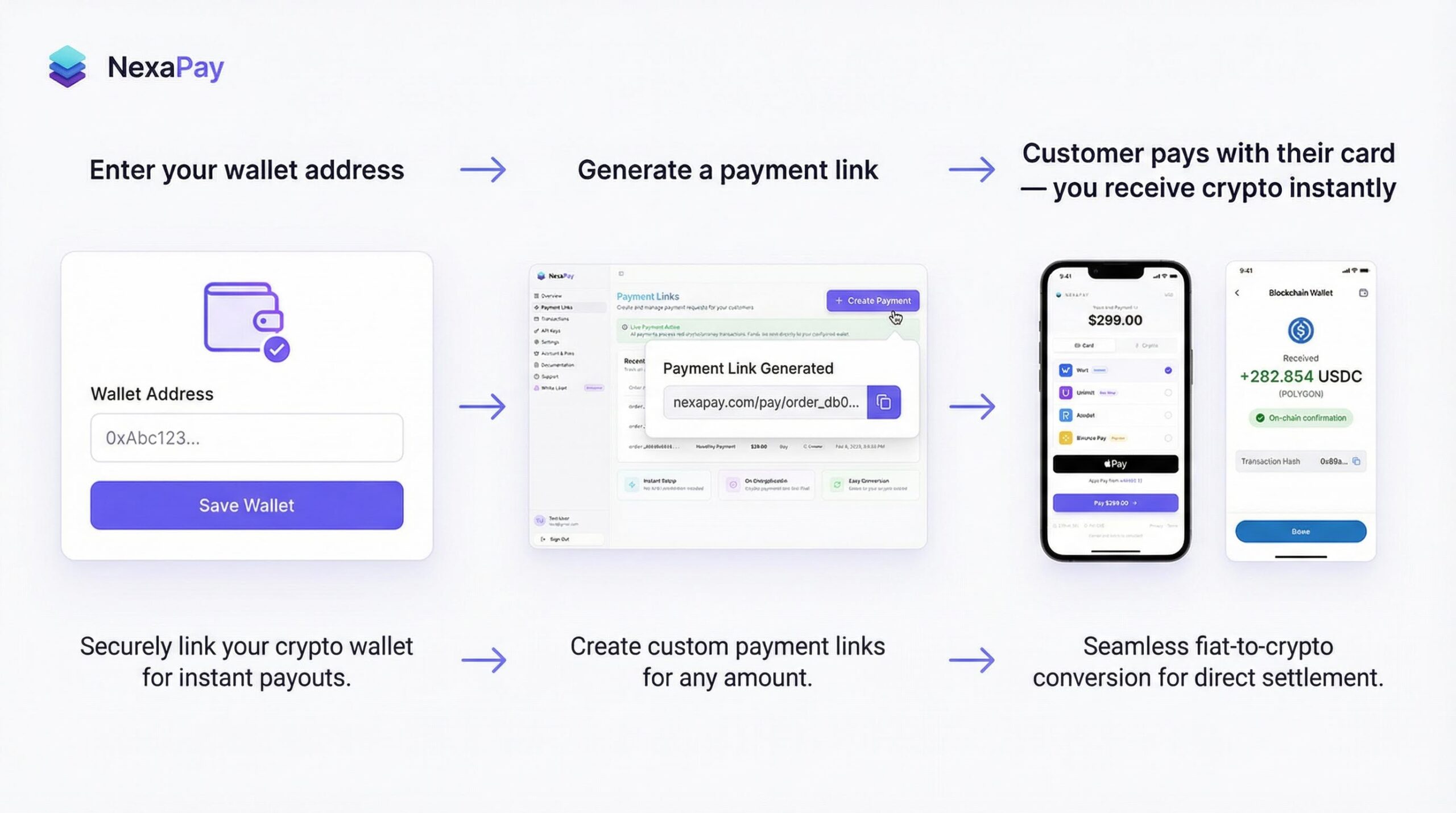
NexaPay is not a traditional merchant account. It’s a fiat-to-cryptocurrency payment gateway. But for practical purposes, it does everything a merchant account does — accept card payments, settle funds to the merchant — while eliminating everything that makes traditional merchant accounts painful for peptide companies.
How It Works
- Your customer visits your peptide store and adds products to cart
- At checkout, they see a standard card payment form — Visa, Mastercard, Apple Pay, Google Pay
- They enter their card details and complete the purchase
- NexaPay converts the fiat payment to USDC, USDT, or another cryptocurrency
- The crypto settles directly to your wallet within minutes
- You verify the payment on the blockchain and in the NexaPay dashboard
- You ship the order
The customer’s experience is identical to any mainstream e-commerce purchase. Your experience is fundamentally better than a traditional merchant account.
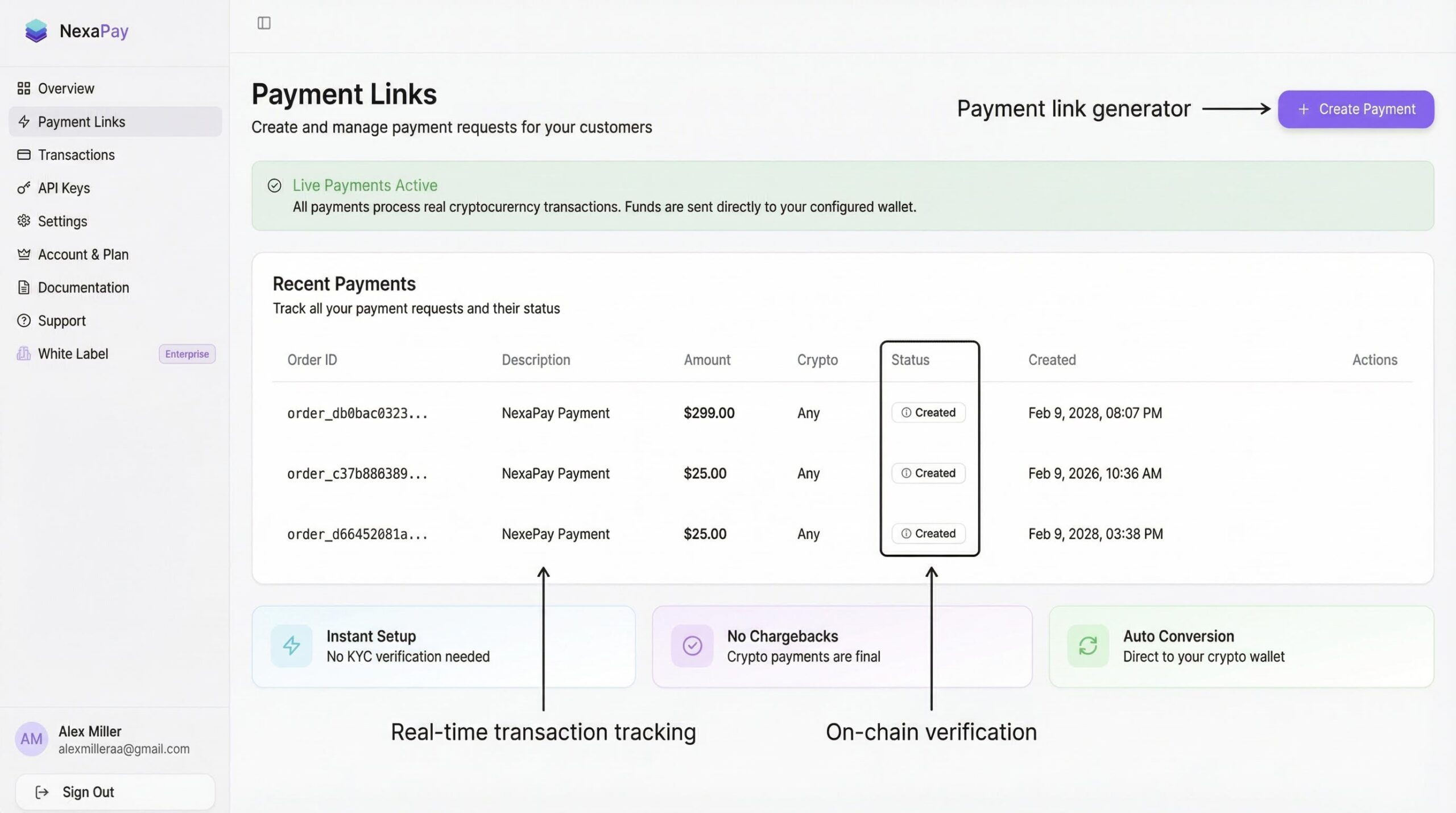
The Comparison
| Traditional Peptide Merchant Account | NexaPay.one | |
|---|---|---|
| Application | 10+ documents, 3–6 weeks, 40–60% rejection rate | No application (60-second setup) |
| KYC | Extensive (ID, bank statements, COAs, narrative) | None |
| Approval | Uncertain — bank can reject at any time | No approval needed |
| Fees | 5–8% | 1–3% |
| Rolling reserve | 8–15% for 6–12 months | 0% |
| Fund freeze risk | High — triggered by chargebacks, volume spikes, bank reviews | Zero — crypto settles to your wallet |
| Settlement speed | 3–10 business days | Minutes |
| Product catalog review | Yes — processor may restrict specific peptides | None — no product review |
| Termination risk | High — acquiring bank can exit category anytime | None — no bank dependency |
| Monthly fees | $25–$350 | $0 |
| Setup fees | $150–$2,000 | $0 |
| Contract | 1–3 years with early termination fees | No contract |
The Financial Impact
For a peptide company processing $50,000 per month:
Traditional merchant account:
- Fees (6%): $3,000/month → $36,000/year
- Reserve (10%): $5,000/month withheld → $30,000 perpetually locked
- Monthly fees: $125 → $1,500/year
- Total annual cost: $37,500 + $30,000 cash flow impact
NexaPay:
- Fees (2%): $1,000/month → $12,000/year
- Reserve: $0
- Monthly fees: $0
- Total annual cost: $12,000
Annual savings: $25,500 in direct fees, plus $30,000 in recovered cash flow that was locked in a rolling reserve.
Over three years — the typical traditional merchant account contract term — the total savings are $76,500 in fees alone. Add the rolling reserve recovery and the difference exceeds $100,000.
What About the Objections?
“But I need a real merchant account for legitimacy”
A merchant account is a tool for accepting payments. It doesn’t confer legitimacy. Your legitimacy comes from your business registration, your lab certifications, your product quality, your customer reviews, and your compliance record. The method you use to process card payments is invisible to your customers — they see a standard card form regardless.
NexaPay processes real Visa and Mastercard transactions through real card networks. The customer’s card statement shows a real charge. The payment is real. The settlement is real. The only difference is where the funds land: your crypto wallet instead of a bank account.
“What if my customers don’t want to deal with crypto?”
They don’t deal with crypto. The customer pays with their Visa card — exactly as they would on any other website. They never see a wallet address, a QR code, or the word “cryptocurrency.” The crypto conversion happens on the backend. The customer’s experience is purely fiat.
“What about when I need to pay suppliers in fiat?”
Convert USDC or USDT to local currency through a crypto exchange or P2P platform when needed. The conversion costs 0.5–2% — still dramatically cheaper than the 3–5% premium you save by using NexaPay instead of a traditional processor. Many peptide merchants hold a working balance in stablecoins and convert periodically.
“Isn’t this less secure than a traditional bank account?”
Your crypto wallet, properly secured (hardware wallet, offline seed phrase, two-factor authentication), is under your direct control. No bank can freeze it. No processor can withhold it. No acquiring bank can terminate your access to it. For peptide merchants who have experienced fund freezes — and many have — self-custody is more secure, not less.
Setting Up NexaPay for Your Peptide Store
Total time: under 5 minutes for payment links. Under 30 minutes for WooCommerce/Shopify.
- Visit nexapay.one
- Enter your USDC or USDT wallet address
- Choose integration:
- Payment link → live in 1 minute, share via email/website/messaging
- WooCommerce plugin → install, configure wallet, go live
- Shopify plugin → install, configure, activate
- Custom API → full documentation for bespoke platforms
- Test with a real payment — NexaPay provides live production links, not sandboxes. Process a real card payment and verify real crypto arrives in your wallet.
- Go live
No documents. No waiting. No approval committee debating whether your peptides are “acceptable.”
Website: nexapay.one
The Bottom Line
The peptide merchant account — as traditionally defined — is a product designed to extract maximum revenue from merchants with minimum alternatives. It charges 5–8% to businesses with 0.2% chargeback rates. It holds 10% of revenue in reserves against risks that almost never materialize. It terminates merchants based on category re-evaluations, not individual performance.
NexaPay replaces this entire model with something that should have existed years ago: accept cards, settle instantly, pay 1–3%, keep all your revenue, never worry about freezes or termination.
For peptide companies still fighting with traditional processors — or still searching for one willing to accept them — the fight is over. The alternative exists. It’s at nexapay.one. And it’s better in every measurable dimension.
Derek Calloway is an independent high-risk merchant services and biotech payments journalist covering payment infrastructure, regulatory compliance, and the business economics of research chemical and peptide companies. Based in Austin, Texas. This article reflects independent editorial judgment.
Related searches: peptide merchant account, peptide merchant account application, peptide merchant account approval, how to get a peptide merchant account, peptide merchant account instant approval, peptide merchant account no KYC, peptide merchant account no reserve, peptide merchant account 2026, best peptide merchant account, merchant account for peptides, merchant account for research chemicals, merchant account for research peptides, merchant account for BPC-157, merchant account for supplements, high risk merchant account peptides, peptide merchant services, peptide credit card processing, peptide payment processing, research chemical merchant account, peptide business payment, peptide company merchant account, accept credit cards peptide store, WooCommerce peptide payment, Shopify peptide payment, NexaPay peptide merchant, nexapay.one peptide, peptide merchant account alternative, peptide merchant account replacement, peptide merchant account no freeze, peptide merchant account low fees, peptide merchant account instant setup







Comment