
Why AI Cannot Replace Human Led Penetration Testing: A Field Report

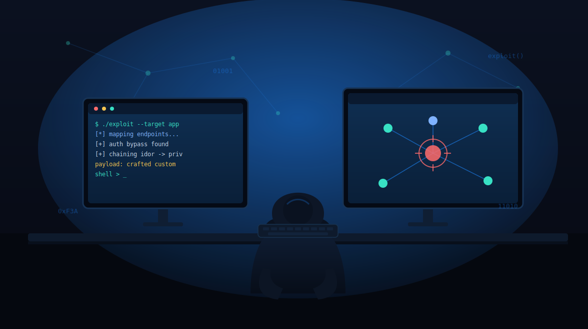
Every few months a new tool promises to fully automate penetration testing. Point it at your application, walk away, and come back to a clean bill of health. It is a compelling pitch, and for the parts of cyber security it is good at, it is genuinely useful. But after years of running engagements across web apps, cloud environments, and internal networks, experienced testers keep arriving at the same conclusion. The vulnerabilities that actually get organizations breached are almost never the ones a scanner flags.
This is not an anti automation argument. Good teams run automated tooling on every engagement. This is a field report on where those tools stop, why they stop there, and what a human led penetration testing approach catches that no AI scanner, as of today, reliably can.
What Automated Scanners And AI Tools Actually Do Well
Let us be fair before we are critical. Automated scanners and the current wave of AI assisted security tools are excellent at a specific job, which is pattern matching at scale.
Give a scanner a large attack surface and it will reliably surface known CVEs, outdated software versions, missing security headers, default credentials, obvious SQL injection on unauthenticated endpoints, reflected XSS in simple parameters, TLS misconfigurations, and exposed services that should not be public. It does this in minutes across thousands of endpoints, and it never gets tired or bored.
For coverage, regression checking, and continuous monitoring, this is real value. The smart use of these tools is to clear the noise floor, to handle the breadth so testers can spend their hours on depth. The problem starts when organizations mistake breadth for a finished assessment.
The Core Limitation: Scanners Match Patterns, They Do Not Understand Intent
An automated tool, even a modern AI driven one, evaluates your application against a library of known bad signatures and heuristics. It asks, in effect, does this look like something on my list.
A human attacker asks a completely different question. What is this application trying to do, and how can I make it do something it was never supposed to.
That gap, between recognizing a pattern and understanding intent, is where the most damaging vulnerabilities live. These flaws are invisible to signature matching because they are not bad code. They are perfectly valid code being used in a way the developer never anticipated. No signature exists for a legitimate feature being abused.
Below are the categories where, across real engagements, automated tooling has reported no issues found on systems that were, in fact, critically exposed. Details are generalized, but the patterns are representative of what testers see repeatedly.
1. Business Logic Flaws
This is the single largest blind spot for automated testing, and it is where hands on web application penetration testing consistently earns its keep.
On one ecommerce engagement, every scanner pointed at the checkout flow returned clean. No injection, no XSS, no misconfiguration. But by manually walking the purchase workflow, a tester noticed that the discount coupon value was validated on the client side and only loosely rechecked server side. By intercepting the request and stacking the same single use promo code across parallel requests, an attacker could drive the cart total negative, effectively having the store pay them to check out.
There is no CVE for your discount logic can be stacked. A scanner has no concept of what a coupon is supposed to do, so it cannot recognize the abuse. A human who understands the business context finds it in twenty minutes.
2. Broken Access Control and IDOR
Insecure Direct Object References and broken authorization consistently rank among the most severe issues in real breaches, and they are notoriously hard for automated tools to detect with confidence.
The reason is context. A scanner sees a request to an invoice endpoint return a 200 response. To the tool, that is a successful request, working as intended. It has no way of knowing that the invoice belongs to a different customer, and that your account should never be able to see it. Distinguishing authorized access from unauthorized access that happens to succeed requires understanding who should be able to see what, which requires understanding the application permission model.
On a SaaS engagement, testers created two low privilege accounts and methodically swapped identifiers between them. Automated tools had reported the endpoints as functioning normally. Manually, they pulled another tenant financial records, exported the user list, and modified settings, a full horizontal privilege escalation across tenant boundaries. Every individual request looked successful to a machine. Only a human comparing what should be visible against what was visible could see the breach.
3. Chained and Multi Step Exploits
Scanners evaluate findings in isolation. They rate a low severity information disclosure here, a medium severity misconfiguration there, and move on. What they almost never do is connect those findings into a single attack path.
Real intrusions are rarely one clean exploit. They are chains. A verbose error message leaks an internal hostname. That hostname exposes a forgotten staging service. That service uses a default credential. Those credentials are reused on a more sensitive system. Individually, each link might be rated low or informational. Chained together by someone thinking like an attacker, they are a full compromise.
This is fundamentally a creativity and reasoning problem. It requires holding the whole system in your head and asking, if I combine these three minor things, what do I get. That synthesis is exactly what current AI tooling struggles with, and exactly what an experienced tester does instinctively.
4. Race Conditions and Timing Attacks
Many high impact vulnerabilities only appear under precise timing conditions that scanners do not reproduce. Submitting the same withdrawal, gift card redemption, or referral bonus request simultaneously across dozens of parallel connections can slip past checks that assume requests arrive one at a time.
Detecting this requires forming a hypothesis about how the backend handles concurrency, then deliberately engineering the conditions to test it. A scanner sending sequential requests will never trigger it because it is not trying to. It does not have the hypothesis in the first place.
5. Second Order and Stored Vulnerabilities
Some injection and logic flaws do not fire where the input enters. They fire later, somewhere else entirely, when the stored data is processed by a different component. A payload submitted in a notes field might do nothing on submission but execute when an admin later views a report that renders that field in a different context.
Tracing input from entry point to eventual sink, across features and often across days, is a tracking and reasoning task that automated tools handle poorly. Humans follow the data.
AI Scanning vs Human Led Penetration Testing: A Side by Side Comparison
The fastest way to see the gap is to put the two approaches next to each other. The table below compares automated and AI driven scanning against human led penetration testing across the factors that decide whether a real attacker gets in.
| Capabilities | AI and Automated Scanning | Human Led Penetration Testing |
| Coverage and Speed | Scans thousands of endpoints in minutes and never tires. Excellent for breadth and continuous monitoring, but coverage is wide and shallow. | Focused and deliberate. Covers less ground per hour, but goes deep on the areas that matter, following the attack paths a real adversary would take. |
| Business Logic Flaws | Largely blind. A scanner has no concept of what a feature is supposed to do, so it cannot recognize logic being abused. | Core strength. Testers understand business context and intent, uncovering coupon stacking, workflow abuse, and pricing manipulation that no signature exists for. |
| Broken Access Control and IDOR | Often missed. A successful request looks fine to a tool, even when it exposes another customer data. | Reliably found. Testers compare what should be visible against what is visible across multiple accounts to catch privilege escalation. |
| Chained and Multi Step Exploits | Evaluates findings in isolation and rarely connects them. Low severity issues stay low severity on the report. | Synthesizes minor findings into full attack chains, showing how small issues combine into a real compromise. |
| Accuracy and False Positives | Prone to false positives that flood reports with noise and waste developer time. | Every meaningful finding is manually verified and, where safe, exploited to prove real impact. |
| Creativity and Context | Matches known patterns. Cannot form a hypothesis or improvise the way an attacker does. | Thinks like an attacker, forms hypotheses, and tests the unexpected. This is where the most damaging flaws are found. |
| Cost and Value | Low cost and fast, but a clean scan can create false confidence about your true exposure. | Higher investment that reflects real risk, delivering findings and remediation guidance that automated tools cannot produce. |
| Reporting | Generates a raw list of alerts and CVSS scores with little business context. | Human written reports explain why each issue matters to your business, with clear reproduction and remediation steps. |
The takeaway is not that one replaces the other. Automation gives you breadth. Human led penetration testing gives you the depth and judgment that actually reflect how a breach happens.
How a Human Led Engagement Actually Works
So how does a skilled team find what scanners miss. A strong methodology deliberately front loads the human reasoning that tools cannot replicate.
Reconnaissance and context building first. Before touching an exploit, testers learn what the application does, its business model, its user roles, its money flows, its trust boundaries. You cannot abuse logic you do not understand. This phase is almost entirely human.
Automated tooling for coverage, not conclusions. Scanners run early to map the attack surface and clear known issues fast. Their output is a starting point, a list of things to investigate, never the final assessment.
Manual exploitation and validation. Every meaningful finding is manually verified and, where safe, exploited to demonstrate real world impact. This eliminates the false positives that plague automated reports and, more importantly, uncovers the logic and authorization flaws that were never on any scanner list.
The attacker perspective and a deep exploit arsenal. This is the edge that automated tools cannot copy. A skilled human tester brings a genuine adversarial mindset, the same lateral, creative thinking a real attacker uses to look at a system and ask not what is broken, but what can I turn against you. On top of that instinct sits decades of accumulated offensive knowledge. Testers draw on thousands of documented exploits across public and private databases, exploit frameworks, and hard won techniques shared across the security community, and they know which of those apply to your exact stack. More importantly, when your application is custom and nothing off the shelf fits, they write custom exploits for it by hand, tailored to your unique code, logic, and architecture. AI scanners are limited to the patterns they were trained on. They cannot yet invent a novel exploit for a one of a kind application the way an experienced human can, which is precisely where the highest impact vulnerabilities tend to hide.
Attack path thinking. Testers deliberately chain lower severity findings to model how a real adversary would move through the environment, rather than reporting isolated issues that look harmless on their own.
Human written reporting. Good deliverables explain not just what is broken but why it matters to the specific business, with reproduction steps a developer can actually follow and remediation guidance tailored to the stack. A CVSS score and a stack trace are not a remediation plan.
Where AI Fits: Augmentation, Not Replacement
None of this means AI has no place in offensive security. The honest position is that in a modern cybersecurity program, AI is a force multiplier, not a substitute. It accelerates recon, helps sift large volumes of output, drafts payload variations, and frees skilled testers to spend their limited hours where human judgment is irreplaceable.
The tester who uses AI well outperforms the tester who ignores it. But the AI alone, pointed at an application without a human driving it, will keep returning no critical issues found on systems that a determined attacker would walk straight through. The gap is not about model size or training data. It is that the highest impact vulnerabilities are defined by intent and context, and abusing intent is, for now, a distinctly human skill.
The Bottom Line
Automated and AI driven scanning tells you whether your application resembles known bad patterns. Human led penetration testing tells you whether a motivated, creative adversary can actually break in. Those are different questions, and only one of them reflects the cyber security threat your organization actually faces.
If your last penetration test was a scan report with a nice PDF cover page, you do not yet know what a real attacker could do with your systems.
This article was contributed by the team at PlutoSec (Pluto Security), a human led offensive security firm. Learn more at plutosec.ca, plutosec.us, and plutosec.uk.







Comment