Germany remains the most common starting point for companies expanding into the European Union — it’s the bloc’s largest consumer market and a benchmark many partners and investors use to judge whether a foreign brand is ready to operate in Europe. But for businesses on a tight launch timeline, one factor consistently shapes how (and when) they enter: trademark registration.
Why Trademark Timing Matters for Market Entry
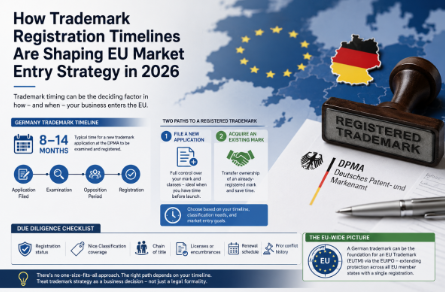
A new trademark application filed with Germany’s trademark office, the DPMA (Deutsches Patent- und Markenamt), typically takes 8 to 14 months to move through examination and the statutory opposition period before it’s fully registered. During that window, the application exists but carries limited enforceable rights — meaning a similar mark could still be filed, challenged, or opposed before your registration is finalized.
For companies planning product launches, retail partnerships, or investment rounds tied to a specific date, that timeline is often the real constraint on expansion — not product readiness or capital.
Two Paths to a Registered Trademark
Businesses generally have two ways to establish trademark rights in Germany:
- Filing a new application This is the standard route: submit an application to the DPMA, pay the filing fee, and wait out the examination and opposition periods. It’s the most straightforward option for brands with enough runway before launch, and it allows full control over the mark’s classes and specification from the start.
- Acquiring an existing registered mark A trademark can also change ownership through a legal assignment — the formal transfer of an already-registered mark from one owner to another. Because the mark is already through examination and opposition, the rights transfer with the registration, rather than restarting the process. This route is more commonly used by companies working against a launch deadline or entering a market where speed outweighs the benefit of building a mark from scratch.
What Due Diligence Looks Like Either Way
Whether a company files new or acquires an existing registration, the same due-diligence questions apply before relying on any mark commercially:
- Registration status — is it active, lapsed, opposed, or under cancellation proceedings?
- Nice Classification coverage — does it cover the actual goods or services the business will offer?
- Chain of title — is ownership history clear, with no unresolved disputes?
- Existing licenses or encumbrances — is the mark tied to any prior agreements?
- Renewal schedule — German trademarks are renewed every 10 years; when is the next deadline?
- Prior conflict history — has the mark faced opposition or litigation before?
Skipping this step is one of the more common mistakes companies make in either scenario — a registration certificate alone doesn’t confirm a mark is free of encumbrances or fully usable for a given product category.
Beyond Germany: The EU-Wide Picture
A German trademark registration also often serves as a foundation for broader EU protection. Many companies use their German mark as the basis for later filing an EU Trademark (EUTM) through the EUIPO, which extends protection across all EU member states under a single registration. Understanding the specifics of trademark registration in Germany — including classification, timelines, and renewal requirements — is a useful starting point before deciding which route fits a given expansion timeline.
There’s no universally “right” path — filing new suits companies with time to spare and specific classification needs, while acquiring an existing mark suits those working against a fixed deadline. What matters most is treating trademark strategy as a timeline decision, not just a legal formality, and applying the same due-diligence standard regardless of which path a business chooses.