When choosing proxies, price is often one of the first factors to consider. This is especially true for projects where pricing is based on traffic volume: it may seem logical to compare the cost per gigabyte across several providers and choose the most affordable option.
However, price per GB represents only one part of the overall cost.
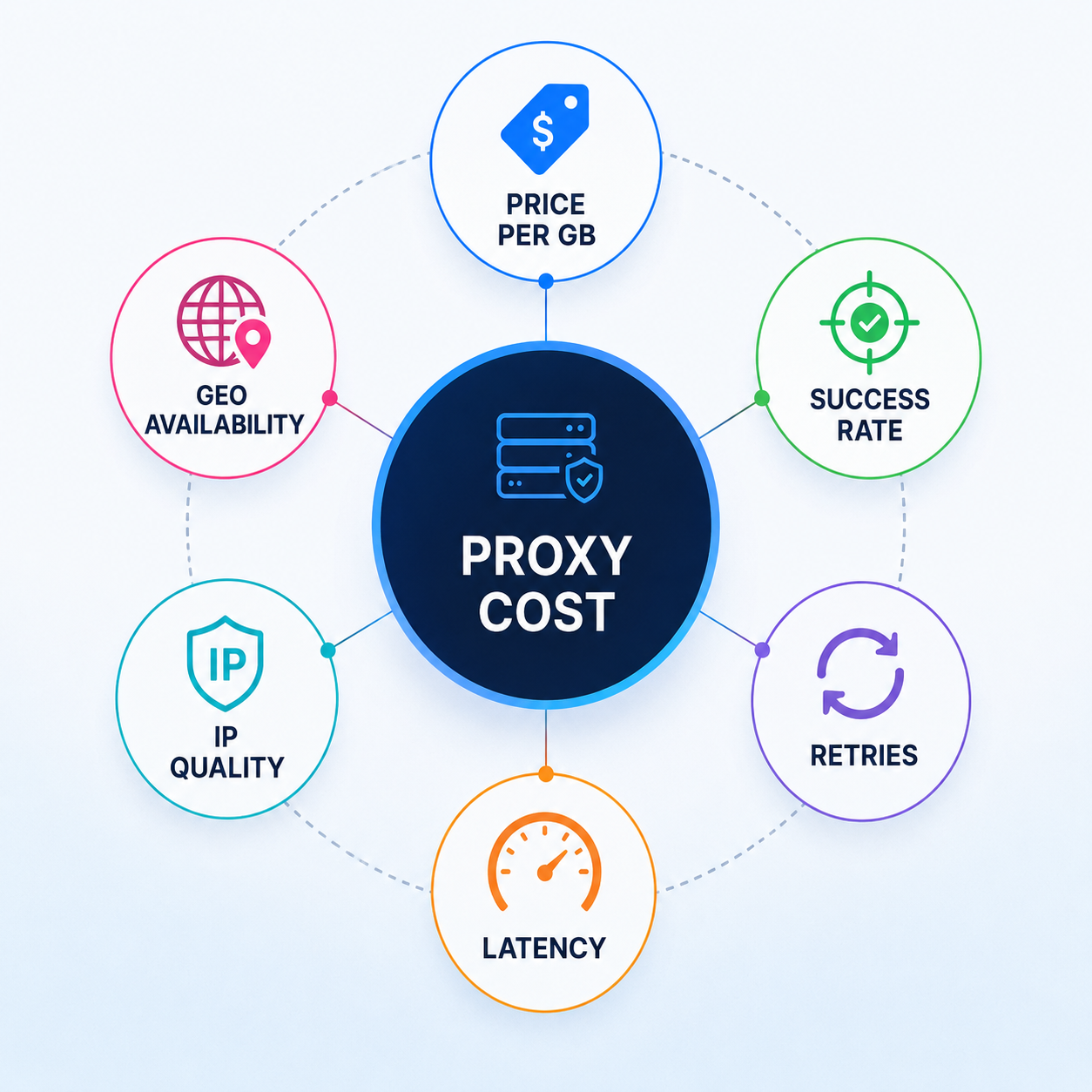
The actual cost of running proxy infrastructure is influenced by response speed, the number of successful requests, retries, IP pool quality, availability in required locations, rotation rules, and even how well the selected proxy type matches a specific task.
As a result, a plan with a lower traffic price does not always turn out to be cheaper in real-world use.
Let’s look at what makes up the actual cost of proxy infrastructure and which metrics should be considered beyond price per GB.
Why Comparing Price per GB Alone Is Not Enough
Imagine two proxy services.
The first offers cheaper traffic, but some requests need to be retried, connections are slower, and suitable IPs are not always available in the required location.
The second costs slightly more per GB but allows the same workload to be completed with fewer retries and in less time.
If you compare only the listed prices, the first option appears more attractive. But if you calculate the cost of successfully retrieved data, the result may be very different.
That is why, when evaluating proxies, it is useful to look not only at:
Cost per GB
but also at:
Cost per Successful Request
or, for data collection:
Cost per Successfully Retrieved Data Unit
This approach provides a more realistic picture of the project’s actual expenses.
Success Rate Directly Affects Costs
Success rate shows what percentage of requests are completed successfully.
Suppose a project needs to retrieve data from 1 million pages.
If 95% of requests succeed, significantly fewer retries will be required to obtain the necessary results than with a 75% success rate.
Every retry means additional:
- requests;
- traffic;
- time;
- infrastructure load;
- computing resources.
For this reason, a small difference in cost per gigabyte may become irrelevant if the cheaper proxy pool requires substantially more repeated requests.
At the same time, success rate should not be treated as a universal number for an entire proxy network. It depends on the target website, GEO, proxy type, request frequency, and other factors.
It is better to evaluate it using the project’s actual workload.
Retries Are a Hidden Consumer of Traffic
Retries are often treated as a technical detail of an application, but at scale they have a direct impact on the budget.
Suppose a system sends a request, receives an error, and automatically retries it through another IP.
From the user’s perspective, this may look like a single successfully retrieved result. From the infrastructure’s perspective, however, it has already required two or more requests.
If this happens regularly, actual traffic consumption can become significantly higher than the amount of data the project ultimately uses.
Retries may occur for different reasons:
- an unavailable IP;
- request timeouts;
- connection issues;
- restrictions imposed by the target resource;
- unsuccessful rotation;
- an incorrectly selected location;
- application errors.
Analyzing retries therefore helps determine whether a cheaper plan is actually reducing costs.
Latency Becomes a Cost at Scale
Connection latency is especially important for projects processing hundreds of thousands or millions of pages.
A difference of a few hundred milliseconds on a single request may seem insignificant. Across a large number of sequential or parallel operations, however, it can have a noticeable impact on overall performance.
High latency may result in:
- longer task completion times;
- the need to maintain more concurrent connections;
- longer server runtimes;
- fewer processed requests per unit of time.
For this reason, proxy costs cannot be completely separated from performance.
If more expensive infrastructure can process the same amount of data significantly faster, the difference in traffic price may be offset by savings elsewhere.
IP Quality Matters More Than the Total Number of Addresses
IP pool size is often one of the main metrics used to market proxy services.
A large pool is certainly useful, especially for rotating scenarios. However, a figure of tens of millions of IPs alone says little about how suitable the network will be for a particular project.
More important questions include:
- how many addresses are available in the required country;
- how consistently they perform;
- how frequently the available portion of the pool changes;
- whether the IP type is suitable for the target resources;
- how easily sessions can be managed.
For a project operating in only a few markets, the total number of countries or IPs across the entire network may not matter very much.
What matters more is the actual availability of suitable addresses where they are needed.
GEO Can Affect Both Results and Costs
IP geography directly affects many online tasks.
Depending on location, websites may change:
- prices;
- currency;
- product catalogs;
- search results;
- advertising offers;
- language;
- availability of certain pages.
If a project needs data from a specific country, an IP from another location may technically complete the request, but the retrieved data may be useless for the intended task.
In that case, the traffic has been paid for without producing a useful result.
That is why proxy efficiency should be evaluated not simply by connection availability, but by the availability of the right IPs for the specific task.
Rotation Also Has a Cost
Frequent IP changes are useful in many scenarios, but maximum rotation is not always necessary.
Assigning a new IP to every request can be convenient when processing a large number of independent pages.
However, some workflows involve several requests that belong to the same sequential session. In such cases, changing the address too frequently can create additional complexity.
This is why modern proxy infrastructure commonly supports several models:
- a new IP for each connection;
- automatic rotation;
- sticky sessions;
- persistent static IPs.
Configuring rotation correctly helps avoid using proxy pool resources where they are not actually needed.
When Paying per IP Can Be More Cost-Effective Than Paying for Traffic
Pricing per GB is particularly convenient for rotating proxies, where a project uses a large pool of addresses and workload is directly related to the amount of transferred data.
However, there are scenarios where another model makes more sense: paying for a specific static IP.
For example, a task may require:
- a long-running session;
- a consistent network address;
- a sequence of related requests;
- regular interaction with a limited number of resources;
- automation where changing the IP is undesirable.
In these cases, a large rotating pool may simply not provide much benefit.
Static proxies may be worth considering instead.
When a Per-IP Pricing Model Can Be More Practical
In some scenarios, the amount of transferred traffic matters less than the ability to work through the same IP address for an extended period. This applies to long-running sessions, sequences of related requests, and processes where frequent IP changes are unnecessary.
Static ISP proxies can be used for these tasks. For example, MangoProxy offers Static ISP Proxies with HTTP, HTTPS, and SOCKS5 support across more than 50 locations. The promo code TECHBULLION provides an 8% discount on Static ISP Proxies.
Not Every Task Requires an Expensive Proxy Type
| Proxy Type | Pricing Model | Best Fit | Main Cost Consideration |
| Residential | Per GB | Large-scale distributed requests, GEO tasks | Traffic consumption |
| Dynamic ISP | Per GB | Rotation with ISP IPs | Traffic + retries |
| Static ISP | Per IP | Long-running sessions, consistent IP workflows | Cost per IP |
| Dynamic Datacenter | Per GB | High-volume scraping, public data, technical monitoring | Low traffic cost |
Another source of unnecessary spending is using the same proxy type across the entire infrastructure.
For example, a project may automatically route all traffic through residential IPs even though some target resources work perfectly well with datacenter addresses.
This may simplify the architecture, but it is not always the most efficient approach from a budget perspective.
Different data sources can be separated according to their requirements.
Residential
Residential proxies are suitable for tasks that require a large distributed IP pool, broad GEO coverage, and rotation.
They can be used for web scraping, price monitoring, localized content research, and other large-scale tasks.
ISP
ISP proxies are suitable for scenarios where the characteristics of internet service provider IPs are important.
Dynamic ISP proxies can be used when rotation is required, while static ISP proxies are suitable for long-running sessions.
Datacenter
Datacenter proxies generally cost less and provide high speeds.
If the target resource works well with these addresses, using more expensive IP types may not be economically justified.
Mixed Infrastructure Instead of One Universal Plan
For larger projects, the most efficient approach is often not to search for a single “best” proxy, but to distribute workloads across several IP types.
For example:
- public and less demanding sources → Datacenter;
- large-scale data collection with broad GEO requirements → Residential;
- tasks requiring both rotation and ISP IPs → Dynamic ISP;
- long-running related sessions → Static ISP.
This approach makes it possible to use more expensive infrastructure only where its characteristics are actually required.
As a result, cost optimization comes not only from finding a lower price, but also from distributing workloads correctly.
Engineering Support Has a Cost Too
Proxy expenses do not end with the purchase of traffic or IP addresses.
If the infrastructure requires constant manual configuration, error handling, and changes to connection logic, team costs increase as well.
Hidden expenses may include:
- integration time;
- error handling;
- rotation configuration;
- session management;
- GEO control;
- analysis of failed requests;
- replacement of problematic IPs;
- traffic consumption monitoring.
The larger the project becomes, the more significant engineering time becomes as a cost factor.
For this reason, a convenient API, straightforward proxy management, and the ability to switch quickly between different IP types also have economic value.
How to Calculate the Real Cost of Proxy Infrastructure
There is no universal formula for every project, but instead of relying on a single $/GB metric, it is useful to evaluate several metrics together.
1. Cost per Successful Request
How much the project actually spends to obtain one required result, including retries.
2. Cost of Successfully Retrieved Data
How much of the paid traffic actually turns into useful data.
3. Task Completion Time
How long the infrastructure takes to process a given volume of requests.
4. Number of Retries
What percentage of the workload consists of repeated requests.
5. Availability in Required GEOs
Whether enough suitable IP addresses are available in the countries and regions the project actually needs.
6. Supporting Infrastructure Costs
Servers, computing resources, development, monitoring, and maintenance also contribute to the project’s actual cost.
Once these factors are included, comparing providers becomes much more accurate than simply comparing price per GB.
Example: Why a Cheaper GB Can Cost More
Imagine two hypothetical proxy pools.
Pool A offers traffic at a lower price but requires a noticeable number of retries and has higher latency.
Pool B costs more per GB, but a larger share of requests succeeds on the first attempt and average response times are lower.
For a small workload, the difference may be barely noticeable.
But when processing millions of requests, Pool A may require more traffic, longer server runtimes, and more computing resources.
As a result, the cost per successfully retrieved result with Pool B may actually be lower despite its higher listed traffic price.
This is why testing under real workloads provides more useful information than comparing price lists alone.
Which Metrics Should Be Tested Before Scaling?
Before moving a large volume of traffic to a particular proxy infrastructure, it is useful to run a test on a smaller sample.
Key metrics to measure include:
- success rate;
- average and median latency;
- number of retries;
- traffic consumption;
- IP availability in required GEOs;
- sticky-session stability;
- performance under concurrent requests;
- final cost of successfully completing the task.
Testing should ideally be performed on the same websites and scenarios the project will actually use.
Results from a general benchmark do not always reflect performance on a specific target resource.
MangoProxy for Different Workload Models
MangoProxy provides several proxy types, allowing infrastructure to be selected according to the nature of the workload:
- Residential Proxies;
- Residential Light Proxies;
- Dynamic ISP Proxies;
- Static ISP Proxies;
- Dynamic Datacenter Proxies;
- Static Datacenter Proxies;
- Mobile Proxies.
The overall pool includes more than 90 million IPv4 addresses, while residential solutions are available across more than 200 countries. HTTP, HTTPS, and SOCKS5 are supported.
For projects involving large numbers of distributed requests, rotating solutions can be used. For long-running sessions, static ISP or Datacenter IPs may be more appropriate. If a target resource does not require residential IPs, Datacenter proxies can help reduce infrastructure costs.
In other words, optimization comes not only from the price of a particular plan, but also from choosing the right IP type for each scenario.
Conclusion
Price per GB remains an important metric when choosing proxies, but on its own it does not reflect the real cost of proxy infrastructure.
Actual expenses consist of several components: paid traffic, failed requests, retries, latency, availability of suitable IPs, computing resources, and engineering time.
Choosing the right usage model is equally important. Rotating Residential or ISP proxies are suitable for some scenarios, Static ISP proxies for others, while Datacenter proxies may be the most efficient option when more expensive IP types are unnecessary.
For this reason, proxy infrastructure should be evaluated not only by the cost of a gigabyte, but by the cost of the result. This metric provides a much clearer picture of how efficiently proxy infrastructure performs in a real-world project.