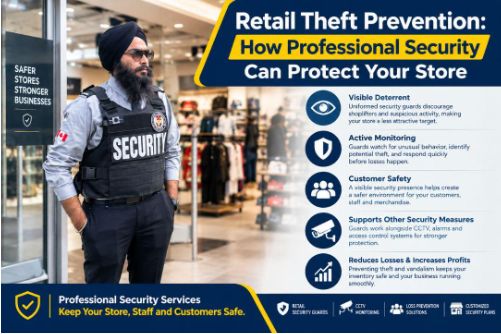
Retail theft could have a serious impact on a business. Lost merchandise affects profit margins and repeated security incidents could reduce employee confidence and make customers feel insecure. Shoplifting, organized retail crime, employee theft, inventory discrepancies, and fraudulent returns could be the reason for lost profits.
For many shops, security cameras and alarms are very important tools, but technology alone is not enough for protection. A professional retail security strategy combines trained security officers, surveillance systems, access controls, employee procedures, and ongoing risk assessments.
If you run a neighborhood store, supermarket, specialty retailer, or multi-location chain, a security plan designed around your specific risks could help protect merchandise, employees, customers, and business operations.
Identify Where Retail Losses Are Occurring
Effective theft prevention starts with understanding the source of risk. Retail shrinkage could result from many different problems such as:
- Shoplifting and organized retail crime
- Employee theft or unauthorized activity
- Inventory and receiving errors
- Supplier or delivery discrepancies
- Refund and return fraud
- Weak access controls
- Poor inventory management
Not every missing product is necessarily stolen. Incorrect receiving records, misplaced merchandise, administrative errors, or inaccurate inventory counts could also create unexplained losses.
A professional security assessment could help identify vulnerable areas and recurring patterns. Reviewing incident reports, inventory discrepancies, access records, and surveillance footage would give a clearer picture of where improvements are needed.
Use Professional Security Officers as a Visible Deterrent
A trained security officer could give something that technology cannot do: a physical, responsive presence.
Persistent officers positioned strategically throughout a retail environment could observe activity, monitor entrances and exits, patrol vulnerable areas, respond to alarms, and report incidents to management. Their presence could also discourage some opportunistic theft before it happen.
However, effective retail security should not make customers feel like suspects. Officers should be professional, approachable, and trained to communicate calmly. Their role should focus on observation, prevention, safety, and following established procedures.
Depending on the store’s needs, officers would also assist with emergency situations, document incidents, monitor restricted areas, and coordinate with management or emergency services when appropriate.
Combine Security Personnel With Modern Technology
Security technology becomes more useful when trained professionals know how to use the information it gives:
Retailers may benefit from:
- High definition CCTV systems
- Remote video monitoring
- Video analytics
- Electronic article surveillance
- Intrusion detection systems
- Access control technology
- Panic or emergency buttons
- Point-of-sale monitoring
Camera placement is very important. Surveillance should cover areas where theft or unauthorized activity is more likely, such as entrances, exits, self-checkout stations, stockrooms, loading areas, and high value merchandise sections.Technology should support security strategy rather than replace human judgment. A security professional could review surveillance activity, recognize unusual situations, document incidents, and help management determine whether additional measures are important .
Design the Store to Improve Visibility
The physical design of a store could influence how easily employees and security personnel could observe the sales floor.
Crowded shelves, tall displays, poor lighting, and hidden corners could create areas where suspicious activity is harder to detect. Retailers could improve visibility by keeping aisles organized, maintaining adequate lighting, and reducing unnecessary obstructions.
High value merchandise could be placed in areas with better visibility or closer to staffed locations. Mirrors and strategically positioned cameras could also help deal with difficult to monitor spaces.
Even relatively small changes could make a difference. Moving a display, improving lighting near an exit, or reorganizing a high risk product area may increase visibility without needing a major renovation.
Train Employees in Safe Theft Prevention
Employees interact with customers throughout the day, which makes them an important part of a store’s security strategy.
Training could help staff recognize unusual behavior. They follow reporting procedures, communicate the right way and respond safely to difficult situations. Employees should understand who to contact when they notice a concern and how to document relevant information.
Training should also focus on suspicious behavior that must be understood early. Staff should avoid customers based on personal characteristics and instead follow consistent, behavior based procedures.
Employees should not place themselves in danger. Depending on company policy and applicable local laws, suspected theft should be handled through established procedures and qualified security personnel rather than impulsive confrontation.
Secure Stockrooms, Loading Areas, and Employee Spaces
Security risks could extend beyond the sales floor. Stockrooms, offices, loading docks, employee entrances, and equipment areas may contain valuable merchandise, sensitive information, or business assets.
Access controls could help limit these areas to authorized personnel. Depending on the facility, businesses may use key cards, PINs, biometric systems, visitor logs, or other access-management measures.
Security personnel could also monitor loading and delivery areas, verify authorized visitors, conduct patrols, and report unusual activity. Reviewing access records alongside inventory information could help management investigate unexplained discrepancies.
Establish a Clear Incident Response Procedure
A security plan is most effective when employees know exactly what to do when an incident happens.
Retail businesses should build procedures covering theft, aggressive behavior, emergencies, suspicious activity, alarms, and other security concerns. Employees and managers must know how to report an incident, when to seek emergency assistance, and how to protect customers and coworkers.
Incident reports should contain relevant details such as the date, time, location, people involved, merchandise affected, actions taken, and available surveillance information.
Reviewing these reports regularly could reveal patterns. If incidents repeatedly occur during specific hours or in specific locations, management could adjust staffing, patrol schedules, merchandise placement, or surveillance coverage.
https://secureshieldsecurity.ca/blog/top-10-security-companies-in-mississauga/
Protect the Customer Experience
Strong security should make a store feel safer, not uncomfortable.
Retailers could achieve this balance by using professional officers, clear procedures, well-maintained facilities, right signage, and discreet technology. Security staff who communicate respectfully could become a positive part of the customer experience.
The objective is not to treat every shopper as a potential. It is to create an environment where customers could shop comfortably and employees could perform their jobs with greater confidence.
Choose the Right Retail Security Company
If you are selecting a security provider, cost should not be the only consideration. Retailers should look for a company with relevant experience, trained personnel, reliable supervision, and the ability to build a security plan around the store’s actual risks.
When choosing a security guard company in Burnaby, consider:
- Retail security and loss-prevention experience
- Officer training and licensing
- Supervision and quality-control procedures
- Incident reporting capabilities
- Emergency response protocols
- Technology integration
- Insurance and regulatory compliance
- Scheduling flexibility
- Experience with similar retail businesses
Safe X Security provides security services in Burnaby, including security guards, mobile patrols, and retail loss-prevention support. Retailers can consider a customized security assessment to identify vulnerable areas and determine which combination of security personnel, surveillance, access control, and monitoring may be appropriate for their property.
A reliable security provider should begin with an assessment rather than offering the same solution to every retailer.
Conclusion
Retail theft requires more than just using cameras or placing a guard at the entrance. The strongest approach combines professional security personnel, right technology, thoughtful store design, employee training, controlled access, and well-defined response procedures.
Every retailer has a different risk and loophole. A small shop may need targeted patrols and improved surveillance, while a larger operation may need dedicated officers, remote monitoring, access controls, and a structured loss-prevention program.
By understanding risks early and implementing the right security measures, retailers could better protect merchandise, support employees, improve customer experience, and create a more controlled business environment. If your store is experiencing theft, inventory losses, or security concerns, a professional assessment could help you understand which measures are important for your operation.