
Why ProxyStores Makes Sense for Dedicated and Shared Proxy Needs in 2026

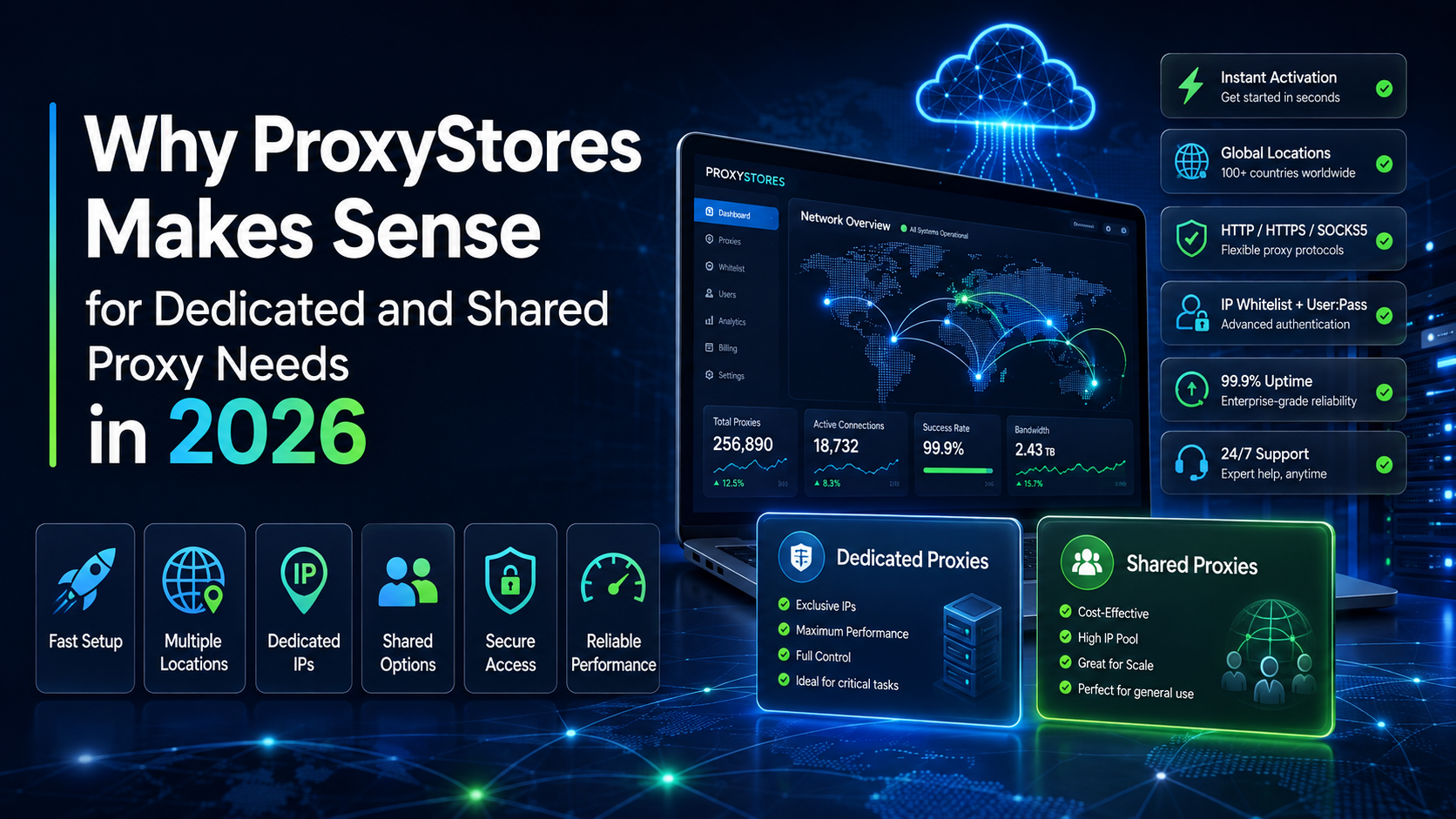
ProxyStores offers a mix of individual IPv4 proxies, shared IPv4 proxies, IPv6/32 options, and MTProto proxies. That range makes the service relevant to several kinds of users, but it also means choosing the right product matters more than simply buying the cheapest IP.
On its current English-language service pages, ProxyStores advertises HTTP/SOCKS5 support, immediate activation, manual selection of IPs, subnets, and regions, unlimited traffic on dedicated offerings, a 48-hour money-back policy for eligible products, and more than 1,500 networks and subnets. The provider is also unusually explicit that shared proxies have important limitations and are not recommended for sensitive or account-heavy workflows.
What is ProxyStores?
The most useful way to evaluate ProxyStores is to separate its product types. Individual proxies are designed for one user and generally provide the most predictable reputation and compatibility. Shared proxies cost less because several customers can use the same endpoint, but they carry a higher chance that another user’s activity affects IP reputation. IPv6 can be economical, yet many destinations still provide better compatibility with IPv4.
Key features
- Individual IPv4 proxies assigned to one user for general-purpose compatibility.
- Shared IPv4 proxies for narrower workloads where sharing and reputation risk are acceptable.
- IPv6/32 offerings for destinations and tools that support IPv6.
- HTTP and SOCKS5 formats delivered by the ordering system.
- Manual selection of IPs, subnets, and regions where available.
- Automatic activation after payment plus everyday customer-support coverage.
- MTProto proxy options listed separately for compatible messaging use cases.
Pricing and value
ProxyStores gives buyers several price points because it sells shared IPv4, individual IPv4, IPv6/32, and MTProto options. That makes the lowest price meaningful only when it is matched to the right compatibility and reputation requirements.
| Plan | 5 days | 30 days | Pricing notes |
| IPv4 Shared | $0.67/IP | $0.99/IP | Low-cost shared option; best treated as a different product from a dedicated address. |
| Individual IPv4 | $0.96/IP | $1.77/IP | 1–20 IP tier. The 90–1000 IP tier is listed at $0.83 for 5 days and $1.50 for 30 days. |
| IPv6/32 | $0.10/IP | $0.51/IP | 1–99 IP tier. Volume pricing reaches $0.48 for 30 days and $0.09 for 5 days in larger bands. |
| MTProto | $0.96/IP | $1.77/IP | Published tiers track the Individual IPv4 pricing schedule. |
ProxyStores also publishes 90-day and 360-day rates. Because shared, dedicated, IPv6, and MTProto products serve different needs, compare more than the headline cost per IP. Pricing checked 19 August 2026. View ProxyStores’ live pricing page.
Best use cases
Geo-testing for websites and campaigns
A dedicated proxy can help marketers and QA teams verify public pages, regional content, landing pages, and location-based experiences. For a campaign team, this can be a useful way to catch incorrect redirects or localization issues before they affect customers.
Market research and public-web monitoring
Researchers can use proxies to distribute permitted requests and compare public information across regions. As with any proxy service, users should respect target-site terms, copyright, privacy requirements, and rate limits.
Development and test environments
When a staging service, API, or firewall needs a known outgoing IP, a dedicated proxy can provide a stable endpoint that is easier to document and whitelist than a changing home connection.
General browser routing
Users may configure a proxy in a browser or supported application to send that app’s traffic through a chosen endpoint. This is useful for application-level routing, but it should not be confused with a VPN that can protect all device traffic.
Pros and limitations
| Strengths | Consider before buying |
| • Clear distinction between dedicated and shared proxy products.
• HTTP/SOCKS5 support covers many common tools. • Manual location/IP selection can help precise QA tasks. • Provider publishes warnings about shared-proxy limitations rather than presenting every plan as interchangeable. |
• Shared IPs can inherit reputation problems created by other users.
• IPv6 remains less universally compatible than IPv4. • Performance claims should be verified with your own target sites and locations. • Support hours shown on the site are broad but not described as fully 24/7 on every page. |
How to evaluate it before committing
- Choose individual IPv4 for production workflows that need the highest compatibility and predictable IP ownership during the rental.
- Consider shared IPv4 only when cost matters more than exclusive reputation and your target services permit it.
- Use IPv6 only after confirming the destination and software support it reliably.
- Buy a small test quantity first, especially if the project depends on geo-accuracy or low latency.
- Document the proxy purpose and access rules internally so team members use it consistently and lawfully.
Final verdict
ProxyStores is most appealing to buyers who want several proxy categories in one place and appreciate the ability to choose between dedicated, shared, and IPv6 options. Its dedicated IPv4 product is likely the safest starting point for general professional use, while shared and IPv6 plans make more sense for narrower, well-tested workflows. The service is worth considering when protocol flexibility and manual location selection matter, but—like every proxy provider—it should be validated against your exact applications before a large purchase.
Check current inventory, plan details, and product rules on the official ProxyStores website.







Comment