
Your Website Is Translated. Is It Ready for South Korea and Japan?

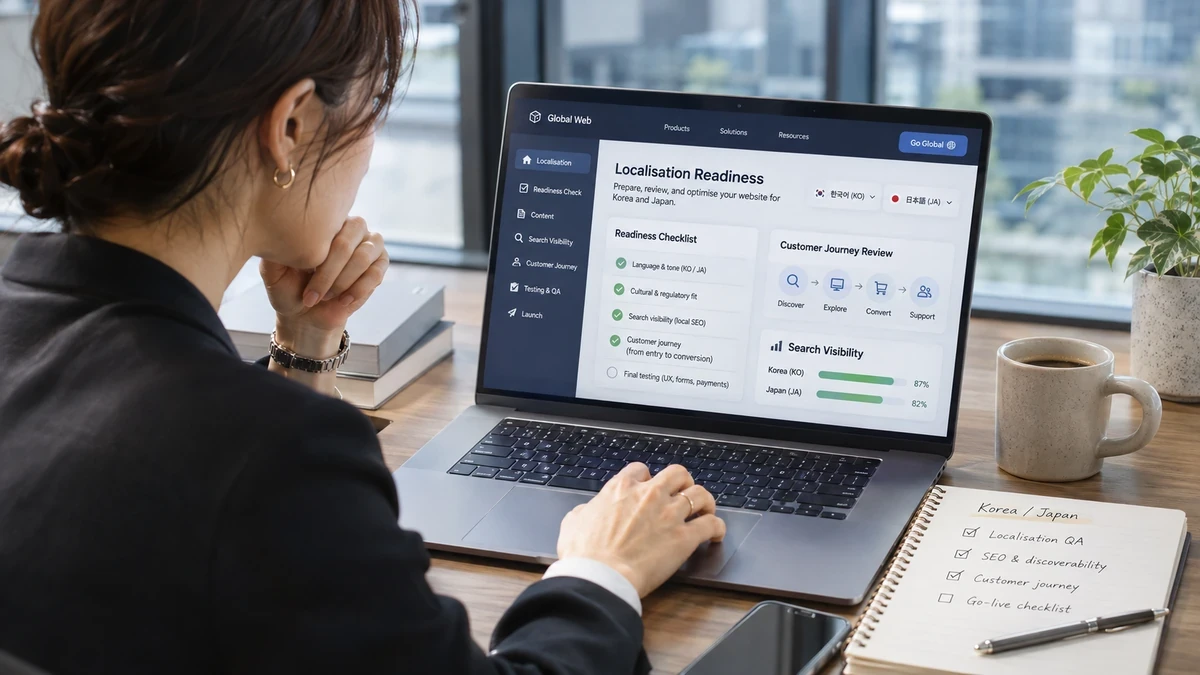
For technology companies entering new markets, fluent translation is only one part of the job. The real test is whether local customers can find the right information, understand the offer and complete the next step.
A translated website can look finished long before it is ready for customers.
Consider a hypothetical SaaS company preparing to enter South Korea and Japan. The product descriptions have been translated, the language switcher works and the local homepages have passed a linguistic review.
But the Korean visitor who clicks “Book a demo” reaches an English-only form. The Japanese visitor can read the product description but cannot establish whether the advertised pricing and support terms apply in Japan.
Neither problem is necessarily a translation error. Both are market-readiness problems.
For technology businesses, the question is not simply whether the website speaks another language. It is whether customers in that market can use it to make an informed decision.
Two markets require two search plans
South Korea and Japan should not be treated as a single localisation project simply because they appear together in an international expansion plan.
Each market needs its own research into search terminology, customer questions and relevant discovery channels.
In South Korea, a Google-only assessment may leave part of the picture unexplored. NAVER operates its own search infrastructure and provides webmaster guidance through NAVER Search Advisor, including documentation for crawling, indexing and site diagnostics.
That does not mean every company needs the same investment in every Korean search platform. The choice should depend on the audience and the searches that matter to the business.
Japan requires a separate investigation rather than a translated copy of the Korean keyword plan. Teams should examine Japanese-language search results, relevant competitor pages and the terminology prospective buyers actually encounter when comparing products.
The distinction becomes especially important for B2B technology.
An English content plan built around “employee onboarding software” may seem easy to translate. Yet the local searcher might be looking for a particular administrative workflow, a software category, implementation information or a comparison between vendors.
A literal translation cannot establish which of those tasks the local page should address.
Before commissioning copy, teams need to understand what decision each page is supposed to support.
Build the content brief around the buyer’s decision
A useful local content brief should answer a few questions before anyone starts writing.
Who is expected to visit this page? What problem are they trying to solve? What information would allow them to move forward?
The answers should come from local-language research, relevant search results and product knowledge rather than assumptions carried over from an English website.
For a software comparison page, the buyer might need to understand integration requirements, service limitations, pricing conditions and the process for speaking to a sales representative.
A product education page may need a different structure. It should help the reader understand the feature and decide whether it is relevant before presenting a commercial offer.
This is also where local editorial review matters. A sentence can be grammatically correct and still use terminology that does not fit the product category or customer task.
The objective is not to make every page sound different for the sake of localisation. It is to preserve the accuracy of the product while adapting the information to the people who need it.
Check the business promise behind the content
Search visibility is of limited commercial value if the resulting visitor cannot establish what the business actually offers.
Before a local page goes live, somebody needs to confirm its practical details.
Does the displayed price apply to the intended market? Is the service available there? Are payment options and support arrangements represented accurately? Do the contact forms and follow-up messages work in the language being offered?
In regulated sectors, the review needs to go further. Claims about eligibility, security, financial products or customer protection may require qualified legal or compliance review for the relevant jurisdiction.
These checks cannot be delegated entirely to a translator.
A language specialist can assess clarity and terminology. Product and operations teams must verify what the company can deliver. Where necessary, legal specialists should review the implications of market-specific claims.
For a business launching in both South Korea and Japan, those decisions need to be recorded separately. Approval for one market is not automatically approval for the other.
Make the technical website match the publishing plan
Once the content and commercial details have been checked, the technical setup must support them.
Google recommends using distinct URLs for language versions of a page. Where pages are genuine language or regional alternatives, hreflang annotations help Google identify the appropriate version for users.
Its international website documentation also advises against automatic redirects that prevent visitors and search engines from accessing other language editions.
These rules matter, but they are not a substitute for usable content.
Imagine a product available in English, Korean and Japanese. Visitors should be able to reach the appropriate version, switch languages when necessary and continue to a working next step.
If the Korean product page leads to English documentation, that should be an explicit publishing decision rather than an unnoticed gap. The same principle applies to the Japanese edition.
Canonical URLs and hreflang annotations should also describe the intended relationship between the pages. Pointing every translated page back to the English original as its canonical may undermine the plan to make those local pages available in search.
The practical challenge is maintaining these relationships as the website changes.
Teams need a record of which pages correspond across languages, whether each edition is published and who is responsible for updating it. MOCOBIN’s multilingual SEO publishing workflow provides a useful framework for organising page relationships, local search briefs and checks on the finished website.
Without that ownership, a technically sound launch can gradually become inconsistent as product pages, navigation and support information change.
Follow one customer journey all the way through
Reviewing a collection of translated pages is not the same as testing the experience of a customer.
A more useful launch test begins with a real task.
For a B2B SaaS company, that might mean finding a product feature, understanding the pricing and requesting a demonstration.
Start with a plausible search in the target language. Use the discovery channels relevant to that market. Open the landing page on a mobile device, follow the links a new visitor would choose and continue through the enquiry process.
Do not stop when the form submits.
Check the confirmation message, automated email and next action. If the website promises local-language support, verify that the subsequent communication is consistent with that promise.
The exercise can reveal problems that a translation review would miss: an unsupported payment option, a broken language switcher, an outdated service statement or a follow-up email that sends the visitor back to a different language without explanation.
It also helps teams decide where localisation effort is genuinely necessary.
Some technical documentation may be suitable for an international audience in English. Pages that explain commercial commitments or guide customers through a transaction may require much more careful adaptation.
The decision should follow the customer task and the company’s ability to support it.
Set a launch decision, not just a publication deadline
A local website should not be declared ready solely because every planned translation has been delivered.
A practical launch review needs agreement across three areas.
Search readiness: The intended pages are accessible to search engines, use the correct URLs and represent the relevant local search tasks. Eligibility for indexing can be checked, but indexing itself is not guaranteed.
Offer accuracy: Pricing, availability, support arrangements and important product claims have been reviewed by the people responsible for delivering them.
Customer journey: A visitor can move from the relevant entry page to the intended action without encountering an unexplained language change or a broken process.
Each area needs a named owner who can identify unresolved problems and decide whether they prevent launch.
For a business entering two markets, a limited but complete experience may be preferable to a large collection of translated pages that nobody has tested from start to finish.
After publication, performance measurement should keep different outcomes separate.
Google Search Console can help teams examine Google search visibility and indexing information. Where NAVER is relevant, its own webmaster tools provide a separate source of search diagnostics. Website analytics and sales systems are needed to evaluate enquiries and business outcomes.
An impression is not a visit. A visit is not a qualified lead. Reporting them as separate stages helps teams understand whether the problem lies in discovery, content relevance or the customer journey.
A translation proves that a company has made its information available in another language. A successful local launch requires a more demanding test: whether the business can deliver what that information promises.
Previously in Digital Marketing: How Text Messaging Improves Customer Experiences







Comment