
The Next Phase of DevOps Could Be Teams of Specialized AI Agents


Artificial intelligence is already changing how software teams write code, test applications and troubleshoot problems. The next shift may be larger than adding another AI assistant to a developer’s toolkit. Companies are beginning to explore systems in which multiple specialized AI agents handle different parts of the software delivery process. One agent might analyze requirements while others generate code, create tests, identify security issues or monitor releases. For business leaders, this development could change the economics of software production while creating new questions about oversight, accountability and operational risk.
Specialization Changes the AI Model
Most early generative AI tools functioned as assistants. A person asked a question or requested a task, the system produced an answer and the person decided what happened next. Specialized agents can operate differently because they can receive defined responsibilities and participate in a larger workflow.
A software organization could eventually use separate agents for planning, development, testing, security and deployment. Instead of asking one general-purpose system to understand every aspect of software delivery, companies can assign narrower responsibilities to agents designed around particular tasks and business contexts.
This resembles the way human teams divide work. A quality assurance specialist approaches a release differently from a security engineer or product manager. Specialized agents can follow a similar model while exchanging information as work progresses.
For businesses, the appeal is easy to understand. Software teams could automate more repetitive work while allowing employees to concentrate on architecture, difficult technical decisions and business priorities. The challenge is making sure those automated contributions remain coordinated.
Agent Operations Become Essential
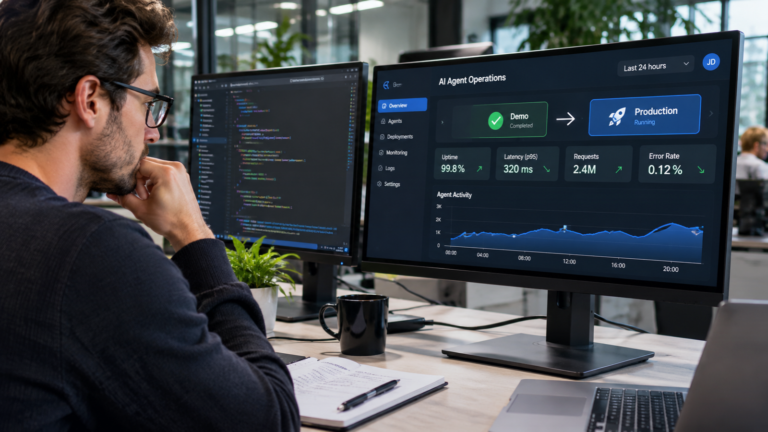
Once businesses rely on multiple agents, managing them becomes its own operational discipline. AgentOps addresses the systems and practices needed to observe, coordinate and govern AI agents as they perform work across business and technical environments.
This becomes increasingly important as agents gain more autonomy. A company needs to know which agent performed an action, what information it used and whether the result met established requirements. Teams also need ways to identify failures and prevent one incorrect output from creating problems farther along a workflow.
The financial implications are significant. Automation only creates value when the cost of operating it remains lower than the value it produces. If employees spend hours correcting unreliable agent output, or if automated mistakes repeatedly delay releases, expected productivity gains can disappear.
Businesses therefore need to measure agent performance much as they measure other operational systems. Reliability, task completion, error rates, processing costs and human intervention can all help determine whether an agent is producing meaningful value.
DevOps Roles Will Evolve
The rise of specialized agents does not necessarily mean software teams simply become smaller. It could change where employees spend their time and which skills organizations value most.
Developers may spend less time producing routine code and more time reviewing architecture, defining requirements and validating AI-generated work. Quality assurance professionals may supervise automated testing strategies rather than manually creating every test. Security teams could use agents to identify potential vulnerabilities earlier while retaining responsibility for higher-risk decisions.
DevOps professionals may increasingly design the systems through which agents interact. Someone must establish permissions, determine when human approval is required and decide what happens when an agent produces an unexpected result.
These changes could also alter technology budgets. Companies may spend less on certain repetitive tasks while investing more in AI infrastructure, monitoring, governance and employees capable of supervising automated systems. Leaders evaluating AI adoption should account for both sides of that equation rather than treating automation as a simple labor-cost reduction.
Governance Has Financial Value
Speed has traditionally been one of the major goals of DevOps. AI agents can accelerate portions of software development even further, but faster output can create additional risk when companies lack appropriate controls.
An agent that produces code rapidly can also produce errors rapidly. If automated work reaches production without sufficient testing or approval, the resulting security incident, outage or compliance problem could cost far more than the time saved during development.
Governance should therefore be considered part of the financial case for agent-based automation. Businesses need clear rules defining what agents can do independently and which actions require human authorization. They also need records showing how important decisions and changes occurred.
Human review will remain particularly important for actions involving sensitive data, security, regulatory requirements or significant production changes. The objective is not to place a person between every automated step. It is to identify where human judgment provides enough risk reduction to justify the additional time.
Measure the Business Results
The success of specialized AI agents should ultimately be measured by business outcomes rather than the number of automated tasks completed. A company gains little from generating code faster if releases become less reliable or employees spend the saved time fixing new problems.
Useful measurements can include development time, deployment frequency, failure rates, recovery time and the amount of human intervention required. Companies should also track the total cost of operating agent systems, including infrastructure, software, monitoring and oversight.
The next phase of DevOps may involve teams in which people and specialized agents work alongside one another throughout the software lifecycle. Companies that measure both productivity and risk will be in a better position to determine whether those agents are actually making software delivery faster, safer and more economical.
Previously in Artificial intelligence: When Does a Business Need AI Development Services Instead of Buying an AI Tool?






Comment