There is a specific kind of frustration that comes with writing something, like, reading it back and knowing a sentence feels off, without being able to say exactly why. Maybe it’s a comma that shouldn’t be there, or a word that almost fits but not quite.
This happens constantly, especially for students. And most of the time, the fix isn’t putting in more effort; it actually lies in understanding the ‘why’ behind the rule, not just the rule itself.
That was the specific problem we were trying to solve when we came across WordlyCove.
We weren’t looking for ‘the best grammar site ever’, we just wanted something that could explain writing basics in a way that actually made sense, instead of reading like a textbook appendix.
So, let’s see how this website fits into that criterion.
So, What Actually Is WordlyCove?
After a thorough review, we’ve found that WordlyCove is a website that has been developed around teaching people to write better without drowning them in grammar-textbook language. Their own tagline, ‘Learn Easily, Write Clearly,’ sums it up fairly well.
The content of the website revolves around grammar, plagiarism, proofreading, punctuation, spelling, and vocabulary.
So, it basically has the full toolkit that someone needs if they’re trying to write blog posts, essays, or professional writing with more confidence.
What we appreciated right away is that it doesn’t try to be everything for everyone; it sticks to its specialty, which is language and writing, and it does that one thing reasonably well.
The Homepage Tells You What You’re Getting Into
From our experience, we think that some sites make you hunt around to figure out what they’re actually about. But WordlyCove doesn’t do that. The categories are laid out clearly. So, if you already know what you need help with, you won’t have to waste time scrolling up and down.
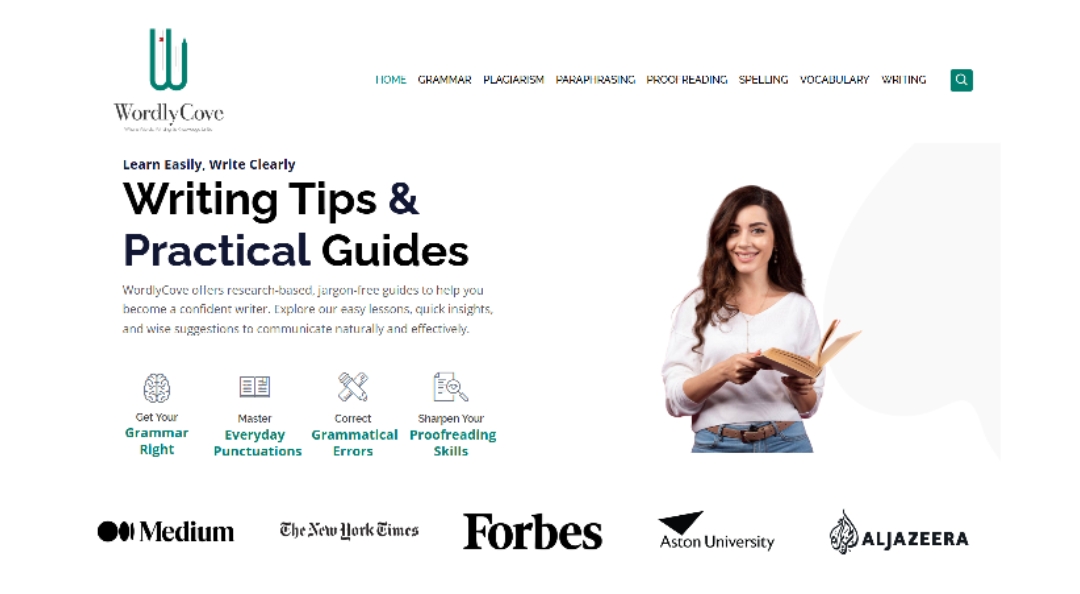
We also noticed logos for Medium, The New York Times, Forbes, and Al Jazeera, along with a mention of Aston University, sitting near the top of the page. Although we can’t verify the exact nature of those associations, it feels like this site is trying to position itself as more than just another hobby blog.
Where the Content Actually Holds Up
This is the part that matters most, and it’s where we think WordlyCove does something worth mentioning.
A lot of grammar resources either oversimplify things to the point of being useless, or they overexplain with so much jargon that a student or non-native English speaker gives up halfway through. But WordlyCove mostly avoids both traps.
So, a few things stood out while we were reading through published blog posts are as follows:
Grammar Checker Comparisons
They also have a roundup comparing different online grammar checkers, which is useful, especially if you’re trying to decide between tools rather than just take one recommendation at face value.
Reasoning-Based Punctuation and Proofreading Tips
Beyond that, the punctuation and proofreading guides don’t just state rules; they explain the reasoning behind them, which honestly makes the information stick better than a bullet-point list of ‘dos and don’ts.’
Word-Count-Specific Essay Guides
Their essay-writing guides are broken-down by-word count, from 250 words to 400 words essay and 900 words, which is oddly specific. However, upon analyzing each piece deeply, we’ve realized that each blog post is genuinely practical. And if you’re a student who is trying to hit an exact assignment length, these guides would be perfect for you.
Who Gets the Most Out of It
Reading through WordlyCove, we realized that it seems to be aimed at three kinds of readers, though probably not exclusively:
- People still building their writing habits—those who know something feels off in a sentence but can’t quite name why.
- Students working on essays or assignments who need grammar help that doesn’t read like a linguistics paper.
- And writers or content creators who already know the basics but want sharper, more polished output.
One of the reader’s testimonials on the website puts it in a way that resonated with us. Like, someone mentioned that they used to place punctuation just to ‘look right’ without understanding the actual function it served. And that’s a pretty common experience. In fact, it is the kind of gap this type of resource is meant to close.
Where It Falls Short
No resource is perfect, and the same is the case with WordlyCove. So, it’s worth being upfront about that.
The website is still relatively young. So, the content library isn’t as deep as some of the more established grammar and writing platforms out there.
This means that if you’re looking for extremely advanced or niche writing topics like legal writing or technical writing, you may not find much yet. That’s because it is better suited for foundational and intermediate writing improvement than highly specialized needs.
Concluding Remarks
To conclude, if you’re a student who is trying to polish an essay, someone brushing up on basic grammar and punctuation, or a writer who wants a plain-language refresher on proofreading and vocabulary, WordlyCove is a reasonable place to spend twenty minutes. That being said, it won’t replace a dedicated grammar checker or a writing tutor. But as a supplementary resource for building stronger writing habits, it does what it sets out to do without overcomplicating things.