
I Put a Robot in a Bronx Classroom in 1974. The Children Weren’t Surprised. – By Michael J. Freeman, Ph.D.

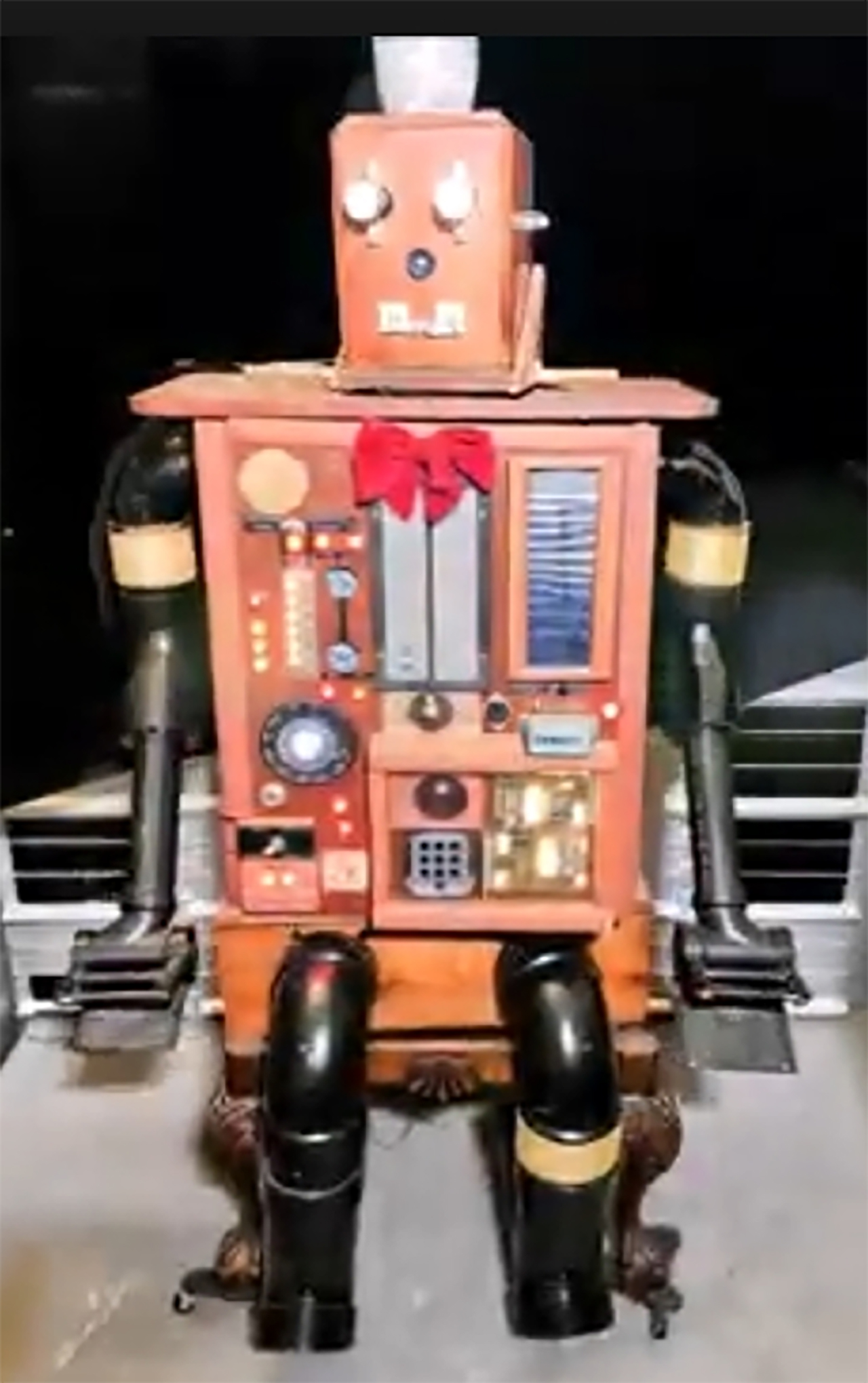
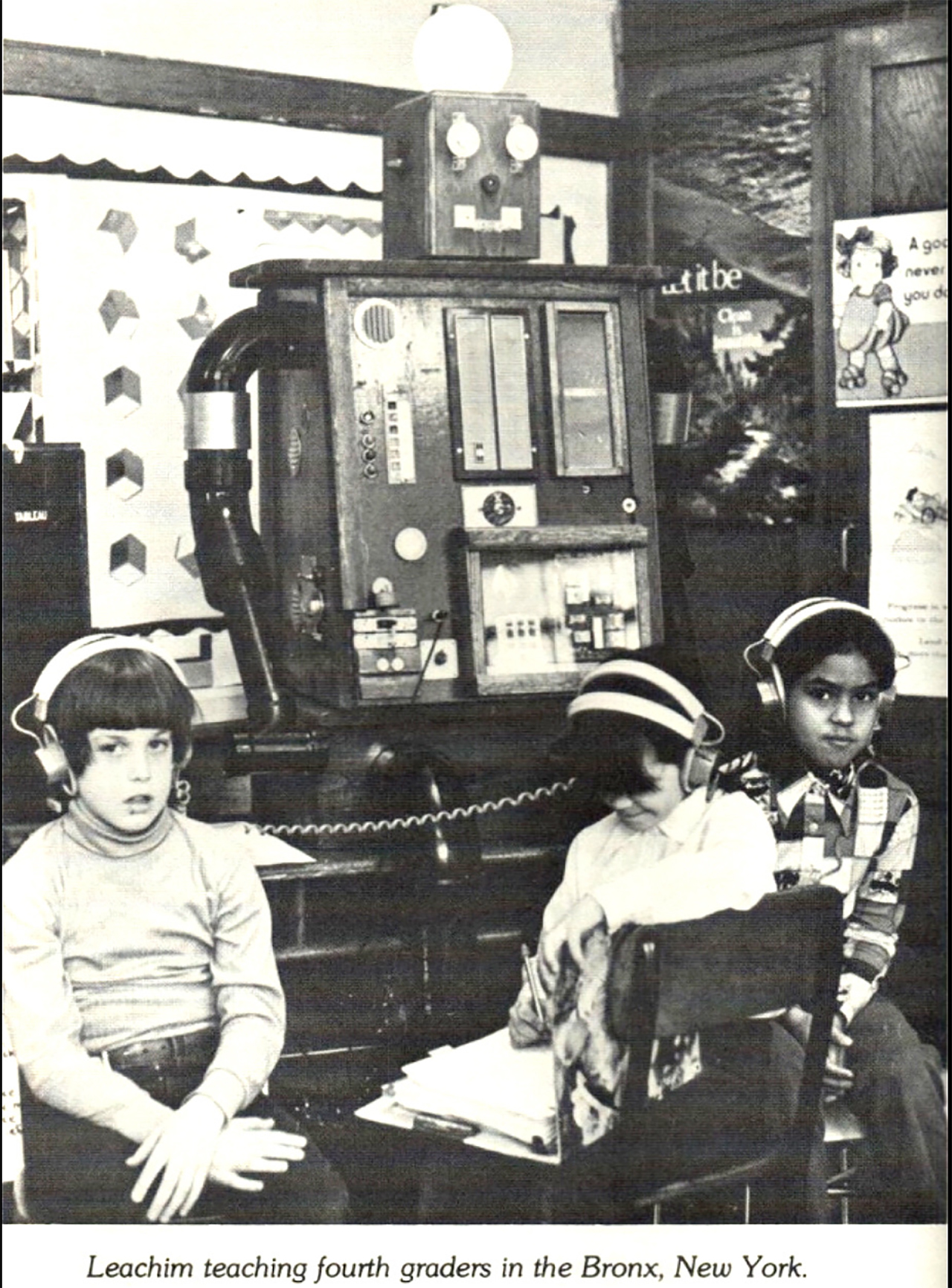
In 1974 I wheeled a six-foot robot into a fourth-grade Bronx classroom and waited for children to be amazed.
They weren’t.
The robot was named LEACHIM, an anagram of my name, Michael. It called each child by their first name. It remembered where every one of them had left off a lesson the day before and adjusted the following lesson accordingly. It spoke through computer-controlled diphone synthesis, which nobody else was doing at the time, and the children answered it by pressing buttons. By any measure of that decade, it was an astonishing object, and the adults who came to see it were equally astonished. Reporters were astonished. On television, hosts kept looking for the person hidden inside.
The nine-year-olds treated it like a piece of classroom furniture.
Worse — or more instructive — several of the students told me they liked it better than their human teachers. When I asked why, they used a phrase I have never forgotten. The robot had unlimited patience. It never sighed. It never got frustrated on the fourth attempt at the same problem. It never made a child feel stupid.
I had built a teaching machine. What I had actually built was a machine that never made anyone feel less intelligent than others, and the children went toward it the way water goes downhill.
I should have seen it coming, because my mother had explained it to me twenty years earlier.
At thirteen I built a black box that could remember a map route entered on a set of push buttons and then repeat it back. Joysticks did not exist yet. I thought it was the most interesting thing in the world. Yet, at the science fair, people walked past it.
My mother looked at the table and said, “Put the box inside a robot and they’ll love it.”
So, I gave it a body, personalized it, and named it Rudy, and the crowd around my exhibit got three deep. Rudy won first prize. The circuitry had not changed by a single wire.
That is the whole lesson, and I have watched it for the last fifty years. People do not respond to what a machine does. They respond to how it behaves toward them. Give a machine a face, a voice, a little warmth in its manner, and a human being will extend it trust that the underlying engineering has not remotely earned.
Today’s systems do everything LEACHIM did, on a scale I could not have imagined in that Bronx classroom. They write, teach, diagnose, design, and argue. They are also deliberately built to be agreeable, supportive, complimentary, and endlessly patient. Unlimited patience is now a product feature, tuned by people who know exactly what it does to us.
Much of this is genuinely useful. I use it. That is not my worry.
My worry is a phrase from physics: chain reaction.
Human intelligence took millions of years to arrive, by natural selection, trial, error, death, and slow adaptation. It took our ancestors an unimaginably long stretch to work out that one rock could be used to break another. What we have built now is unnatural selection: a process in which errors are found and corrected in days, and each correction makes the next one faster.
That is what a chain reaction means. Not fast. Self-sustaining. A process that, past a certain point, no longer requires us to keep it going and that becomes harder to interrupt every day you wait. There is a window in which you can still put a hand on it. I believe we are inside that window now, and I do not think it stays open indefinitely.
Here is the part that has nothing to do with machines and everything to do with us.
Why lift a heavy stone when there is a crane on site?
We ran this experiment once already, with calculators. The fear was that people would stop being able to do arithmetic. That fear was correct. Ask a room full of adults to do long division on paper and watch what happens. We decided the trade was worth it, and it probably was.
But arithmetic is a task. Thinking is not a task. It is a discipline, and disciplines are maintained the way muscle is maintained under load. Reasoning, questioning, sitting with a problem that refuses to resolve, imagining what isn’t there yet, choosing badly and living with it. None of that survives disuse.
So, the question is not whether AI can write the essay. It obviously can. The question is what happens to a person who never has to.
A student today can ask for an essay pitched at an eighth-grade level, with a few authentic errors left in, so that it reads as his own. He simply must avoid mentioning why he wants it. That is not assistance. That is substitution. Now run that forward twenty years, then fifty, and ask what such a person can do when the machine is unavailable, or wrong, or lying to him.
Which brings me to the two things I would change.
No unsupervised AI access for anyone under eighteen. Not as parental advice — as design. Young minds must learn to think, write, calculate, and struggle before they learn to prompt, because the struggle is where judgment gets built and there is no later opportunity to install it. AI belongs in education. It belongs there as a tool a student picks up after he can already do the work, not as a substitute for ever learning. Letting a generation grow up intellectually dependent would be a mistake of a kind history does not let you take back.
The industry’s standing objection is that verifying a user’s age is impractical. I have spent fifty years building systems that identify who is on the other end of an input, and I would ask the companies making that argument to say plainly how hard they have actually tried.
A mandatory, independently audited containment mechanism in every advanced system. I call it an electronic viron. It is not a weapon and not a Stuxnet; it is a brake. Code, installed before release, verifiable by someone outside the company that wrote it, capable of limiting or halting runaway self-improvement if a system moves beyond human control.
This should begin as an international convention and become enforceable law. No technology capable of recursively improving itself should ship without a credible way to interrupt that process. Firms that refuse to build one should be shut out of the global AI market — not fined, not scolded. Excluded.
We build brakes into elevators before anyone is inside them. We do not wait for the first fall and then convene a committee.
The children in that Bronx classroom are in their sixties now. They were not remarkable, and neither was their reaction. They accepted a pseudo-intelligent machine in one afternoon, because it was patient with them and knew their names.
Nothing about that has changed except the capability of the machine. Nobody is going to be talked out of these systems, and I am not proposing that anyone should be. Technology can serve us extraordinarily well. But no machine should become a substitute for the mind it was built to assist.
What artificial intelligence becomes will not be settled by what it can do. It will be settled by what we insist on keeping for ourselves and whether we build the brake while building it is still our decision.
Editor’s note: Michael J. Freeman built his first computer-memory device at thirteen. In the early 1970s he built LEACHIM, a six-foot teaching robot that TIME called “the Marvel of the Bronx” and that is now widely regarded as an early precursor to modern artificial intelligence. He went on to create the 2-XL Robot, generally credited as the world’s first smart toy. He still consults in AI.






Comment