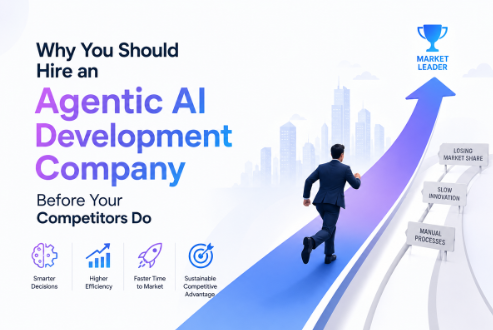
The race isn’t coming, it’s already running. Here’s what I’ve learned building agentic systems, and why timing beats budget.
Last spring I watched a mid-sized logistics firm lose a contract they’d held for six years. Not because their pricing slipped. Because a competitor quietly stood up a handful of autonomous AI agents that quoted, scheduled, and reconciled shipments faster than the incumbent’s team could open the request email. By the time anyone noticed, the deal was gone. That was the moment it clicked for me, the race isn’t coming, it’s already running.
So let me be straight with you. This isn’t another “AI is the future” pep talk. I’ve spent the last two years building and breaking agentic systems, and I want to tell you what I’ve seen: who’s winning, why timing matters more than budget, and what a good agentic AI development company does that you probably can’t pull off alone yet. If you’ve been telling yourself you’ll get to this next quarter, this is the part where I gently grab your shoulders.
The gap between “we’re looking into it” and “they already shipped it”
Here’s the number that made me sit up. Gartner projects that 40% of enterprise applications will have task-specific AI agents baked in by the end of 2026, up from under 5% in 2025. That’s not a trend, that’s a cliff. And yet the same research shows only about 17% of organizations have deployed agents so far, while more than 60% plan to within two years.
Read those two stats together and you’ll see the whole opportunity. Everyone intends to move. Almost nobody has. That gap, between intent and execution, is the game. The companies filling it right now are the ones your customers will be comparing you to eighteen months from now.
I keep meeting leaders who think they’re “early.” They’re not. They’re on time, at best. Deloitte expects roughly 75% of companies to invest in agentic AI, and Capgemini found 93% of leaders believe whoever scales agents in the next twelve months gains a real edge over their peers. When nearly everyone agrees the window is now, the window is closing.
What an agentic AI development company builds (and why it’s not a chatbot)
Let me clear up the biggest misconception first, because it costs people money. An AI agent is not a chatbot with a nicer font. A chatbot answer. An agent does, it plans a multi-step task, calls the tools it needs, checks its own work, and adapts when something breaks. Gartner even has a name for the fakes: “agent washing,” slapping the word “agent” on the same old automation.
Real agentic AI development pulls together a stack most in-house teams haven’t assembled before. At the core sits a large language model (LLM), usually something from OpenAI, Anthropic, or Google Cloud, with Microsoft, Amazon Web Services, IBM, and Meta Platforms all racing to bake agentic tooling into their platforms, and NVIDIA supplying the computer underneath. But the model is maybe 20% of the work. The rest is engineering:
- Retrieval-Augmented Generation (RAG) so the agent answers from your data, not the open internet, which usually means a vector database, and often a knowledge graph, to give it structured memory.
- Multi-agent systems where specialized agents hand work off to each other. Both Forrester and Gartner call 2026 the breakout year for this.
- AI orchestration, the layer that decides which agent runs when, catches errors, and keeps a human in the loop.
- Model Context Protocol (MCP), the open standard that lets agents securely reach your existing systems. Forrester expects 30% of enterprise app vendors to ship MCP servers this year, which tells you exactly where the plumbing is headed.
Underneath all of it sits plain old machine learning and natural language processing, doing the unglamorous work of turning messy human requests into actions. A capable agentic AI development company earns its fee on the orchestration and integration, the stuff that never shows up in a demo but decides whether the thing survives contact with real users.
The real reason first movers win: it compounds
Here’s what I didn’t understand until I’d shipped a few of these. The advantage isn’t the agent. It’s what the agent accumulates.
Every workflow you automate throws off data about how that workflow runs, where it stalls, what customers keep asking, which exceptions repeat. Feed that back in, and your agents get sharper while your competitor is still drafting their RFP. Six months of that head start isn’t a 5% lead. It’s a moat. The workflow automation you deploy today is the training signal that makes next year’s version genuinely hard to catch. That’s the honest case for moving before your competitors, not fear, compounding.
Build it yourself, buy off-the-shelf, or hire specialists?
The question I get most: “Can’t we just do this in-house?” Sometimes, yes. Usually, not yet. Here’s the trade off as I see it after doing all three.
| Approach | Best when | The honest catch |
| Build fully in-house | You already have ML engineers, MLOps, and time to burn | Hiring and ramping that talent often costs more than the project itself; teams routinely underestimate orchestration and governance |
| Off-the-shelf platform (Copilot Studio, Agentforce, etc.) | Standard workflows, fast start, tight budget | You bend your process to fit the tool; it runs out of road exactly when your edge is a custom workflow |
| Hire an agentic AI development company | Custom workflows, gnarly integrations, and you want it shipped and governed | Higher upfront cost than a template; you have to vet for real engineering depth versus “agent washing” |
For a lot of enterprise agentic AI work, the answer ends up being a hybrid: a specialist ships the first version and hardens the governance, your team learns on the job, and ownership shifts in-house over time.
Where I’ve seen agentic AI pay off
I’m allergic to vague ROI claims, so here are the patterns that held up. Customer-support agents that resolve tickets end-to-end, not just deflect them. Sales development agents that qualify leads and draft outreach, BCG and Forrester put median payback across agent deployments at about 5.1 months, with SDR agents landing closer to 3.4. Finance and operations agents for reconciliation and reporting, which take longer to pay back (call it nine months) but scale beautifully once they do.
One thing I’ve learned on the marketing side: an outreach agent is only as good as the research feeding it. Before I let one draft a single message, I still do the human part, sizing up what competitors are posting and how their audience reacts. For that kind of quiet, no-footprint competitor research I lean on tools like PV Stories, then hand the findings to the agent. Garbage in, garbage out applies to agents more than almost anywhere.
The through-line: agentic AI services earn their keep on repetitive, multi-step, judgment-light work with a clear success metric. Point them there first. Don’t start with your hardest, fuzziest problem, I’ve watched that sink more than one project.
The honest part: most agent projects fail
I’d be lying if I pretended this is easy. Forrester and Anaconda data show roughly 88% of agent pilots never reach production, and Gartner warns more than 40% of agentic AI projects could be cancelled by 2027, mostly over unclear value, runaway cost, and weak governance.
That scared me at first. Then I realized the failures share a pattern, and it’s avoidable. Here’s the checklist I now run before starting anything:
- Clean, centralized data. An agent on top of siloed, messy data inherits every one of those flaws. Fix this first or nothing else matters.
- One clear success metric. “Improve support” fails. “Cut first-response time to under two minutes” survives the budget review.
- Governance from day one. Who can the agent act as? How do you shut it down fast? Bolt this on early, not after an incident.
- Human-in-the-loop where it counts. The winning deployments keep people setting the rules and holding final authority.
- Start narrow, then expand. One workflow, shipped and measured, beats a grand platform that never launches.
An experienced agentic AI development company should push you through every one of these before writing a line of code. If they don’t, that’s your signal to walk.
So, what would I do if I were you?
If you take one thing from this: the risk isn’t moving too early. It’s discovering, eighteen months from now, that “we were evaluating options” was itself the decision, and your competitors made a different one.
Start small and start now. Pick one painful, repetitive workflow with a metric you can actually measure. Run a tight six-week pilot, in-house if you’ve got the talent, with a specialist if you don’t. Prove it, then compound it. That’s how the companies pulling ahead right now actually got there. They didn’t wait for the perfect moment. They created a head start and let it snowball.
FAQs
What’s the difference between agentic AI and regular AI automation?
Traditional automation follows fixed rules, if this, do that. Agentic AI sets a goal and figures out the steps itself, using tools, reasoning through problems, and adapting when something changes. Regular automation breaks the moment reality doesn’t match the script. Autonomous AI agents are built to handle the messy middle. That flexibility is exactly why they’re harder to build well, and why the payoff is bigger when you get it right.
How much does it cost to hire an agentic AI development company?
It ranges wildly with scope, so think in terms of a scoped pilot rather than a blank check. A focused first project, one workflow, one clear metric, is far cheaper than a sprawling “AI transformation,” and it tells you whether to invest more before you’ve spent much. Honestly, I’d be suspicious of anyone quoting a big number before they understand your data and your workflow.
Is it too late to start if competitors already have AI agents?
No, but “not too late” isn’t “no rush.” Most competitors are still stuck at pilots that never shipped. A focused deployment on the right workflow can close the gap fast, especially now that the tooling, MCP, better orchestration, turnkey platforms from the big cloud providers, is far more mature than it was a year ago. The cost of waiting another year, though, keeps climbing.
Can small businesses use custom agentic AI solutions, or is this just for enterprises?
Small and mid-sized businesses are adopting fast, partly because turnkey platforms lowered the barrier. You don’t need an enterprise budget to deploy AI agents for business, you need one clear, repetitive process worth automating and clean data to run it on. Often the smaller and more focused your starting point, the better the result.