For many factories, the biggest challenge is not just making metal parts. It is making them faster, with less waste, and at a cost that makes sense. Traditional CNC machining is still important, but mold development, design changes, and small-batch production can become expensive when every revision adds more time, labor, and material loss.
That is why many smart factories are now looking at the industrial metal 3D printer as a practical investment, not just a new technology. In this article, we will break down how metal 3D printing can affect ROI, where it can reduce costs, and what business owners should consider before choosing the right machine.
Why CNC Machining Can Become Costly in Mold Development
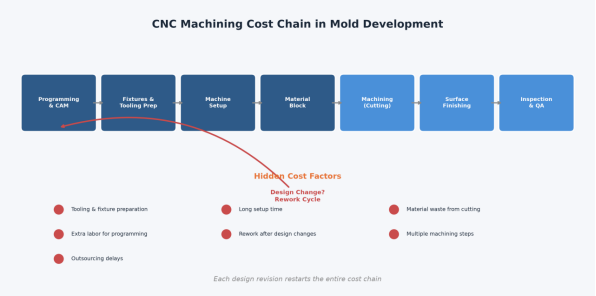
Figure 1: CNC Machining Cost Chain – The full chain of work around CNC that creates hidden costs
CNC machining has been a trusted process for many years. It is accurate, reliable, and still necessary for many production environments. But when a factory is developing molds, testing new designs, or producing small batches, the cost structure can become harder to control.
The issue is not only the machining cost itself. It is the full chain of work around it. A new mold may require programming, fixtures, repeated machine setup, skilled labor, material blocks, surface finishing, and inspection. If the design changes after testing, the same cycle may need to start again.
For mold development and low-volume production, CNC costs often increase because of:
Tooling and fixture preparation
Long setup time before machining starts
Material waste from cutting away metal
Extra labor for programming and adjustments
Rework after design changes
Multiple machining steps for complex parts
Outsourcing delays when internal capacity is full
This does not mean CNC is a poor choice. It means purchasing directors need to understand where CNC gives the best return and where a different process may reduce the hidden costs.
Where Metal 3D Printing Changes the Cost Model
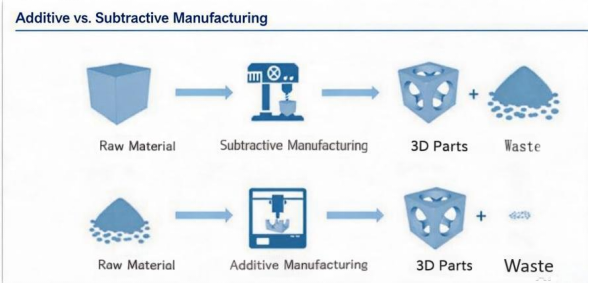
Figure 2: Subtractive vs. Additive Manufacturing – How metal 3D printing changes the cost model
Metal 3D printing works differently because it builds parts layer by layer from metal powder. Instead of cutting a part out of a solid block, the machine forms the part based on a digital design. This can make a major difference when the part has complex shapes, internal channels, lightweight structures, or frequent design updates.
For a smart factory, the value is not only in printing a part. The value comes from reducing waiting time, shortening development cycles, and making changes without rebuilding the entire production plan. A design team can test an idea, adjust the CAD model, and move to the next version faster than many traditional workflows allow.
This is why metal 3D printing is often discussed in terms of ROI. It can help factories save money in areas that are not always visible on a simple cost sheet, such as engineering delay, supplier waiting time, mold correction time, and lost production opportunities.
CNC Machining vs. Industrial Metal 3D Printing
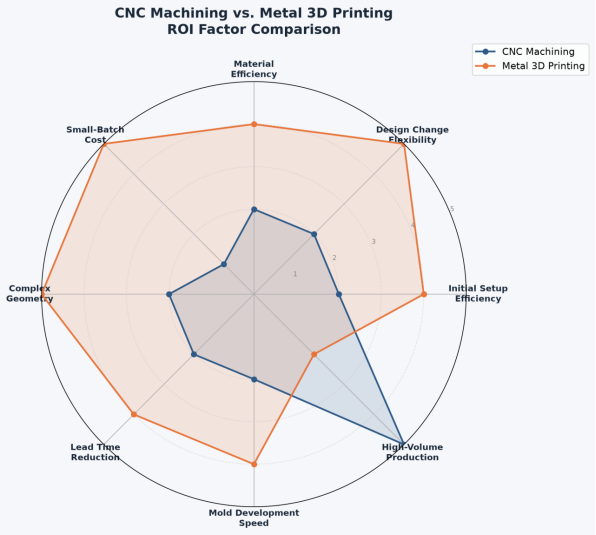
Figure 3: Multi-dimensional ROI Factor Comparison – CNC Machining vs. Metal 3D Printing
The best way to compare the two processes is not to ask which one is better in every situation. A better question is: which one gives better value for this specific job?
ROI Factor
CNC Machining
Industrial Metal 3D Printing
Initial setup
Often requires fixtures, tooling, and programming
Requires machine investment, but reduces tooling dependence
Design changes
Can require reprogramming and remachining
Design updates can be made from the digital model
Material use
Removes material from a metal block
Uses powder to build the part layer by layer
Small-batch production
Cost per part can stay high due to setup work
More practical for complex low-volume parts
Complex geometry
May require several machining steps
Can produce complex forms more directly
Mold development
Strong for finishing and standard features
Useful for complex mold inserts and faster design testing
Lead time
Depends on machine availability and process steps
Can reduce waiting time for prototypes and revisions
Best use case
Repeated parts, high-volume work, finishing
Complex parts, prototypes, small batches, design changes
A smart factory does not need to choose only one process. In many cases, the best ROI comes from using metal 3D printing and CNC machining together. Metal 3D printing can create the complex part or near-net shape, while CNC can finish the surfaces that need very tight tolerances.
Key ROI Drivers Behind Metal 3D Printer Adoption
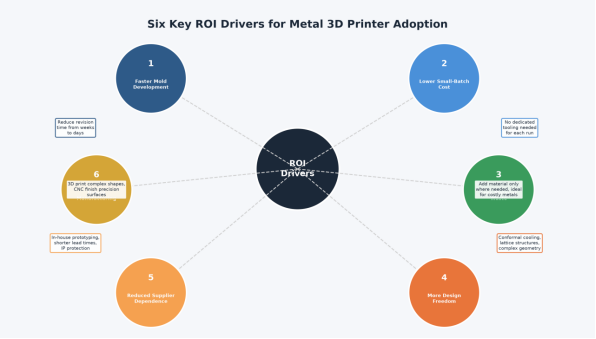
Figure 4: Six Key ROI Drivers Behind Metal 3D Printer Adoption
Faster Mold Development Cycles
Mold development can become expensive when every design correction takes days or weeks. If a mold insert needs changes, the delay affects engineering, testing, production planning, and sometimes customer delivery.
Metal 3D printing can help teams move faster from design to testing. For example, a factory can print a mold insert, test it, study the result, and make the next version with fewer delays. This faster cycle can help reduce the total time spent before the mold is ready for production.
Lower Cost for Small-Batch Production
Small-batch production is often difficult to manage with traditional methods. The setup work may be almost the same whether the factory makes 10 parts or 1,000 parts. That means the cost per part can stay high when the order volume is low.
Metal 3D printing can make more sense when the batch is small, the part is complex, or the design may still change. It allows the factory to produce functional metal parts without investing in dedicated tooling for every small run.
Less Material Waste
CNC machining starts with a metal block and removes material until the final shape is achieved. For some parts, especially complex ones, this can lead to a large amount of unused material.
Metal 3D printing adds material only where the part needs it. There will still be powder handling, support structures, and post-processing, but the process can reduce waste for suitable geometries. This matters more when the factory works with costly metals or parts with complex shapes.
More Design Freedom
Traditional machining has limits. Some internal channels, curved cooling paths, lattice structures, and lightweight forms are difficult or expensive to machine.
Metal 3D printing allows engineers to design parts around function instead of only around machining limits. In mold manufacturing, this can support features such as conformal cooling channels, which may help improve cooling performance and production efficiency. In product development, it can support lighter, stronger, or more compact parts.
Reduced Dependence on External Suppliers
Many factories outsource complex prototypes, mold inserts, or low-volume metal parts. This can work well, but it also creates waiting time. If the supplier is busy, the entire project can slow down.
Bringing metal 3D printing in-house can give companies more control over schedules. It can also protect sensitive designs, reduce communication delays, and allow engineering teams to test ideas faster.
Mold Manufacturing as a Practical ROI Example
Mold manufacturing is one of the clearest areas where ROI can be measured. A mold is not just a part. It affects the entire production line. If mold development is delayed, the final product launch may also be delayed.
A factory that depends only on CNC machining may spend heavily on mold revisions, outsourced inserts, and repeated corrections. These costs can add up over time, especially when the company handles many development projects each year.
To estimate ROI for metal 3D printing in mold development, a business can review:
Annual spending on outsourced mold inserts
Average cost of CNC rework after design changes
Number of mold projects completed each year
Average delay caused by external machining or rework
Material cost for each mold development cycle
Labor hours spent on corrections and setup
Revenue impact of faster product launch
Expected usage rate of the metal 3D printer
A simple way to look at payback is:
Payback Period = Total Investment ÷ Annual Net Savings
This formula is only a starting point. The real payback period depends on machine utilization, material choice, part complexity, operator skill, print success rate, post-processing needs, and how many suitable projects the company can move onto the machine.
Small-Batch Production and the Need for Flexible Equipment
Small-batch production is becoming more common because companies want to test markets faster, reduce inventory risk, and offer more customized parts. In this situation, the factory needs flexibility more than it needs a one-size-fits-all production line.
CNC machining is still powerful when the design is stable and the production volume is high. But when the order is small, the part is complex, or the design may change, metal 3D printing can offer a better route.
Common small-batch use cases include:
Functional prototypes
Custom metal components
Spare and replacement parts
Mold inserts
Tooling parts
Product testing before mass production
Short-run industrial components
The ROI advantage comes from speed and flexibility. A factory can respond to engineering changes without waiting for new fixtures or long supplier lead times.
Equipment Selection: The Factors That Affect Payback Period
When a company decides to purchase an industrial metal 3D printer, the machine’s stability and build precision directly determine the payback period. A lower-priced machine may look attractive at first, but failed builds, poor repeatability, unstable printing, and extra finishing work can quickly reduce the expected return.
For business owners and purchasing directors, the buying decision should not be based on machine price alone. It should be based on the total value the machine can deliver over time.
Build Volume and Part Size
Build volume matters because it determines what the machine can produce in one job. If the build area is too small, the factory may not be able to print larger mold inserts or multiple parts together. If the machine is much larger than needed, the company may pay for capacity it does not use.
The right build volume should match the company’s current parts and future production plans.
Laser Configuration and Productivity
Laser configuration affects production speed and throughput. Multi-laser systems can help factories complete larger jobs or multiple parts more efficiently. For companies that expect regular production work, laser power and laser quantity can influence how quickly the machine creates value.
This is especially important when a factory wants to use metal 3D printing beyond prototyping and move into small-batch production.
Stability and Repeatability
Print stability affects ROI directly. A failed build wastes time, powder, machine hours, and labor. It can also delay a customer project or internal development schedule.
A stable system helps improve repeatability, which is important for factories that need consistent results across multiple builds. Repeatability also makes it easier to move from trial printing to planned production.
Build Precision and Surface Quality
Precision affects how much post-processing is needed after printing. If the printed part is closer to the required shape and size, the factory may spend less time on finishing, correction, or machining.
For mold inserts and functional metal components, this can make a big difference. Better precision can reduce rework and help the printed part move faster into testing or use.
Material Compatibility
Material compatibility should be checked before purchase. A machine may look suitable on paper, but it must support the metals the factory actually needs.
For industrial work, companies may need materials such as titanium alloys, aluminum alloys, stainless steel, high-strength steel, high-temperature alloys, or copper alloys. The buyer should also confirm powder supply, process parameters, and support for each material.
Software, Monitoring, and Support
A metal 3D printer is not only hardware. Software, process control, monitoring, training, maintenance, and technical service all affect the final ROI.
Good software helps operators prepare builds, manage parameters, and track production quality. Strong supplier support helps the factory solve problems faster and reduce downtime.
How to Calculate ROI Before Buying
Before buying a metal 3D printer, a company should build a realistic ROI model. This helps avoid both underestimating and overestimating the value of the investment.
A simple ROI review can include these steps:
Calculate current annual CNC machining costs.
Add outsourcing costs for prototypes, mold inserts, and low-volume parts.
Identify which parts are suitable for metal 3D printing.
Estimate how many jobs the machine can handle each month.
Include powder, gas, electricity, labor, maintenance, and post-processing.
Estimate savings from faster design changes and shorter lead times.
Compare total annual savings with the full equipment investment.
Review conservative, moderate, and high-use scenarios.
The safest ROI estimate is usually the conservative one. If the machine still makes business sense under conservative use, the investment is more likely to be reliable.
Why Smart Factories Use Hybrid Manufacturing
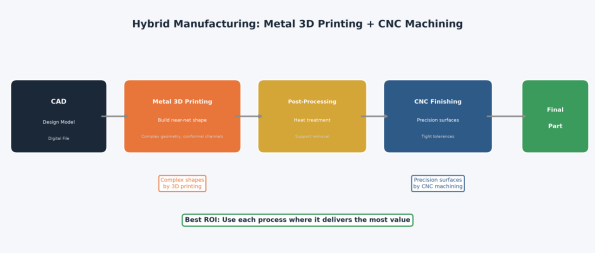
Figure 5: Hybrid Manufacturing Workflow – Combining Metal 3D Printing and CNC Machining
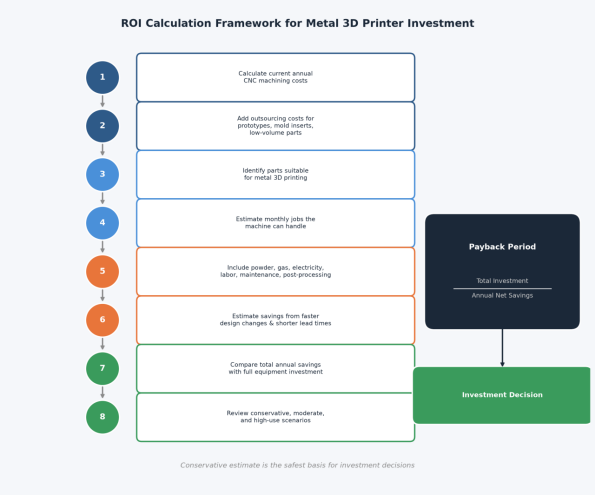
Figure 6: ROI Calculation Framework and Payback Period Formula
In real production, metal 3D printing does not need to replace CNC machining completely. Many smart factories use both because each process has different strengths.
CNC machining is still valuable for finishing, flat surfaces, standard parts, and high-volume production. Metal 3D printing is useful for complex parts, internal features, fast prototypes, mold inserts, and small batches.
Together, they can create a more flexible production model. A factory can print complex shapes, finish critical surfaces with CNC, and reduce the delay between design and production. This hybrid approach is often more practical than trying to force one process to do everything.
Where Forgecise Additive Systems Fit Into the Decision
When reviewing Forgecise additive systems, buyers should look at the full additive manufacturing ecosystem, not only the machine itself. For industrial users, the long-term value depends on equipment, materials, software, application support, and technical service working together.
Forgecise offers SLM metal 3D printing systems designed for industrial applications, including mold manufacturing, aerospace, automotive, medical, and other production-focused sectors. For buyers comparing CNC costs with metal 3D printing investment, this type of solution can help them evaluate not only the printer but also the wider production workflow.
The key is to match the machine to the factory’s actual use cases. A company that needs faster mold development, small-batch production, complex metal parts, or stronger in-house prototyping ability may find more measurable value than a company with only simple high-volume machining needs.
Final Thoughts
An industrial metal 3D printer is not automatically the right investment for every factory. Its ROI depends on how often the company can use it to reduce delays, lower rework, improve design flexibility, and produce complex parts more efficiently.
For smart factories, the question is no longer only about machine price. The better question is whether the machine can shorten development time, reduce hidden costs, and create long-term production value. When the right applications are selected, metal 3D printing can become a practical step toward a faster, more flexible, and more competitive manufacturing system.
FAQs About Industrial Metal 3D Printer ROI
Is a metal 3D printer cheaper than CNC machining?
Not always. CNC machining can be more cost-effective for simple parts and high-volume production. Metal 3D printing may offer better value for complex parts, prototypes, mold inserts, design changes, and small-batch production.
How long does it take to recover the investment in a metal 3D printer?
The payback period depends on machine cost, usage rate, material cost, labor, post-processing, maintenance, and the amount saved from reduced outsourcing, shorter lead times, and fewer design revision delays.
Can metal 3D printing replace CNC machining?
In most factories, it works better as a complementary process. Metal 3D printing can produce complex or low-volume parts, while CNC machining can be used for finishing and high-precision surfaces.
What industries benefit most from industrial metal 3D printing?
Industries such as mold manufacturing, aerospace, automotive, medical, tooling, and industrial product development can benefit when parts are complex, customized, or require fast design changes.
What should buyers check before purchasing an industrial metal 3D printer?
Buyers should review build volume, laser configuration, material compatibility, precision, stability, software, monitoring tools, operator training, maintenance requirements, and technical support.