
Why Technical Cleaning Belongs in Every Data Centre Reliability Strategy

Data centres are designed around resilience. Power systems are duplicated, cooling is monitored, fire protection is tested and critical infrastructure is maintained according to defined procedures. Yet one operational risk is frequently underestimated: airborne contamination and the gradual accumulation of dust and particles inside technical environments.
Professional data centre cleaning is not ordinary cleaning. It is a controlled process intended to reduce contamination without introducing new risks to sensitive IT and electrical infrastructure. Done properly, it supports uptime, protects equipment and creates a cleaner baseline for inspections, maintenance and commissioning.
Contamination is a reliability issue
Dust does not need to be visibly excessive before it affects a technical environment. Airborne particles can settle in server racks, cable trays, raised-floor voids, electrical panels, UPS systems and cooling equipment. Over time, this can restrict airflow, reduce cooling efficiency and create insulating layers on components designed to dissipate heat.
In electrical infrastructure, contamination can also retain moisture and contribute to tracking, corrosion or heat development at vulnerable points. The risk is particularly relevant in equipment that runs continuously and carries significant load, including switchgear, UPS installations, battery systems and power distribution units.
For facilities teams, the issue is rarely one dramatic event. It is the gradual development of conditions that make a future failure more likely—and make its root cause harder to identify.
A clean technical environment supports predictable cooling
Cooling performance depends on controlled airflow. When filters, grilles, floor voids, rack interiors or cooling components are contaminated, the system has to work harder to maintain the intended temperature profile.
That can lead to several operational consequences:
- Higher energy consumption from cooling equipment
- Uneven temperature distribution between racks
- Localised hot spots around sensitive equipment
- Reduced capacity during periods of high IT load
- Less reliable temperature data if sensors do not reflect conditions at equipment level
A data centre may still appear to operate normally while these conditions develop. That is exactly why cleaning should be planned as a preventative measure rather than triggered only when contamination becomes obvious.
Standard cleaning methods are not sufficient
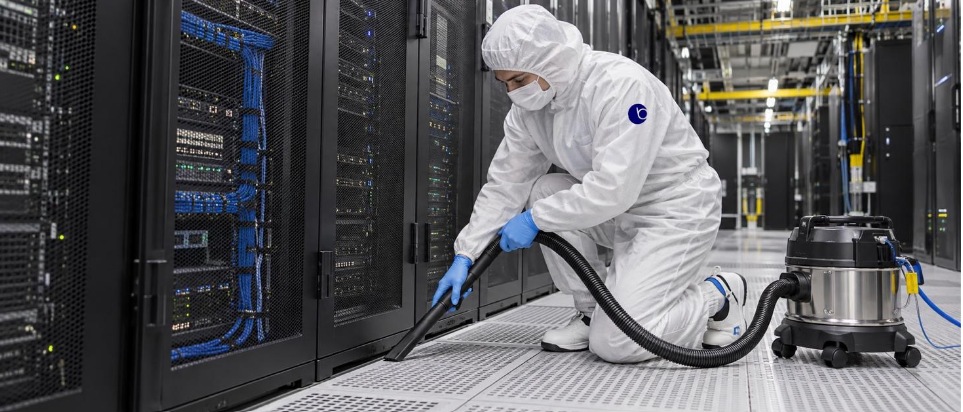
A conventional cleaning approach can create more risk than it removes. Sweeping, dry dusting or the use of unsuitable vacuum equipment may redistribute fine particles into the air, allowing them to settle inside racks and electrical equipment.
Technical cleaning requires methods appropriate for controlled environments. This typically includes HEPA-filtered vacuuming, controlled wiping techniques, antistatic materials and clear procedures for working around live or sensitive infrastructure. The work must be planned so access, sequencing and protection of equipment are managed without disrupting operations.
The objective is not simply to make the room look clean. It is to remove contamination from the places where it affects reliability: beneath raised floors, around cable routes, inside technical zones and on surfaces where particles can be drawn into cooling or electrical systems.
Cleaning should be linked to the facility’s risk profile
The right cleaning frequency depends on the facility and its exposure. A newly commissioned data hall, a site undergoing construction work and an operational facility with stable access conditions do not carry the same contamination risk.
Factors that should be considered include:
- Construction, refurbishment or cabling activity near live areas
- Access routes between external areas and technical rooms
- Condition of raised floors, ceilings and cable pathways
- Air filtration and pressure control
- Equipment density and cooling design
- Previous particle measurements or inspection findings
- The criticality of the services supported by the data centre
For high-availability environments, it makes sense to include technical cleaning within the broader maintenance and assurance programme. This creates a defined standard rather than leaving cleanliness to visual judgement or ad hoc intervention.
Particle control provides evidence—not assumptions
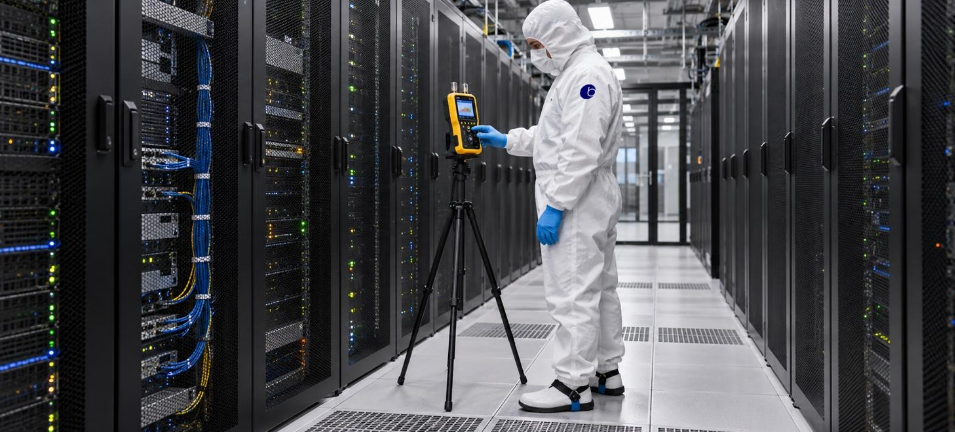
Visual inspection has limits. Fine particles can be present even where a room appears clean, while visible dust may not reveal the actual contamination level in critical locations.
Particle measurement can provide a documented baseline and help determine whether a facility meets its own cleanliness requirements. It is particularly valuable before handover, after construction activity, prior to commissioning and following a cleaning project.
For facilities working with cleanroom principles, ISO 14644-1 provides a recognised framework for classifying air cleanliness by particle concentration. The relevant target and measurement strategy must always reflect the actual environment and operational purpose; a data centre is not automatically a cleanroom. However, measuring, documenting and verifying conditions creates a far stronger basis for decision-making.
Cleaning is especially important during change
Data centres are rarely static. Capacity expansions, cable installations, upgrades, equipment replacements and maintenance projects can all introduce contamination into areas that are otherwise tightly controlled.
This is why technical cleaning often delivers the greatest value at key transitions:
- Before commissioning and integrated systems testing
- After construction, drilling, cutting or cable work
- Before installing new IT or power equipment
- Prior to contamination-sensitive inspections
- Following a contamination incident or water ingress
- As part of a planned annual assurance programme
Treating cleaning as a defined project step helps prevent a common handover problem: infrastructure is technically complete, but the environment has not been brought back to an appropriate operational condition.
Reliability is built through small, controlled disciplines
No single activity guarantees uptime. Resilience comes from the combined effect of good design, testing, monitoring, maintenance, documentation and disciplined operational procedures.
Technical data centre cleaning belongs in that picture because it addresses a controllable risk before it develops into reduced cooling performance, hidden contamination or an avoidable equipment issue. It also supports the quality of other maintenance activities: thermographic inspections, electrical testing and visual condition assessments are more meaningful when equipment and surrounding areas are clean and accessible.
It is not a cosmetic exercise. It is a practical part of protecting critical infrastructure, maintaining a controlled technical environment and supporting reliable operations over time.







Comment