Most small business owners treat their digital marketing like separate projects. They hire someone to handle SEO, get a designer to build their website, and maybe run some Google Ads when they need quick leads. Each initiative exists in its own bubble, managed by different people with different goals.
This fragmented approach wastes money and limits results.
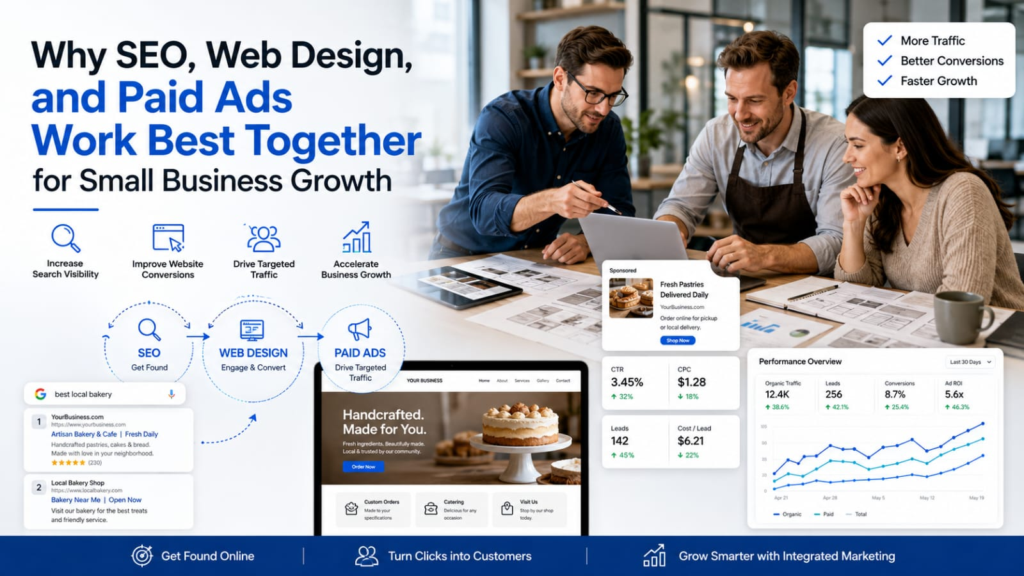
After working with dozens of small businesses over the years, I’ve seen the same pattern repeatedly. The companies that grow fastest online aren’t necessarily the ones spending the most. They’re the ones who understand that SEO, web design, and paid advertising form an interconnected system. When these three elements work together, they amplify each other’s effectiveness in ways that isolated tactics simply can’t match.
The Problem with Siloed Marketing
Think about what happens when these elements operate independently. Your SEO specialist optimizes content without considering how the site structure affects conversions. Your web designer creates beautiful pages that load slowly and confuse search engines. Your paid ads team sends traffic to landing pages that weren’t built with user experience in mind.
Each team might hit their individual targets while the business struggles to see real growth. Your website ranks well but doesn’t convert. Your ads get clicks but bounce rates are terrible. Your design looks modern but lacks the technical foundation that search engines need.
This disconnect creates expensive inefficiencies. You’re essentially paying multiple times to solve problems that a unified approach would prevent entirely.
How SEO and Web Design Form a Foundation
The relationship between SEO and web design runs deeper than most people realize. Search engines don’t just read your content anymore. They evaluate how quickly your pages load, how easily people can navigate your site, and whether your design works properly on mobile devices.
A website designed without SEO principles might look impressive in a portfolio but performs poorly where it matters. I’ve seen gorgeous sites tank in search results because designers prioritized aesthetics over site structure, creating navigation that search engines couldn’t crawl properly. Beautiful imagery that wasn’t optimized slowed page load speed to a crawl. Fancy animations that interfered with core web vitals and pushed the site down in rankings.
Conversely, some SEO efforts fail because the underlying web design can’t support them. You can’t fix fundamental problems with content hierarchy through keyword optimization alone. If your website navigation confuses visitors, no amount of backlinks will improve your conversion rate.
When you approach SEO and web design as partners from the start, everything changes. Your site structure gets built with both users and search engines in mind. Internal linking becomes strategic rather than an afterthought. Mobile optimization isn’t something you retrofit later; it’s baked into the responsive web design from day one.
Technical SEO elements like schema markup, clean website code, and proper heading structure become natural parts of the development process. Image optimization happens automatically. Accessibility in web design improves both user experience and SEO simultaneously because search engines favor sites that serve all users well.
Where Paid Ads Accelerate Everything
Here’s where it gets interesting. While organic search through SEO and web design builds long term value, paid advertising provides immediate testing ground and quick wins.
Paid ads let you validate your messaging before investing months in content creation. You can test which headlines resonate, which offers convert, and which audience segments respond best. This intelligence feeds directly back into your SEO strategy and website optimization.
When your web design supports fast landing page creation and testing, your paid ad campaigns become more efficient. You can build conversion focused design elements specifically for ad traffic, measuring what works and applying those insights across your entire site.
The data flow works in reverse too. Your organic search performance reveals which keywords and topics genuinely interest your audience. This informs smarter paid ad targeting, helping you avoid wasting budget on terms that look good in theory but don’t convert in practice.
The Synergy in Action
Let me walk you through a real scenario that illustrates this integration. A small business launches a new service. Instead of treating this as three separate initiatives, they take a unified approach.
Their web design team creates a dedicated landing page optimized for both user experience and technical SEO. The page loads quickly, works perfectly on mobile devices, and includes proper schema markup. The content hierarchy guides visitors naturally toward conversion while giving search engines clear signals about relevance.
Simultaneously, they launch paid ads to drive immediate traffic to this new page. The ad campaigns test multiple value propositions and audience segments, generating data within days. Some messages perform significantly better than others. Certain demographic groups convert at higher rates.
This paid traffic data immediately shapes the SEO strategy. The winning messages from ad tests get incorporated into on page SEO elements. Title tags, meta descriptions, and heading structures reflect the language that actual customers respond to, not just what the business thinks sounds good.
As the page begins ranking organically over the following weeks and months, the paid ad spend can shift. Maybe you reduce bids for keywords where organic rankings are strong, reallocating that budget to newer opportunities. Or you maintain paid presence at the top of search results while your organic listing provides a second touch point, increasing overall visibility and trust.
The web design continues evolving based on both paid and organic traffic behavior. Heatmaps show where people click. Conversion tracking reveals which page elements drive action. A/B testing identifies improvements. These insights enhance website performance for all traffic sources.
Practical Implementation for Small Businesses
You don’t need unlimited resources to make this integration work. Start by ensuring whoever handles your website design understands basic SEO principles like site structure, page load speed, and mobile optimization. Even simple conversations between your designer and SEO specialist prevent major mistakes.
When planning paid ad campaigns, involve the same people who manage your website usability and organic search. Share conversion data across teams. Let your paid ad insights inform content creation. Allow your organic search research to guide ad targeting.
Choose tools and platforms that support this integration. Your website should make it easy to create new landing pages quickly. Your analytics setup should track both paid and organic traffic behavior in comparable ways. Your content management system should support technical SEO requirements without requiring developer intervention for every small change.
For small businesses in competitive markets, working with an integrated team makes this much easier. An SEO and web design agency in Ireland or your local market that understands paid advertising can orchestrate these elements from the start, avoiding the coordination challenges that plague fragmented approaches.
The Long Term Advantage
The compounding effects of this integration become more valuable over time. Your website gets stronger technically, making future SEO efforts more effective. Your understanding of customer behavior deepens, improving both organic and paid performance. Your ability to launch and optimize new initiatives faster than competitors creates sustainable advantage.
Small businesses that treat digital marketing as a unified system rather than separate tactics consistently outperform those with bigger budgets but fragmented strategies. They waste less money on conflicts between channels. They learn faster from each customer interaction. They build momentum that becomes increasingly difficult for competitors to match.
When SEO, web design, and paid ads work together, they create something greater than the sum of their parts. Your website becomes both a lead generation engine and a testing laboratory. Your paid ads provide immediate results while building long term organic strength. Your SEO efforts compound over time while paid advertising fills gaps and accelerates growth.
This isn’t about spending more. It’s about spending smarter by recognizing that these elements were never meant to work in isolation. For small businesses competing against larger companies with bigger budgets, this integrated approach often provides the edge that turns good results into exceptional growth.