Dr. Mikhail Urinson, a quantitative researcher and allocator who spent a decade behind institutional trading desks before founding Legacy Quant, on why the $500,000 entry barrier to data-driven investing has to fall
In 2025, American retail investors poured approximately $302 billion into U.S. equities — a 53% jump from $197 billion the year before. By every measure, individual traders are now a structural force in global markets, accounting for 20 to 35 percent of daily volume across the U.S., U.K., and South Korea.
Yet the tools they trade with have barely changed. A December 2025 study by the FINRA Foundation, based on a survey of more than 2,800 U.S. investors, found that knowledge scores remain low even as participation surges. Separate industry data puts the picture in sharper relief: 51% of retail investors admit their decisions are driven by fear of missing out, and 30% panic-sold during the 2025 volatility episodes. Meanwhile, behind the closed doors of institutional trading desks, teams of PhDs in economics, statistics, and programming deploy algorithmic strategies and multi-layered risk frameworks that most individual investors have never seen, let alone used.
Dr. Mikhail Urinson has spent two decades studying exactly this divide. He holds advanced academic training in economics, finance, statistics, and data science, and has held senior corporate positions across the financial sector. During the later stage of his career, he financed and launched several successful ventures across multiple industries. Now, as Co-Founder and Chief Investment Officer of Legacy Quant in Miami, he builds cross-asset quantitative allocation frameworks and works to make institutional-grade methodology accessible to retail investors.
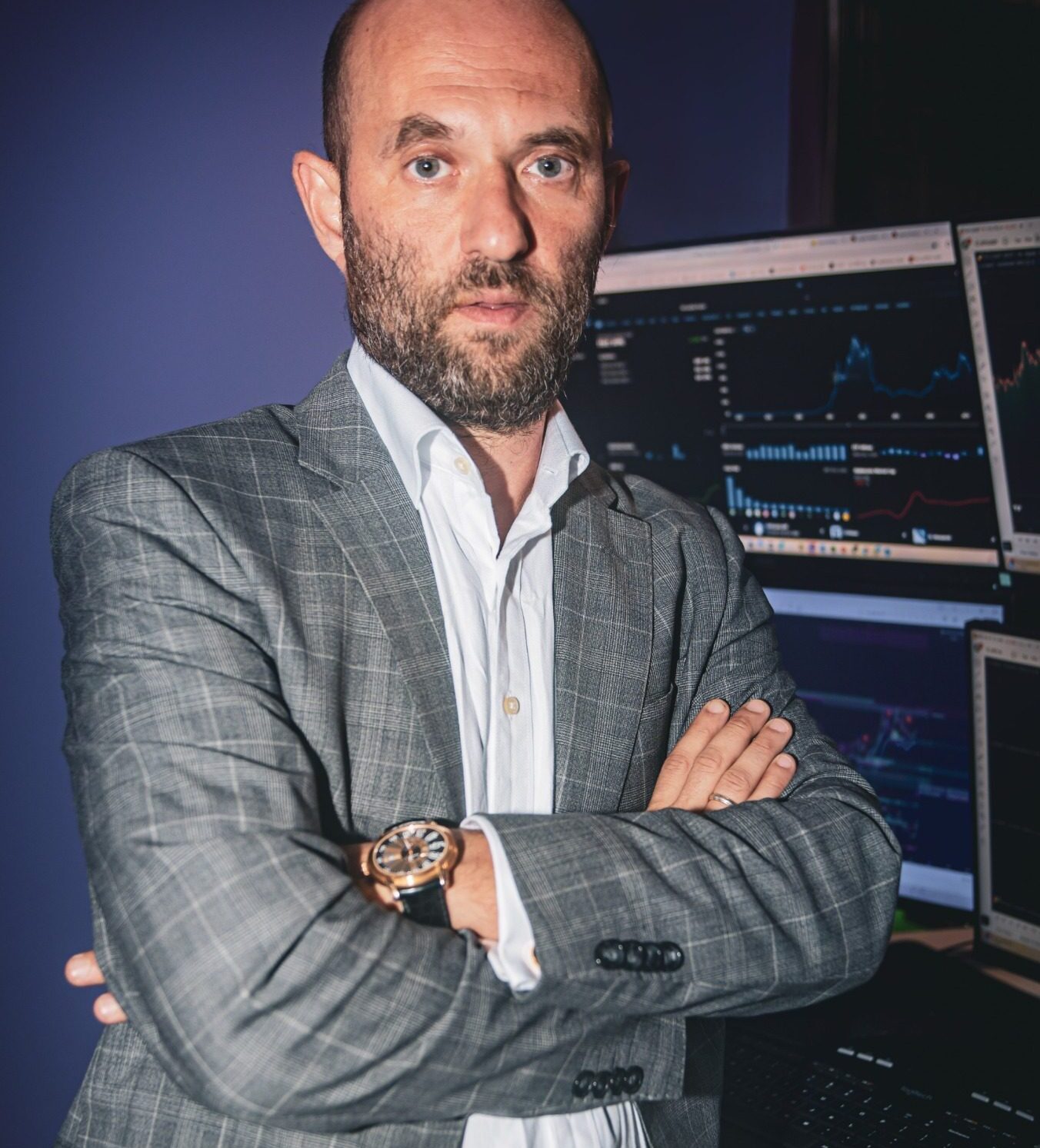
We meet Dr. Urinson at his office in the heart of Miami, a city whose transformation into a global financial center he sees as a backdrop to his own work. During a short tour, he points to screens running parallel dashboards, each one tracking a different quantitative system in real time. At any given moment, he says, seven to ten alternative investment systems are simultaneously deployed and monitored through Legacy Quant. The setup is a visual summary of his core argument: the infrastructure that institutions built decades ago now costs a fraction of what it used to, yet almost none of it has reached the people who need it most.
What Institutional Investors Have and Retail Investors Don’t
Behind the closed doors of institutional trading desks, teams of PhDs (economists, statisticians, programmers) deploy algorithmic strategies and multi-layered risk management frameworks to guide capital allocation. On the other side of that wall, millions of retail investors navigate the same markets with far simpler instruments. According to Dr. Urinson, who spent half of his two-decade career inside those institutional environments, the gap is enormous, whether the two sides trade against each other intentionally or not.
He recalls being struck by this divide fifteen years ago, when he first realized that none of the institutional practices he had internalized (quantitative modeling, systematic risk controls, data-driven rebalancing) were being applied on the retail side.
“Retail and institutions play on the same field, with the same rules. What’s different are the skills and the ammunition, clearly to the advantage of the latter,” Dr. Urinson says.
Having since worked across academic, entrepreneurial, and retail contexts as well, he holds a perspective that few in the industry share: a firsthand understanding of what exists behind the institutional wall and what is missing on the other side. Over the years, financial markets grew more complex: new instruments were added, outreach broadened, costs decreased, and institutional trading developed in step with each new economic reality. Meanwhile, for retail investors, buy-and-hold and the static 60/40 equity-bond allocation remained the industry standard. The tools changed for one side of the market. For the other, they did not.
How Market Crashes Shaped a Data-Driven Approach
That asymmetry might remain an abstract problem if markets were calm. They are not. Dr. Urinson’s commitment to quantitative discipline was forged through live exposure to some of the most consequential market failures of the past two decades, starting with the Dot-com bubble, continuing through the systemic banking crisis triggered by the collapse of the U.S. housing bubble and structured credit markets (Lehman Brothers, Bear Stearns), and including major fraud scandals such as Enron and Bernard Madoff. Each event exposed the fragility of markets driven by emotion, speculation, and incomplete data. He emphasizes a phrase he learned early in his career: “Garbage in, garbage out.”
“The lesson was simple. Markets reward disciplined analysis driven by accurate data, not intuition, and not emotions. I had to learn this through live examples of major systemic failures and collapses,” Dr. Urinson recalls.
He is the first to admit that neither macroeconomic data nor models are perfect. They are not built to deliver a hundred-percent success rate; they work until they don’t, crash without warning, and require constant revision, for institutional and retail investors alike. But the absence of perfection is not an argument against discipline.
“Trading without quantitative models is like navigating without GPS through unknown terrain. GPS doesn’t guarantee you’ll avoid traffic or accidents, but it gives you an optimal route toward your goal,” he explains.
Since institutional capital is routinely described as “smart money,” he sees every reason to expect that retail traders will sooner or later be compelled to adopt the quantitative practices that institutions have applied for decades. The question is what stands in the way.
Why Retail Investors Still Don’t Have Access to Quantitative Tools
This was one of the key questions in our discussion with Dr. Urinson. He outlined four problems:
- While numerous quantitative models and strategies are currently offered to retail customers, they are mostly offered through unregulated subscription services. This creates significant room for fraud, abuse, and customer disappointment in quantitative and algorithmic trading in general.
- Regulated brokers at this point show no interest in moving in this direction, while admitting a very low level of interest in classical wealth management products, especially among younger generations.
- On the ETF side, quantitative methodology has a very limited application.
- Currently, the starting level for quantitative-style allocations is $500,000 to $1 million and above, mostly available to high-net-worth accredited investors at the hedge fund level.
The lack of qualified, accessible investment products keeps quantitative investing out of reach for the vast majority of individual participants. And financial systems are inherently resistant to rapid change. The rough path of digital asset legislation illustrates the tension: regulation is necessary to prevent fraud and abuse, but it also slows innovation and leaves retail investors without adequate tools in the meantime.
If the barriers are structural, the response has to be structural as well. That is where Dr. Urinson’s current work begins.
What Dr. Urinson Is Building to Close the Gap
As Co-Founder and Chief Investment Officer of Legacy Quant, Dr. Urinson is building the infrastructure he believes the market lacks. His advanced investment analysis pipeline integrates more than 1000 data points from over 30 sources (market prices, macroeconomic indicators, and alternative data signals) into unified machine-learning frameworks capable of adapting to changing market regimes. The architecture combines classical financial econometrics with modern techniques: ensemble models, deep neural networks designed for time-series data, and adaptive regime-detection algorithms. Rather than attempting to predict market movements outright, the systems aim to identify statistical edges, subtle probabilistic advantages derived from large-scale data analysis.
The systems he deploys target a 3–5% monthly return with a maximum drawdown below 10%, though he is quick to add that losses are an inevitable cost of doing business and that no model guarantees a perfect track record. His job, as he defines it, is to tip the probability of success while minimizing, not eliminating, the risk of failure.
A critical part of the approach is collaboration. Dr. Urinson points to one of his close mentors and associates, Bob Kendall, a quantitative trader with over 45 years of experience and a pioneer in algorithmic trading. Kendall’s institutional-grade methodology has been used to manage billions of dollars. But institutional investors require a wide variety of instruments to satisfy complex allocation needs, while retail investors need clarity and simplicity, something achievable through a small number of model portfolios with a specified level of risk. Dr. Urinson has been working closely with Kendall to distill that institutional methodology into a retail-accessible format.
“Dr. Urinson demonstrates a rare ability to translate complex quantitative research into practical trading systems curated for retail investors,” Kendall says.
He also continuously screens quantitative traders globally, evaluating track records to qualify talent and provide access to capital markets, an approach that turns Legacy Quant into both an allocator and a platform.
The same quantitative logic extends to newer asset classes. Through ARK Quant Crypto, operating within the broader Legacy Quant architecture, Dr. Urinson applies systematic strategies to crypto markets, where speculative approaches still dominate and institutional-grade discipline is especially scarce. His framework treats digital assets as components within diversified portfolios, integrating them into the same cross-asset allocation logic. The crypto-specific models incorporate on-chain analytics, sentiment modeling, volatility regime detection, and machine-learning-based signal validation. The underlying principle is consistent: whether the asset is a stock, a bond, or a token, the analytical discipline should be the same.
Dr. Urinson is actively exploring regulated channels for mass-market adoption of this infrastructure, including signal generation, model portfolio construction and reallocation, and market regime tools.
Research, Education, and the Case for Financial Literacy
Building products, however, solves only half the problem. If retail investors lack the knowledge to evaluate what they are buying, even the best tools will be misused or ignored. For Dr. Urinson, the educational work is inseparable from the commercial work.
He is engaged in scholarly research in collaboration with Bernard Parenteau, Ph.D., Program Director and Associate Professor at Saint Thomas University, Miami Gardens, Florida, within the School of Computer Science, Data Science, and Cybersecurity. He regularly speaks at specialized events, hosts masterclasses to educate a broader audience on quantitative methodology, and publishes independent research, including peer-reviewed work. His professional community on LinkedIn recently reached 10,000 subscribers and continues to grow.
Mass adoption of data-driven investing, he argues, requires not only accessible products but also a baseline of financial literacy that, as the FINRA study confirmed, remains alarmingly low. The technology itself is no longer the bottleneck. Cloud computing, open-source machine learning libraries, and an abundance of relatively affordable data have dramatically reduced the cost of building sophisticated analytical systems.
“Twenty years ago, it made sense that only institutions had access to these tools. Today, the technology is here to make them widely available,” Dr. Urinson says.
What remains is the gap between what is technically possible and what is practically available. And closing that gap, Dr. Urinson believes, requires working on both ends at once: building the products and educating the people who will use them.
Starting With Himself
On the way out of Dr. Urinson’s office, a detail on his desk catches the eye: Securities License Exam manuals. He notices the glance and explains without prompting.
“Industry-wide regulatory compliance and transparency is the inevitable cost of mass-market adoption. My goal is to enable widespread quantitative investment governed by the highest industry standards, not to create a Wild West. That starts with my own full compliance, certification, and licensing. The industry lacks credibility in this area, and it is part of my overall mission. So I decided to start with myself,” he says.
For a market where $302 billion of retail money flowed in last year alone, much of it guided by instinct, social media, and fear of missing out, the question is no longer whether institutional tools should reach individual investors. The question is how fast the infrastructure, the regulation, and the people willing to build both can catch up with the money that is already there.